
Most affiliate marketing advice assumes a one-time purchase. A customer clicks an affiliate link, buys a product, the affiliate earns a commission, and the transaction is finished.
Building an affiliate program for subscription service requires a different approach. A customer an affiliate sends you in January may still be paying in December, and in many subscription businesses they are still paying three years later. That changes what you pay affiliates, when you pay them, which affiliate partners you recruit, and what keeps your top affiliates promoting you instead of a competitor.
This guide is for subscription-based businesses and subscription services of every kind: SaaS tools, membership platforms, subscription boxes, streaming and media apps, and online courses or other digital services sold on a recurring plan.
It covers how affiliate marketing works when recurring revenue arrives month after month, the commission structures subscription affiliate programs use, five real affiliate programs and what they pay, how to pay affiliates, and the tracking and fraud controls that decide whether the program makes money.
Table of Contents
Overview
| Factor | One-Time Purchase Program | Subscription Affiliate Program |
|---|---|---|
| Commission structure | Flat percentage of the sale | Recurring commission on renewals, a one-time bounty sized to lifetime value, or both |
| What affiliates are paid for | The first sale | The first payment and, in recurring models, every renewal |
| Brand’s cost profile | One payment per sale | Smaller payments spread across the customer’s lifetime |
| Fraud risk | Moderate | Higher, because free trials and early cancellations can be gamed |
| Best affiliate types | Content sites, coupon sites, deal communities | Review and comparison sites, niche newsletters, YouTube creators, podcasts, educators |
| Cookie window | 7 to 30 days is common | 30 to 180 days, with longer tracking for free trials |
| Tracking requirement | The sale | The sale plus every renewal, cancellation, and refund |
| Common payment method | Bank transfer or PayPal | Bank transfer, direct deposit, or PayPal, usually paid monthly |
How an Affiliate Program for Subscription Services Works
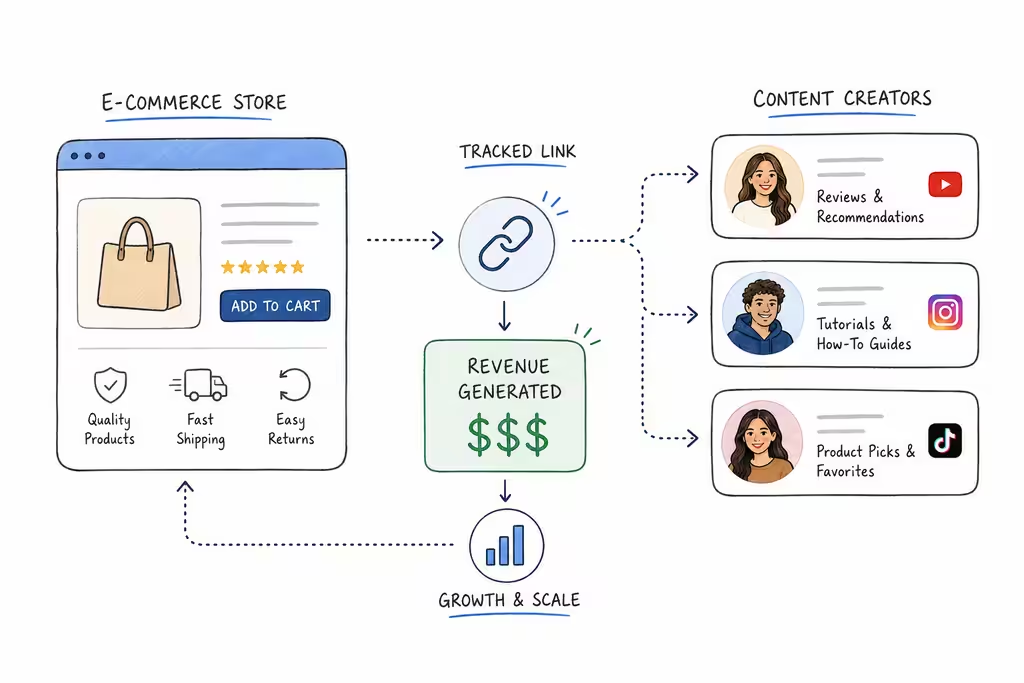
Affiliate marketing works the same way at the start as it does for any product. An affiliate shares a unique affiliate link or code on their own website, in YouTube videos, in a newsletter, or on social media platforms. A visitor clicks, a cookie or server-side record ties that visitor to the affiliate, and the visitor signs up as one of your new subscribers.
The difference starts after the sign-up. In a subscription service, the affiliate software has to keep following that customer through every billing cycle. Subscription renewals, upgrades, downgrades, cancellations, and refunds all change what the affiliate is owed. A service that only records the first payment cannot pay recurring commissions accurately, and it cannot reverse commissions on customers who cancel.
Most subscription businesses run their affiliate marketing programs through an affiliate network or a dedicated platform that handles this. An affiliate network connects affiliates with brands, tracks the referrals, and processes the payouts.
Impact and PartnerStack are the most common choices for software companies. HubSpot, Semrush and Shopify run their affiliate programs on Impact, and Kit runs its program on PartnerStack. Some companies build their own: Kinsta uses an in-house affiliate dashboard.
For the brand, affiliate marketing is low-risk compared with paid ads. You pay only after a customer subscribes, and in a recurring model, you pay as that customer’s revenue comes in.
When Affiliate Marketing Works for a Subscription Business
Affiliate programs work best for subscription businesses that already have three things in place.
Retention you can predict. Recurring commissions are only affordable if you know roughly how long a subscriber stays. If you cannot estimate customer lifetime value yet, start with a one-time bounty and a qualifying period, then move to recurring commissions once you have the data.
Margin to share. Affiliates choose affiliate products partly on what they pay. Software and other digital services usually have the margin to pass 20 to 30% of recurring revenue to affiliates. Physical subscription boxes carry product and shipping costs, so they usually work with smaller flat bounties per new subscriber.
A service affiliates can explain. The program depends on affiliates who can describe the product clearly to their target audience. Subscription services with a defined target market, a free trial, and published pricing are easier to promote than ones that need a sales call before anyone can buy.
With those in place, affiliate marketing is one of the cheaper ways for subscription businesses to acquire new subscribers. Under a subscription model with recurring commissions, the cost of each customer is spread across the months they pay you.
Why Standard Affiliate Structures Fail Subscription Businesses
Most affiliate marketing programs built for ecommerce pay a flat percentage of the first sale. For subscription services, that default creates a mismatch.
Take a SaaS brand that pays 20% of the first month on a $49/month plan. The affiliate earns $9.80 when the customer signs up. If that customer stays for 18 months, they pay $882 in total. The affiliate who brought them in earned $9.80 of it.
That has two consequences.
The program underpays the affiliates who send good customers. Experienced affiliate marketers compare affiliate programs before they put content behind any of their affiliate products, and the best affiliate programs in software pay on renewals. A one-time 20% of a single monthly payment loses that comparison.
The program also pays the same for a customer who cancels after three days as for one who stays three years. Nothing in a commission on initial purchases rewards an affiliate for sending subscribers who stay.
The subscription affiliate programs that perform best fix both problems. They pay affiliates in proportion to the recurring revenue a customer generates, and they give affiliates a financial reason to send customers who keep paying.
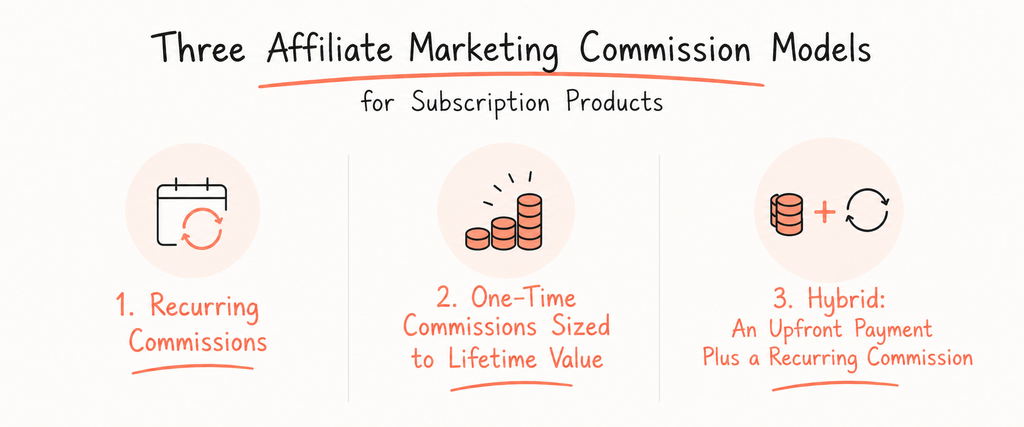
Three Affiliate Marketing Commission Models for Subscription Services
1. Recurring Commissions
A recurring commission model pays affiliates a percentage of every renewal for as long as the referred customer keeps paying, or for a fixed period. Most of the best affiliate programs for subscription services use some version of it.
This is the standard structure in software. 71% of SaaS affiliate programs pay recurring commissions, according to 2026 PartnerStack data. A common setup pays 20 to 30% for the first 12 months and 10 to 15% in months 13 to 24.
Two major brands show the range:
- HubSpot pays a 30% monthly recurring commission for up to one year on its entry tier, with a 180-day cookie window.
- Kit pays affiliates 50% of each referred customer’s payments for their first 12 months. Affiliates who refer at least 10 customers a year reach its Bronze tier, and from there keep earning 10% to 20% of each customer’s payments after the first year, depending on tier.
The recurring commission model changes an affiliate’s math. Refer one customer to a $49/month tool at 20% recurring and you earn $9.80 a month. After 12 months, that single referral has paid $117.60. After 24 months at the same rate, it has paid $235.20.
An affiliate with a newsletter of 8,000 engaged readers who converts a small share of them has built a monthly income stream from a single send. That passive income potential is why affiliate marketers give recurring affiliate programs priority in their content calendars.
The brand benefits as well. An affiliate on a recurring commission only keeps earning if the customer stays. That pushes affiliates toward accurate descriptions of the product and away from tactics that produce sign-ups who cancel in the first week.
The cost is administrative. You need affiliate software that records each renewal against the original affiliate and keeps paying for as long as your terms say. Impact, PartnerStack, Tapfiliate and Rewardful all handle recurring payouts. Many ecommerce affiliate apps do not.
2. One-Time Commissions Sized to Lifetime Value
Some subscription businesses prefer not to carry open-ended commission liabilities. The alternative is a single, larger payment that reflects what a subscriber is worth over time.
Semrush works this way. It pays affiliates between $100 and $300 per new subscription depending on the product, up to $450 at higher partner tiers, plus $10 for every free trial a referral starts. Its cookie lasts 120 days. Shopify pays up to $150 per qualified referral to a paid plan, with the amount varying by the referral’s country.
To size a one-time commission for your own program, start from customer lifetime value. If your average subscriber stays 14 months at $49/month, they are worth about $686 in revenue. A 40% commission on the first payment is $19.60. A bounty of $80 to $120 per verified new subscriber is much closer to what the referral is worth.
This model keeps accounting simple, and new affiliates find it easy to understand. It also removes the retention incentive, because the affiliate is paid the same whether the customer stays one month or thirty. Protect against that by paying the bounty only after a qualifying period: 30 days at minimum, and 60 to 90 days for higher-priced subscriptions.
3. Hybrid: An Upfront Payment Plus a Recurring Commission
The hybrid model combines both, and it shows up in two places.
The first is software and hosting. Kinsta pays a one-time bonus of $50 to $500 per referral and then 10% of that customer’s monthly payments for the life of the account, with a 60-day tracking cookie. The bonus rewards the affiliate quickly. The lifetime commission keeps them invested in sending customers who stay.
The second is creator partnerships. A creator who produces a 15-minute YouTube review has put real time into it, and paying them only on conversions inside a 30-day window undervalues that work. A base fee for the agreed content plus a recurring commission on subscribers who stay past the qualifying period gives you predictable content and gives the creator upside tied to performance, which makes the affiliate partnership worth sustaining on both sides.
For creator-led subscription services, a workable starting point is a modest base fee, a 20 to 30% recurring commission in year one, and a lower rate in year two. Cash bonuses for hitting subscriber milestones can sit on top. See our guide on affiliate incentives for how to structure tiers and bonuses around this.
Subscription Service Affiliate Program Examples
Commission structures vary widely between subscription affiliate programs, even among major brands in the same category. The five subscription service programs below are useful benchmarks because each publishes its terms in full. All figures come from each company’s own affiliate page, checked in October 2026.
| Program | Commission | Recurring? | Tracking window | Payment method | Network or software |
|---|---|---|---|---|---|
| HubSpot | 30% | Monthly, for up to one year | 180 days | Direct bank deposit (EFT) or PayPal, $10 minimum balance | Impact |
| Kit | 50% of payments for the first 12 months | Yes, 10% to 20% after year one at Bronze tier and above | Not published | Not published | PartnerStack |
| Kinsta | $50 to $500 one-time bonus plus 10% monthly | Yes, for the life of the account | 60 days | Paid monthly; method not published | In-house dashboard |
| Semrush | $100 to $300 per sale, up to $450 at higher tiers, plus $10 per trial | No, one-time | 120 days | Electronic funds transfer or PayPal | Impact |
| Shopify | Up to $150 per qualified referral | No, one-time | 30 days, up to 400 days for free-trial sign-ups | Direct deposit or PayPal in most countries, $10 minimum balance | Impact |
HubSpot: Recurring for a Fixed Term
Capping recurring commissions at 12 months limits HubSpot’s long-term liability while still paying affiliates on renewals. The 180-day cookie reflects how long B2B buyers take to choose a CRM. Affiliates are paid through Impact by direct deposit to their bank account or by PayPal, once they reach a $10 minimum balance.
Kit: A High First-Year Rate, Then a Long Tail for Volume
50% for the first year is a high rate for a software program, and Kit ties the long-term commission to volume. Lifetime earnings on a customer continue only while the affiliate keeps referring at least 10 customers a year. That structure rewards the affiliates who promote Kit consistently. Kit’s affiliate page does not list its payment method or cookie window; its affiliate sign-up runs through PartnerStack.
Kinsta: Hybrid Bonus Plus Lifetime Commission
Kinsta’s model lowers the barrier for new affiliates, because the upfront bonus pays for the effort within weeks. The 10% lifetime commission then gives the affiliate a reason to care whether the customer stays, and builds them a source of passive income over time. Affiliates are paid monthly from Kinsta’s own dashboard rather than through an affiliate network.
Semrush: Large One-Time Bounties and Paid Trials
Paying $10 for each free trial rewards affiliates for top-of-funnel activity even when the trial does not convert. For a service with a long evaluation period, that keeps affiliates promoting while they wait for paid conversions. Payouts go out through Impact by electronic funds transfer or PayPal.
Shopify: Long Tracking for Free Trials
Shopify tracks referrals for 30 days from the click, and for up to 400 days on free-trial sign-ups. For any subscription business with a trial, the gap between sign-up and the first paid month is where affiliate credit is most often lost. A tracking window that covers the full trial period closes it. Shopify’s payment method options are direct deposit or PayPal in most countries, with a $10 minimum balance.
HubSpot, Semrush and Shopify all use Impact to track affiliate sales and process payouts, which is one reason affiliate marketers trust their reporting. What these five affiliate programs share: tracking windows far longer than most ecommerce programs, payouts by bank transfer or PayPal, and terms published in full, so potential affiliates can see what they will earn, and by which payment method, before they create content.
Which Affiliates Work Best for Subscription Services
The publisher mix that works for a one-time purchase brand often produces weak results for a subscription brand. Many of the affiliate marketers below find programs through an affiliate network such as Impact or PartnerStack; others will only join if you approach them directly.
Comparison and Review Sites
Someone comparing subscription services by searching “best project management software for remote teams” is about to commit to a recurring cost and wants to compare options first. Review content on an affiliate’s own website or own blog, built on search engine optimization and updated as products change, converts well for subscription services and brings in customers who chose deliberately. A blog post that ranks for a buying-intent search can keep sending sign-ups for years.
Niche Newsletters
A newsletter read by 12,000 marketing directors is a defined target audience with known problems. An accurate recommendation with an affiliate link placed in that newsletter converts because readers trust the writer’s judgment and the product fits their work. Newsletters suit B2B subscription services in particular.
YouTube Creators
YouTube videos stay discoverable far longer than posts on most social media platforms. A comparison video published in January, with the affiliate link in its description, can still drive sign-ups in October. That suits subscription services, where the time from first click to paid plan is longer.
Podcast Hosts
A recommendation from a host listeners have heard for months carries trust that a search result does not. A long-running affiliate partnership with one host usually outperforms a single sponsored read. Podcast promotion works best for subscription services with a clear use case the host can describe from experience, paired with a short code or affiliate link listeners can remember.
Educators and Course Creators
People who teach a skill through online courses, tutorials or workshops are natural affiliates for the tools that skill requires. A course on email marketing that recommends an email platform puts the affiliate link in front of the right target audience at the moment they need the product. Creators who sell their own digital products often promote the tools behind them as affiliate products, as a second income stream.
Your Own Subscribers
Your current subscribers already pay you every month and can describe the product from experience. Many subscription businesses invite them into the affiliate program, or run separate referral programs that reward them with account credit. Subscribers who join as affiliates tend to send people like themselves, which helps retention.
Coupon and Cashback Sites: Handle With Care
For subscription services, coupon and cashback affiliates often capture customers who were already going to sign up, usually at a discount that lowers your first-month revenue. They take a large share of last-click credit and tend to bring the lowest customer lifetime value. If you work with them, pay lower rates and track their customers’ retention separately.
Some subscription affiliate services accept anyone who applies. Others open sign-up only to eligible creators who meet an audience or content threshold. Either way, when you vet potential affiliates, ask which subscription services they already promote and how those customers have retained. Affiliates who can answer that question usually understand what you need from them. For a full vetting methodology, see our guide on how to find affiliates for your brand.
How to Pay Affiliates in a Subscription Service
Payouts are where subscription affiliate programs most often frustrate affiliates. Small details here decide whether yours comes across as an attractive affiliate program to the affiliate partners you are trying to recruit.
Offer Payment Methods Affiliates Can Use
Offer at least two payment methods. Direct deposit or bank transfer to the affiliate’s bank account, plus PayPal, is the standard pair. HubSpot pays by direct bank deposit through electronic funds transfer or by PayPal. Shopify pays by direct deposit or PayPal in most countries. Semrush pays by electronic funds transfer or PayPal.
Ask for each affiliate’s preferred payment method and payout details at sign-up. If you recruit affiliates internationally, check that your payment method works in their country and currency before you approve them. An affiliate who discovers they cannot be paid will stop promoting immediately.
An affiliate network usually handles this for you. Impact and PartnerStack collect each affiliate’s payout details and send payments in the affiliate’s chosen payment method. If you run the program on your own affiliate software, that work falls to your team.
Set a Low Minimum Balance and a Monthly Schedule
A minimum balance stops you paying out tiny amounts at high processing cost. HubSpot and Shopify both set a $10 minimum balance before affiliates can withdraw.
Keep the threshold low in a subscription service program Recurring commissions arrive in small monthly amounts, especially in the first months, and a high minimum means new affiliates may wait a long time for their first payment. Most affiliate programs pay monthly. Kinsta, for example, pays earned commissions in its next monthly payout. Affiliates who know they will be paid monthly, on a set date, are easier to keep active.
Release Commissions After the Refund Window
Most subscription businesses offer a free trial, a refund period or both. Hold each commission until that period has passed, then release it in the next payout. Publish the delay in your terms so affiliates know when each payment will arrive.
Plan for Cash Flow
Recurring commissions spread your affiliate cost across the life of the subscription, so you pay out of recurring revenue as it comes in. A large one-time bounty front-loads the cost: you pay the full commission after the first month while the revenue from that customer arrives over the following year. Early-stage subscription businesses with tight cash flow should weigh this before choosing a model.
Give Affiliates the Marketing Materials They Need
Subscription services ask the buyer to commit to an ongoing cost, so they need more explanation than a one-time purchase. Your marketing materials should answer the questions subscribers ask before they pay.
Useful promotional assets for a subscription affiliate program include:
- A plain-language summary of each plan, its price, and what changes between tiers
- Screenshots or short screen recordings of the product in use
- Current free trial terms and any offer reserved for affiliates
- Deep affiliate links to each plan page, so readers land on the plan the affiliate recommended
- Accurate comparison points against the main alternatives
- Approved disclosure wording affiliates can copy
Update these whenever pricing or plans change. An affiliate whose blog post still quotes last year’s price loses readers’ trust and, with it, their conversion rate.
Keep promotional assets inside the affiliate dashboard so affiliates can find them without emailing you. See our referral landing page examples for how brands present program information to potential affiliates. Many subscription businesses also run referral programs for existing customers alongside their affiliate program; our post on affiliate marketing vs referral marketing explains how the two differ.
Setting Up Tracking for a Subscription Program
Track Renewals, Not Only the First Sale
Your affiliate software needs to track affiliate sales at the first payment and at every subscription renewal after it, so recurring commissions are calculated correctly. Impact, PartnerStack, Tapfiliate and Rewardful do this natively. Check before you commit to a platform: many programs built on ecommerce tools only track sales at checkout and miss every renewal after it.
Use Cookie Windows Long Enough for the Decision
The 7 to 14 day window common in ecommerce is too short for most subscription services. 30 days is a reasonable minimum. HubSpot uses 180 days, Semrush 120 and Kinsta 60. If you offer a free trial, make sure credit survives the trial period: Shopify tracks free-trial sign-ups for up to 400 days.
Write Clawbacks Into Your Terms
If a subscriber cancels within the qualifying period, usually 30 to 60 days, the commission should be reversible. Put this in your affiliate agreement from day one. Without it, you will pay commissions on churned customers and reward the wrong behavior.
Show Affiliates Their Retention Data
Your top affiliates should see detailed analytics on their own subscribers’ retention, alongside conversion counts and affiliate sales. An affiliate who can see that 85% of their referrals are still active after 90 days knows they are sending good customers, and that visibility keeps strong affiliate relationships going. For the reports your program should produce, see our post on what affiliate marketing reports to ask your agency for.
Protecting Against Churn Fraud
Subscription affiliate programs are more exposed to churn fraud than one-time purchase programs. The pattern is simple: an affiliate drives trial sign-ups using their own cards or recruited accounts, collects the commission, and the subscriber cancels before billing or shortly after it.
The standard protections:
Delayed commission payment. Pay commissions only after the subscriber completes at least one full billing cycle beyond any trial.
Clawback terms. If a referred subscriber cancels within 60 days, the initial commission is reversed. Most reputable affiliates accept this as normal practice.
Velocity monitoring. Flag affiliates whose referrals cancel at unusual rates or in unusual bursts. Genuine referrals follow a predictable retention curve.
Trial hygiene. Require email verification before a trial starts. It does not stop fraud outright, but it raises the cost of attempting it.
For a full breakdown of fraud controls and program terms, see our guide on affiliate contract compliance.
Disclose Affiliate Relationships
Affiliates promoting a subscription service must disclose affiliate relationships wherever the link appears. In the US this falls under the FTC’s Endorsement Guides, and the UK and EU have equivalent rules. A short line such as “I earn a commission if you subscribe through this link,” placed before the affiliate link, works in most formats.
Put the disclosure requirement in your affiliate agreement and give affiliates approved wording. Brands can be held responsible when their affiliates fail to disclose, so this protects you as much as them. Our affiliate marketing compliance checklist covers the full requirements.
Retention Is the Number That Matters
Most affiliate marketing programs report conversions. For subscription businesses and subscription services, the more useful report is subscriber retention by affiliate.
Compare two affiliates. One sends 50 subscribers, and 90% are still paying at month three: 45 paying customers. The other sends 150 subscribers, and 20% are still paying: 30 paying customers. The first affiliate produced more affiliate revenue from a third of the sign-ups, and the second left you processing 120 cancellations and their commission reversals.
That data should drive your affiliate marketing strategy: which affiliates get higher rates, which content formats deserve more investment, and which commission structure to offer new affiliates.
It also tells you about your service. If retention drops at the same month across every affiliate source, the cause is likely your onboarding or the service itself, and changing commissions will not fix it.
How Vivian Agency Builds Subscription Affiliate Programs
At Vivian Agency, we set up and manage affiliate marketing programs for subscription brands, from commission structures and affiliate recruitment to payouts, retention tracking and fraud controls. We are a Silver Agency Partner with Impact, the platform behind the HubSpot, Semrush and Shopify programs covered above.
We build each affiliate marketing strategy around retention data from the start, so you can see which affiliates send subscribers who stay. If you want to know which commission model fits your subscription serviceand what a realistic program would look like, book a free call or browse our case studies.
Frequently Asked Questions
Should I offer recurring commissions or a one-time bounty?
Recurring commissions are usually the stronger choice for subscription services. They pay affiliates in proportion to the value of the customers they send, and they give affiliates a reason to send subscribers who stay.
HubSpot, Kit and Kinsta all pay on renewals, and it is the structure most affiliate marketers look for first because of the passive income it creates.
A one-time bounty sized to lifetime value, the approach Semrush and Shopify use, is a reasonable alternative if your affiliate software cannot track renewals or you want simpler accounting. If you choose a bounty, pay it only after a qualifying period of 30 to 90 days.
How long should my cookie window be for a subscription service?
30 days at minimum, and 60 to 180 days for most SaaS and B2B subscription service. Among the programs above, Kinsta uses 60 days, Semrush 120 and HubSpot 180. If you offer a free trial, the window needs to cover the trial too: Shopify tracks free-trial sign-ups for up to 400 days. See our guide on how long affiliate marketing takes to work for how conversion timelines differ by service type.
What commission rate should I offer?
For recurring commissions, 20 to 30% in year one is competitive for most SaaS and subscription categories, with HubSpot at 30% and Kit at 50%. For one-time bounties, work from lifetime value rather than the first payment: a subscriber worth $500 in revenue justifies a bounty of $75 to $100, well above a 20% cut of one monthly payment. See our guide on affiliate incentives for a category-by-category breakdown.
What payment method should I use to pay affiliates?
Offer bank transfer or direct deposit plus PayPal as your payment method options. Direct deposit suits affiliates in countries your bank or network supports; PayPal covers most of the rest. That pair covers most affiliates in most countries, and it is what HubSpot, Semrush and Shopify offer.
Pay monthly, set a low minimum balance (HubSpot and Shopify use $10), and release each commission only after your refund or trial period closes. If you run the program through an affiliate network such as Impact or PartnerStack, the network collects payout details and sends payments for you.
Is affiliate marketing worth it for a subscription business?
Affiliate marketing suits subscription businesses well because the customer pays you repeatedly, so a commission that looks high against one payment can be small against the customer’s lifetime value.
It works best when you have predictable retention, margin to share, and a product affiliates can explain. Software and other digital services usually meet all three. Physical subscription boxes can work too, with smaller flat bounties per new subscriber.
If you are unsure, start with a one-time bounty and a qualifying period, measure retention by affiliate for three to six months, then decide whether recurring commissions suit your subscription model.
How do I stop affiliates sending low-quality subscribers?
Use a qualifying period before commissions are paid, a clawback clause for early cancellations, and retention reporting by affiliate so you can spot problems at the source. Putting all three into your affiliate contract compliance framework at launch is far easier than adding them after a fraud problem appears.
Which affiliate platforms work best for subscription services?
Impact and PartnerStack are the strongest options for subscription tracking at mid-market and enterprise scale. Both record renewals, run recurring commissions and pay affiliates directly, and each also works as an affiliate network that connects affiliates with brands looking for new affiliate partners. Tapfiliate and Rewardful suit smaller subscription businesses.
For a broader comparison of platforms, see our guide on how to set up an influencer affiliate program.