
If you’re evaluating affiliate management networks in 2026, you’ve almost certainly landed on this comparison. CJ Affiliate vs Impact is one of the most important platform comparisons for brands choosing an affiliate management software in 2026.
They are the two platforms that dominate enterprise and mid-market affiliate marketing conversations, and choosing between them is genuinely consequential. The wrong choice can cost you months of onboarding time, significant budget, and, in some cases, measurable tracking accuracy.
Both platforms have undergone significant changes in the past 18 months. CJ’s parent, Conversant, completed its $340M sale to Stagwell in Q4 2025, injecting fresh capital but also fresh uncertainty. Meanwhile, Impact closed a secondary funding round valuing the company at approximately $1.6 billion and shipped its Direct-to-Advertiser Marketplace in early 2026.
This guide breaks down exactly where each affiliate management network wins, where each falls short, and which is the better fit for your affiliate program. It draws on our agency’s direct experience running and managing affiliate programs across both platforms for clients in beauty, health, lifestyle, and e-commerce – as well as the data from thousands of brands that use these systems as their primary performance marketing channels.
Table of Contents
Overview
| CJ Affiliate | Impact | |
|---|---|---|
| Founded | 1998 (formerly Commission Junction) | 2008 |
| Best for | Consumer brands, retail, e-commerce at scale | Multi-partner programs, SaaS, enterprise brands needing automation |
| Publisher/Partner network | 1M+ publisher accounts | 330,000+ vetted partners |
| Pricing model | Custom pricing + percentage of commissions (~30% network fee) | Starter from $30/month + 2.5% network tax; Pro up to $2,500/month; Enterprise custom |
| Tracking technology | Cookieless Tracking Suite (full parity Feb 2026) | Universal Tracking Layer (UTL) — launched late 2024, fully deployed 2025 |
| Fraud detection | Yes — built in | Yes — machine learning-powered |
| Influencer/Creator management | Limited | Fully integrated (2025-2026) |
| Ease of use | Interface criticized as dated and clunky | Modern UI but steep learning curve |
| Support quality | Mixed reviews; account managers for premium tiers | Generally stronger; more proactive |
| Vivian Agency uses | Yes — we work across both platforms | Yes — we are a Silver Agency Partner |
What Success Looks Like on Each Platform
Before comparing features, it’s worth being precise about what success actually means in affiliate marketing – because the two platforms are optimised for different versions of it.
On CJ Affiliate, success typically looks like volume: a large publisher network driving consistent traffic to your website across coupon sites, comparison platforms, and content channels, with conversions tracked and commissions paid reliably at scale.
CJ’s system is built to ensure that high-volume retail affiliate programs run smoothly, with automated contracts and compliance infrastructure that protects both the advertiser and the publisher. For brands where affiliate marketing is primarily a customer acquisition channel and publisher breadth is the key variable, CJ delivers.
On Impact, success looks more like ecosystem depth: a managed mix of affiliates, creators, referral partners, and ambassadors all feeding into a unified system, with attribution that ensures every channel gets credited accurately. Impact is the more valuable platform for brands that want to trust the data – because its tracking technology, fraud detection, and reporting give a more complete picture of what’s actually driving conversions.
For brands where affiliate marketing sits alongside paid media, influencer campaigns, and B2B referral programs, Impact’s ability to manage and attribute across all those channels from one dashboard is what makes it the stronger long-term choice.
The decision, at its core, is about what you’re optimising for: reach and publisher volume, or performance clarity and partnership flexibility.
What Is CJ Affiliate?
CJ Affiliate — formerly Commission Junction — is one of the oldest affiliate networks in existence, having been in the market since 1998. It’s a performance-based affiliate platform that connects brands with a massive network of affiliate partners, serving thousands of advertisers ranging from global retailers to high-growth SaaS brands and helping them acquire new customers through partner-driven affiliate programs.
CJ Affiliate is purpose-built for consumer brands at scale. Its core value proposition: instant access to a publisher network of 1M+ accounts including content sites, coupon sites, loyalty programs, sub-affiliate networks, and influencer ecosystems. For e-commerce and retail brands in particular, CJ’s reach is hard to match. Its 3,800-plus active advertiser count still edges Impact’s approximately 2,600 active e-commerce advertisers.
If your brand sells physical products and you want access to the broadest possible publisher ecosystem — including major coupon sites, cashback networks, and loyalty platforms — CJ remains the dominant affiliate network.
CJ Affiliate Management Tools: Key Features
Publisher network access. CJ’s network of over 1 million publisher accounts is its strongest differentiator. For consumer brands trying to reach a wide audience through content sites, deal publishers, and loyalty platforms, the breadth of publisher reach here is unmatched. The quality of high-intent traffic from these publishers — particularly in retail, fashion, and consumer goods — is what keeps large advertisers on the platform.
Publishers can join CJ’s network directly through its website, and the onboarding process for new affiliates is well-established, which means brands can tap into fresh publisher relationships quickly.
Cookieless tracking. CJ’s response to Google’s third-party cookie deprecation has been its Cookieless Tracking Suite, which rolled out incrementally through 2025 and reached full parity in February 2026. CJ leans heavily on advertiser-side first-party data integration – specifically its deep integrations with Salesforce Commerce Cloud, Adobe Experience Platform, and Shopify Plus – to stitch conversion paths without relying on browser-stored identifiers.
The tracking technology is most accurate for brands already running on those major commerce stacks.
Reporting and analytics. CJ offers robust reporting tools that experienced affiliate marketers are familiar with. You can track impressions, clicks, conversions, and commission data at a publisher and campaign level. The reporting depth is a genuine strength, though the interface it lives inside is not.
Automated publisher contracts. CJ handles the legal and compliance infrastructure for publisher agreements, reducing the admin overhead for brands managing large publisher networks across multiple markets.
Dedicated account management. CJ provides dedicated support channels for both advertisers and affiliates, including email, live chat for some accounts, and account managers for premium tiers. For larger programs that depend on hands-on management, this helps offset the platform’s UX limitations.
CJ also offers managed services for advertisers who want a more full-service approach to running their affiliate programs, though these are priced separately and vary by account tier.
Security and data protection. CJ maintains SOC 2 compliance and provides advertiser-level controls for publisher vetting and fraud detection. For brands in regulated industries, this matters when evaluating platform security alongside tracking flexibility.
CJ Affiliate Pricing
CJ does not offer a public free trial or refund policy, and pricing transparency is limited — you’ll need a sales consultation or demo before seeing real numbers. Pricing is customised, and the percentage-of-commissions model is a meaningful cost consideration at scale.
CJ’s percentage-of-commissions model becomes expensive as programs grow — a $5M annual commission program pays $75,000 to $150,000 per year just in CJ percentage fees, on top of the platform subscription. This cost structure is an important factor for brands building high-volume, scalable programs: the network fee compounds with program growth in a way that flat-fee SaaS alternatives do not.
What Is Impact?

Impact (formerly Impact Radius) is one of the most comprehensive partnership management platforms in the world. Founded in 2008 and headquartered in Santa Barbara, California, it powers partnerships for over 2,000 brands including Uber, Shopify, Airbnb, Adidas, Microsoft, Canva, Semrush, and NordVPN.
Where CJ is fundamentally a publisher network, Impact is more accurately described as an affiliate platform and partnership management system. Within a single Impact account, a brand can manage affiliates, creators, referrals, and B2B partners from one unified system.
This distinction matters: if your affiliate program is part of a broader partner ecosystem that includes influencers, ambassadors, and B2B referral partners, Impact is built for that complexity in a way that CJ is not.
In 2025-2026, Impact integrated creator (influencer) management directly into its performance platform. This makes it one of the few platforms where affiliate commissions and influencer campaign management genuinely live together — reducing the need to run separate systems for each program, and giving lean teams a significant operational advantage.
Impact Affiliate Management Tools: Key Features
Universal Tracking Layer (UTL). Impact’s approach to cookieless tracking centres on its Universal Tracking Layer, launched in late 2024 and now fully deployed across its advertiser base. UTL combines server-side event matching, first-party cookieless ID graphs, and probabilistic fingerprinting fallback for Safari and Firefox traffic.
This tracking technology was credited with recovering 18–24% of previously unattributed conversions on iOS and Safari traffic, according to internal Impact benchmarks shared at Affiliate World Barcelona 2026.
AI-powered partner discovery. Impact’s AI-powered algorithm matches advertisers with potential publisher and creator partners, with weekly recommendations surfaced automatically. For brands that want the platform to surface relevant publishers rather than hunting for them manually, this is a genuinely useful capability — especially for programs launching in new verticals or looking to tap into creator communities they haven’t reached before.
The system also shows ranking data for potential partners, helping advertisers prioritise outreach toward the most valuable accounts rather than spreading resources across low-return relationships.
Workflow automation. Workflow automation handles partner onboarding, approval routing, payout triggers, compliance tasks, and partner communication. For brands managing hundreds of affiliates, this automation eliminates significant manual overhead and makes it practical to run scalable programs with smaller teams.
Fraud detection. Impact’s fraud detection uses machine learning to identify invalid traffic, fake clicks, and fraudulent conversions before they affect brand budgets or program integrity. For brands with significant media spend and affiliate programs running in parallel, the ability to manage fraud risk within a single platform simplifies security oversight.
Reporting and analytics. Impact’s visual reporting interface is one of its most-praised features among users. The flexible attribution model allows brands to choose from last-click, first-click, linear, or custom attribution models — a significant advantage over platforms that lock you into a single approach. Reporting depth spans partner performance, conversion paths, audience overlap, and program growth metrics.
Creator storefronts. At iPX 2026, Impact announced the general availability of Storefronts — persistent, creator-curated shopping destinations with full performance attribution. For brands combining affiliate programs with creator commerce, this removes the need to manage two separate systems.
Global marketplace. Impact gives brands access to a curated network of over 330,000 partners across different regions and verticals, including strong representation in the UK, Canada, Australia, and across continental Europe. For brands running international programs, this geographic flexibility matters.
Impact also offers managed services and agency partnership programs — Vivian Agency is a Silver Agency Partner — giving clients access to platform expertise without having to build that capability in-house. Some of the world’s largest DTC and SaaS brands rely on this services layer to manage program complexity at scale.
Impact Pricing
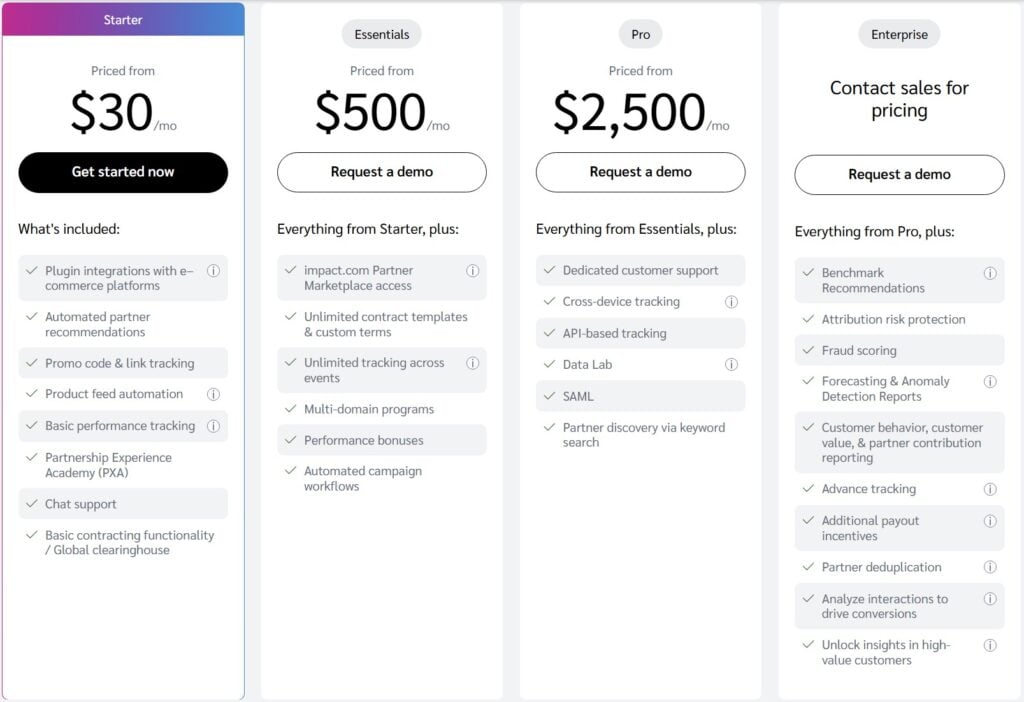
Impact pricing starts at $30/month for the Starter plan, scales to $2,500/month for the Pro plan, and reaches custom pricing for Enterprise contracts. All plans carry a 2.5% network tax on every commission generated through the platform — a transparency concern worth factoring in before signing.
The network tax compounds at scale. If your affiliate program generates $100,000 in monthly sales at a 10% commission rate, you’re paying Impact an additional percentage on top of partner commissions.
The Starter tier provides basic affiliate link tracking, manual partner management, and simple reporting. The Pro tier unlocks campaign automation, advanced tracking technology with TrueLink attribution, fraud protection, and full access to Impact’s Marketplace of vetted publishers and creators.
CJ Affiliate vs Impact: Head-to-Head Comparison
Publisher Network and Partner Reach
This is the area where the platforms diverge most clearly.
CJ wins on raw publisher breadth. Its network of 1M+ publisher accounts is significantly larger than Impact’s 330,000+ partners, and its e-commerce advertiser count is higher.
For brands in retail, consumer goods, fashion, and lifestyle categories where coupon sites, cashback platforms, and content publishers drive meaningful volume, CJ’s network depth is a real competitive advantage. The reach into major coupon sites and loyalty platforms in particular is difficult to replicate.
Impact wins on partner quality and diversity. Its vetted marketplace skews toward higher-quality publishers and creators, and its multi-partnership architecture means you can manage affiliates alongside influencers, B2B referral partners, and ambassadors from a single platform.
Impact’s density in SaaS and B2B verticals is unmatched — if you’re monetising a B2B or productivity-focused audience, the program depth on that platform is two to three times what CJ can offer in the same vertical.
Verdict: CJ for retail and consumer brands at scale. Impact for SaaS, B2B, and multi-partner programs.
Tracking Technology
Both platforms have addressed the post-cookie tracking challenge, but with different architectural approaches and different results.
In a 90-day parallel tracking test across both platforms for a mid-size DTC brand doing about $40M a year, CJ’s cookieless suite was crediting roughly 14% fewer conversions than Impact’s UTL on the same traffic. This is a material difference for brands that depend on accurate attribution to make commission decisions and assess program growth accurately.
CJ’s tracking technology strength is in its deep integrations with major commerce platforms — Salesforce Commerce Cloud, Adobe Experience Platform, and Shopify Plus. For advertisers already on those stacks, CJ’s attribution is strong. For advertisers on custom or lighter tech stacks, the gap widens.
Impact’s UTL is currently the more accurate solution across the broadest range of traffic types, particularly for brands with significant Safari and iOS audiences. For brands investing in paid media alongside affiliate programs, having a single reliable attribution layer across both channels simplifies performance measurement.
Verdict: Impact for tracking accuracy, particularly on mobile and privacy-first browsers. CJ for brands on major commerce platforms.
Reporting
CJ’s reporting tools are functional and familiar to experienced affiliate marketers — you can track impressions, clicks, conversions, and commissions at a publisher and campaign level. The depth is adequate, but the interface it lives inside draws consistent criticism for being dated.
Impact’s reporting is a genuine differentiator. Its visual reporting interface, flexible attribution modelling, and cross-partner dashboards give brands a materially better view of program performance. The ability to compare affiliate performance against influencer and referral partner performance within a single reporting environment is something CJ cannot match.
For brands that want to tie affiliate sales back to broader growth metrics, Impact’s reporting integration with CRM and analytics platforms is more flexible.
Verdict: Impact on reporting depth and flexibility. CJ adequate for straightforward affiliate tracking.
Pricing and Total Cost
Neither platform publishes fully transparent pricing, which is a frustration for brands doing initial evaluation before committing to a demo.
At face value, Impact’s Starter tier ($30/month) looks more accessible than CJ’s enterprise pricing. In practice, both platforms become expensive at scale due to their percentage-based network fee structures.
Impact typically charges a mandatory 2.5% to 5% transaction fee on every commission you pay out. CJ’s network fee runs higher at approximately 30% of commissions, though it’s structured differently.
For a scalable, high-volume affiliate program, both platforms represent significant cost. For brands earlier in their program development, Impact’s tiered entry point offers more flexibility. The lack of pricing transparency on both sides is worth pushing on in sales conversations.
Verdict: Impact for early-stage and mid-market programs. Both become premium investments at enterprise scale.
User Experience and Ease of Use
This is one of the clearest differentiators between the two affiliate platforms.
G2 reviewers report that Impact excels in overall user satisfaction, boasting a significantly higher score than CJ Affiliate. Users appreciate the platform’s modern design and intuitive interface, which simplifies the management of complex affiliate programs and enhances day-to-day usability.
CJ has consistently received feedback that its interface is dated and harder to navigate, with analytics and data tools that don’t meet the experience users expect from a platform at its price point. That said, Impact has its own learning curve — new users report deployment cycles of three to six months to fully integrate tracking pixels and CRM pipelines. The interface is modern, but the platform’s breadth means there’s significantly more to configure before you’re fully operational.
Verdict: Impact on UX, with the caveat that it requires meaningful onboarding investment.
Support Quality
Impact users consistently highlight the platform’s proactive support as a differentiator. Reviewers have found Impact’s support team more effective at addressing issues and more knowledgeable about platform capabilities than their CJ counterparts — a pattern that holds across both agency and direct advertiser reviews.
CJ does offer dedicated account managers at premium tiers, which helps offset the platform’s UX limitations for larger advertisers. For companies running high-volume affiliate programs, having a named account manager is meaningful — but the broader support infrastructure draws more mixed reviews than Impact’s.
Verdict: Impact on support quality across most user segments.
Partnership Management, Creator Integration, and Flexibility
Impact is built as a partnership management platform first, with affiliate network access as one component of a broader system. This architectural flexibility is meaningful for brands that want to manage multiple partnership types — affiliates, influencers, B2B referral partners, ambassadors — from shared data and infrastructure.
The ability to apply consistent attribution, fraud detection, and detailed reporting across all partner types is something CJ’s network-first model doesn’t replicate.
In 2025-2026, Impact integrated creator (influencer) management directly into its performance platform, allowing brands to manage influencer campaigns alongside affiliate programs with performance tracking across both.
Combined with the creator storefront feature launched at iPX 2026, Impact has positioned itself as a genuine unified platform for brands that want affiliate and influencer programs to operate from shared data and infrastructure.
Publishers and creators can join Impact’s marketplace directly, and the contract and payment workflows handle both partner types within the same system.
CJ’s partnership model is more traditional. Publishers operate within CJ’s network infrastructure, and the relationship management tools — while functional — are less sophisticated than Impact’s contract, automation, and communication workflows. CJ’s creator capabilities remain limited by comparison; if influencer marketing is part of your program strategy, this gap is meaningful.
Verdict: Impact for brands managing complex, multi-type partner programs. CJ for straightforward publisher network access.
Geographic Availability
Both platforms operate globally, but with different coverage depth. CJ’s publisher network has particularly strong representation in North America — the US is where its 1M+ publisher base is most concentrated. It has meaningful coverage in the UK and Canada as well, though its e-commerce-heavy network skews toward North American publishers and advertisers.
Impact’s vetted marketplace has broader international representation, with meaningful publisher and creator density in the UK, Canada, Australia, and across continental Europe. For brands running affiliate programs across multiple regions simultaneously, Impact’s global marketplace offers more flexibility than CJ’s network in markets outside North America.
Verdict: CJ dominant in the US. Impact stronger for international and multi-region programs.
How to Evaluate Your Options Before Committing
Most brands stop their evaluation too early, comparing feature lists without stress-testing the questions that actually determine fit. Before you commit to either platform, these are the areas worth getting clear answers on.
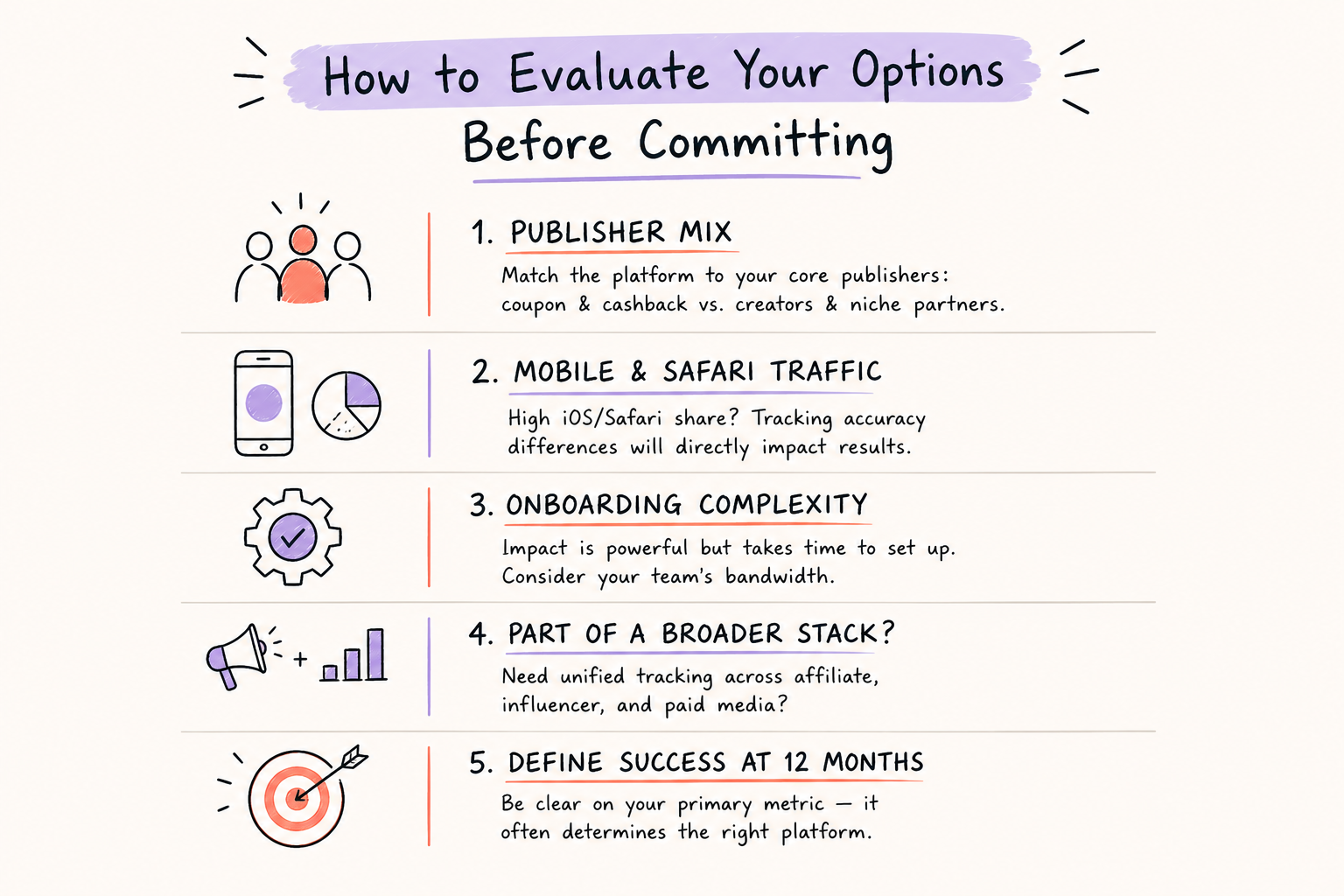
What do your marketing strategy and publisher mix look like today? If coupon sites, cashback platforms, and loyalty publishers are already driving meaningful volume for your category, CJ’s network is the natural fit: its emphasis on that publisher tier is baked into the platform’s DNA. If your program is more focused on content creators, niche bloggers, and B2B referral partners, Impact’s vetted marketplace shows a stronger concentration in those segments.
How much of your traffic comes from mobile and Safari? This is the question that most directly determines which tracking technology you should rely on. If a significant share of your audience uses iOS or Safari — which now represents a substantial portion of consumer web traffic — the attribution gap between Impact’s UTL and CJ’s cookieless suite is material. A platform that undercounts conversions doesn’t just give you bad data; it means you can’t ensure your top publishers are being compensated accurately, which creates real affiliate relationships risk.
What’s your team’s ability to manage onboarding complexity? Impact’s platform is more powerful, but it requires more to configure. If your team can’t dedicate three to six months to a proper integration, CJ’s faster onboarding is a practical advantage. Choosing a platform your team can’t fully operationalise doesn’t protect your program — it slows it down.
Are you planning to run affiliate alongside influencer or paid media? If affiliate is one channel in a broader performance marketing system, Impact’s unified attribution across partner types is significantly more valuable. Running separate systems for affiliate and influencer tracking creates attribution gaps that make it hard to understand which channels are actually driving growth.
What does success look like at 12 months? A program focused on hitting a publisher count milestone looks different from one focused on growing affiliate-driven revenue as a percentage of total sales. Be specific about the metric you’re optimising for — it often answers the platform question directly.
Choose CJ Affiliate if:
- You’re a consumer brand in retail, fashion, lifestyle, or e-commerce that needs to reach the broadest possible publisher network
- Coupon sites, cashback platforms, and loyalty programs are meaningful traffic sources for your category
- You’re already on Salesforce Commerce Cloud, Adobe Experience Platform, or Shopify Plus and want deep native tracking integration
- Publisher volume and network breadth matter more to you than platform sophistication or creator integration
Choose Impact if:
- You’re running a SaaS, subscription, or B2B affiliate program where depth in your vertical matters more than raw publisher count
- You want to manage affiliates, influencers, ambassadors, and referral partners from a single scalable platform
- Tracking accuracy for iOS and Safari traffic is a priority for your audience
- You need automation — for onboarding, payouts, compliance, and partner communication — to run programs efficiently with a lean team
- You’re a DTC brand building a creator-led affiliate program and want storefront and commission tracking in one place
- You’re running programs across multiple regions including the UK, Canada, or international markets
Choose neither if:
- You’re early-stage with fewer than 50 active affiliates — lighter-weight platforms like UpPromote, Refersion, or FirstPromoter will deliver better ROI at lower cost and operational complexity
- You need transparent pricing before committing — both platforms require demos before you see real numbers
At Vivian Agency, we work across both CJ Affiliate and Impact, including as a Silver Agency Partner with Impact. The platform we recommend depends entirely on the brand’s category, program scale, partner mix, and existing tech stack — not on which platform is abstractly “better.” If you want to talk through which network makes sense for your specific affiliate program, book a free call and we’ll walk you through it.
Vivian Agency’s Take: What We’ve Seen in Practice
Running affiliate programs across both platforms for clients in beauty, health, lifestyle, and e-commerce, here is what we’ve observed:
For brands in high-purchase-intent retail categories, CJ’s publisher network consistently surfaces high-volume coupon and comparison site traffic that converts. The breadth of the network is real, and for the right category, it drives volume and affiliate sales that Impact’s smaller publisher base doesn’t match.
For DTC brands building creator-led programs — where the affiliate and the influencer are increasingly the same person — Impact’s unified affiliate platform removes a significant operational headache. Managing creator contracts, tracking affiliate commissions, and measuring influencer campaign performance from a single dashboard changes what’s possible with a lean team, and it makes program growth easier to attribute and optimise.
The tracking technology gap is real and worth taking seriously. For brands with significant mobile traffic or audiences on privacy-first browsers, the difference between what Impact’s UTL captures and what CJ’s cookieless suite attributes can translate to meaningful differences in how creator and publisher performance is assessed and compensated. Underpaying a top publisher because your platform missed their conversions is a relationship problem, not just a data problem.
The scalability question matters too. Both platforms grow with your program, but their cost structures scale differently. CJ’s percentage-of-commissions model means fees compound with every dollar of program growth. Impact’s tiered subscription model is more predictable, though its network tax has the same compounding effect at volume. For brands projecting significant program growth in the next 12–24 months, running cost modelling against both pricing structures before committing is worth the time.
Our recommendation for most mid-market DTC brands building or scaling affiliate programs in 2026: start the conversation with Impact if you’re building a multi-partner program, and with CJ if your primary goal is reaching the widest possible publisher network in a consumer retail category. And if you’re not sure which profile fits your program, work with an agency that has active experience on both — rather than relying on platform sales teams whose job is to sell you their platform regardless of fit.
Our industry expertise across both platforms means we can give clients answers that the platforms themselves won’t: where the tracking gaps are in practice, which publisher segments actually convert for your category, and what the real cost structure looks like once your program scales. That independent view is something brands consistently tell us they couldn’t get from the platforms’ own sales and services teams.
For more on building affiliate programs that compound over time, see our guides on how to set up an influencer affiliate program and how to find affiliates for your brand.
Frequently Asked Questions
What is the main difference between CJ Affiliate and Impact?
CJ Affiliate is primarily a publisher network: its core value is access to over 1 million publisher accounts across coupon sites, content publishers, loyalty platforms, and cashback networks.
Impact is primarily an affiliate platform and partnership management system: its core value is managing multiple partner types (affiliates, creators, influencers, B2B referral partners, and ambassadors) from a single system with sophisticated automation and tracking technology.
CJ wins on publisher breadth, particularly for consumer retail brands. Impact wins on platform flexibility, creator integration, tracking accuracy, reporting depth, and user experience. The right choice depends almost entirely on what your affiliate program actually needs.
Which platform has better tracking technology in 2026?
Impact’s Universal Tracking Layer currently delivers more accurate attribution across the broadest range of traffic types, particularly for brands with significant iOS and Safari audiences. In independent testing, Impact’s UTL recovered 18–24% more previously unattributed conversions on privacy-first browser traffic compared to CJ’s cookieless suite.
CJ’s tracking is strong for brands already integrated with Salesforce Commerce Cloud, Adobe Experience Platform, or Shopify Plus, where its first-party data integration mitigates much of the cookie deprecation impact.
How much does CJ Affiliate cost compared to Impact?
Neither platform publishes fully transparent pricing — both require a demo or sales conversation before you see real numbers.
CJ charges approximately 30% of commissions on top of customised platform fees. Impact charges a 2.5% network tax on every commission generated, on top of subscription fees ranging from $30/month (Starter) to $2,500/month (Pro) to custom pricing at Enterprise.
Both platforms become significant investments at scale, and the percentage-based fee structures mean costs compound as affiliate sales volume grows.
Can Impact replace CJ Affiliate?
It depends on your category and program type. For SaaS companies, subscription, B2B, and DTC brands running multi-partner programs that include both affiliates and creators, Impact is the more capable affiliate platform and can fully replace CJ for most use cases.
For consumer retail brands that depend heavily on coupon sites, cashback platforms, and sub-affiliate networks for volume, CJ’s publisher network is genuinely larger and more developed in those specific categories — and Impact does not fully replicate that reach.
Many enterprise brands run both platforms simultaneously, targeting different publisher segments through each.
Is CJ Affiliate or Impact better for small businesses?
Neither platform is well-suited for early-stage or small companies running lean affiliate programs with fewer than 50 active affiliates. Both carry significant cost structures and operational complexity that typically don’t return sufficient ROI at small program scale.
Impact’s Starter tier at $30/month is the lower-cost entry point of the two, but the platform’s full value only materialises at higher tiers. For smaller programs, lighter-weight alternatives like UpPromote, Refersion, or FirstPromoter deliver better cost efficiency.
Once your affiliate program reaches consistent monthly commission volume above $10,000 and 50+ active affiliates, the case for Impact or CJ becomes much stronger.
How long does it take to get set up on Impact vs CJ?
Impact’s onboarding is more complex. Users report deployment cycles of three to six months for full integration, including tracking pixel implementation, CRM connections, and workflow configuration. CJ’s onboarding is faster for brands on supported commerce platforms, though its interface complexity can extend the learning curve.
For brands migrating from another affiliate platform, both CJ and Impact have onboarding teams that assist with tracking setup and publisher outreach — but expect a meaningful operational investment before the program is running at full capacity on either platform.
Do CJ Affiliate and Impact work for international programs including the UK and Canada?
Both platforms support international affiliate programs, but with different coverage depth. CJ has strong publisher networks in the US, UK, and Canada, with its deepest concentration in North America.
Impact’s vetted marketplace has broader international representation across the UK, Canada, Australia, and continental Europe, and its global marketplace is generally better suited to brands running programs across multiple regions simultaneously. For purely US-focused programs, this distinction matters less.
What does a successful affiliate program look like on Impact vs CJ?
Success on CJ typically means publisher volume and reliable commission tracking across a large network — it’s the right definition of success for brands in retail and consumer goods where coupon sites and cashback platforms are meaningful acquisition channels.
Success on Impact tends to look different: a focused partner mix of high-quality affiliates, creators, and referral partners, all managed through a single system with accurate attribution across channels. Impact is the stronger choice for brands where affiliate is one part of a broader performance marketing system, and where trust in the data matters as much as raw volume.
Do CJ Affiliate and Impact offer managed services?
Both platforms offer managed services options, though the scope and cost vary. CJ provides account management and publisher recruitment services at premium tiers, with more hands-on support available to larger advertisers.
Impact offers managed services through its agency partnership program: agencies like Vivian Agency, which is a Silver Agency Partner, provide full-service affiliate program management for clients who don’t want to run the platform themselves.
For brands that are new to affiliate marketing or don’t have in-house expertise, working with a platform-certified agency is often more valuable than relying on the platform’s own services team alone.
Is CJ Affiliate independently owned?
No. CJ Affiliate’s parent company Conversant was acquired by Stagwell in Q4 2025 for approximately $340M. Stagwell is a publicly traded marketing services company. Impact is privately held, with its most recent funding round valuing the company at approximately $1.6 billion. Both ownership structures have implications for platform roadmap, pricing, and long-term stability — worth factoring in if you’re signing a multi-year contract.
If you want an independent view on which affiliate management network is the right fit for your program, book a free call with our team.
For further reading on building and scaling affiliate programs, see our guides on how to set up an influencer affiliate program, how to find affiliates for your brand, the full affiliate marketing compliance checklist, and affiliate marketing vs referral marketing.