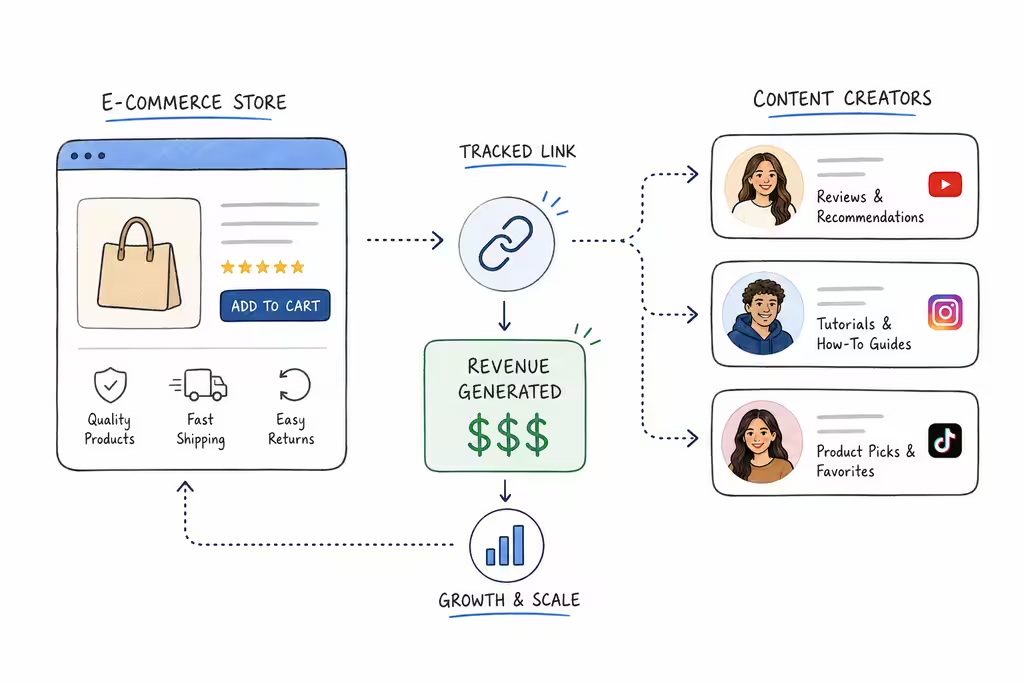

This affiliate marketing guide addresses one of the most searched questions in the space and also one of the most dishonestly answered.
In this article, we explore how long does affiliate marketing take to work from first setup to consistent revenue, for both brands and creators. On one end of the internet, you’ll find people claiming they made money in their first week. On the other, cautionary tales about grinding for two years without a single sale. Neither extreme is particularly useful if you’re trying to make an actual decision about whether or how to invest in this channel.
So here’s the honest answer:
If you’re a brand launching an affiliate program, you can expect meaningful results, consistent partner-driven revenue, a growing publisher network, and measurable ROI within 3 to 6 months, provided the program is set up correctly, actively managed from day one, and supported by a clear affiliate marketing strategy that covers recruitment, content creation, and partner communication.
Some brands see their first attributed sales within weeks. Others spend six months wondering why nothing is moving, usually because the program was set up but never actively recruited or managed.
If you’re an affiliate marketer or content creator promoting products through affiliate links, the timeline is longer and more variable. Most affiliates following a consistent, structured approach and focused execution see their first commissions within 60 to 90 days. Stable, consistent affiliate income typically takes 6 to 12 months. Building affiliate marketing into a primary income source usually takes 2 or more years.
This affiliate marketing guide covers both timelines in depth: what actually determines how long it takes, what a realistic month-by-month breakdown looks like, and the most common reasons affiliate programs and publishers stall before results arrive.
Whether you are new to affiliate marketing or refining an existing affiliate strategy, the affiliate marketing timeline is longer than most people expect and far more manageable when you understand what drives it.
Table of Contents
Overview
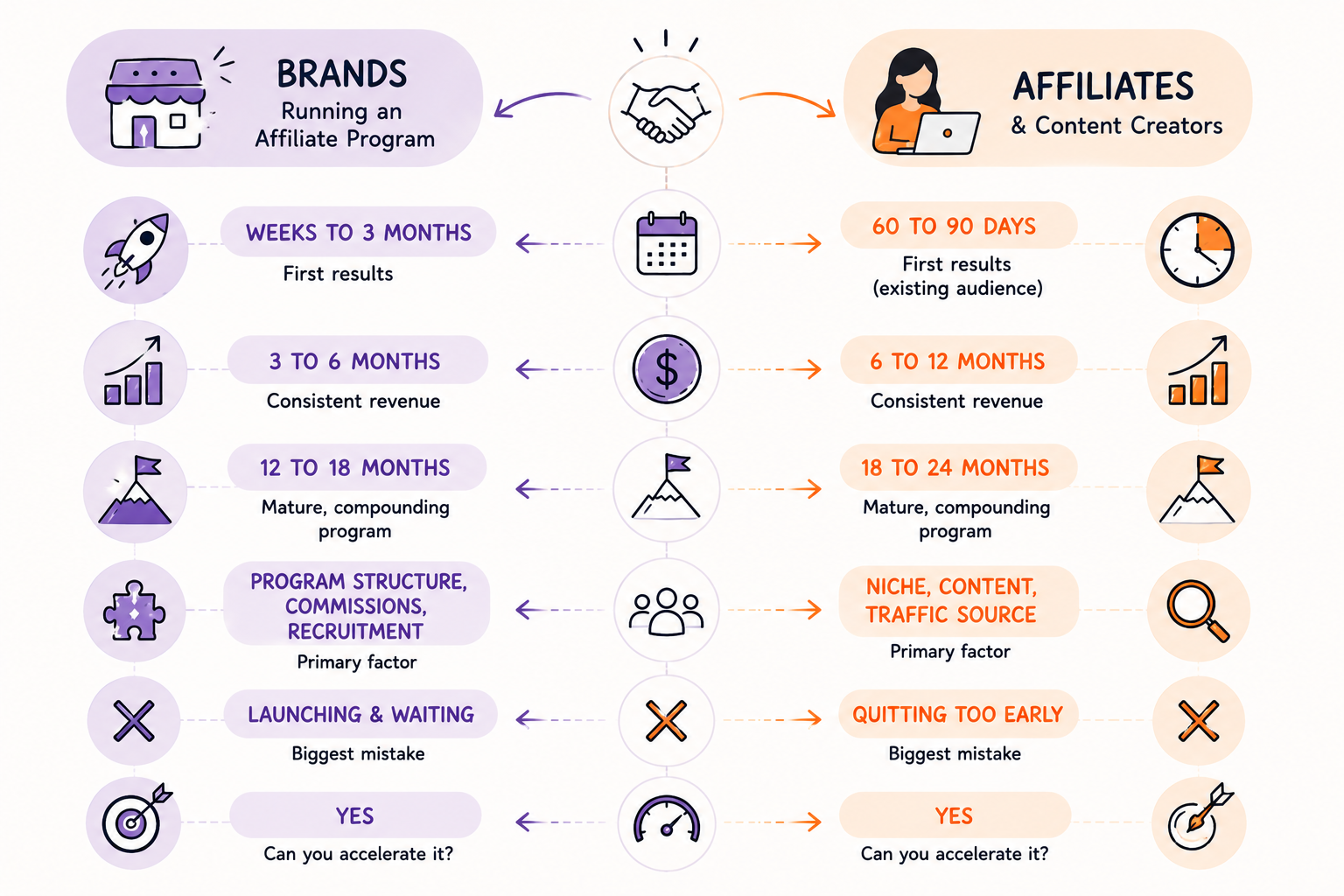
| Metric | Brands Running an Affiliate Program | Affiliates and Content Creators |
|---|---|---|
| First results | Weeks to 3 months | 60 to 90 days with existing audience; longer from scratch |
| Consistent revenue | 3 to 6 months with active management | 6 to 12 months |
| Mature, compounding program | 12 to 18 months | 18 to 24 months |
| Primary factor | Program structure, commission competitiveness, active recruitment | Niche selection, content quality, traffic source |
| Biggest mistake | Launching and waiting rather than actively recruiting | Quitting too early or switching niches before the current one has time to compound |
| Can you accelerate it? | Yes, with specialist agency management, competitive commissions, proactive partner recruitment, and a clear affiliate marketing strategy from day one | Yes, with paid ads, existing audience, short form video, or strong SEO execution |
Part 1: How Long Does an Affiliate Program Take to Work for Brands?
The Realistic Brand-Side Timeline
Launching an affiliate program and watching revenue appear are two very different things. The gap between them is where most brand-side programs underperform, and it usually comes down to treating affiliate marketing as a channel to switch on rather than a program to build.
Here is what a realistic timeline looks like for a brand launching an affiliate program from scratch:
Weeks 1 to 4: Setup and infrastructure
The first month is almost entirely invisible from a revenue standpoint, and that is appropriate. This is where you set the foundation: selecting your affiliate platform, configuring tracking, establishing your commission structure, building your creative asset library, and writing your program terms. None of this generates revenue, but all of it determines how well the program performs later.
The most important decision you make in this phase is your commission rate. A commission structure below the category average will make subsequent recruitment efforts harder and limit your ability to attract affiliate partners with genuine audiences aligned with your affiliate products.
For most DTC categories, 10-15% is the standard starting point. For beauty and skincare, 15-25%. For health and supplements, 20-40%. Getting this right at launch is significantly more efficient than adjusting it later. For a detailed breakdown by category, see our guide on setting up an influencer affiliate program.
Months 1 to 3: Active recruitment and first activations
This is where the real work of building an affiliate program begins. Most brands underinvest here. They list the program on an affiliate network, wait for applications, and wonder why nothing happens.
Active affiliate recruitment is the single biggest lever in the early-stage timeline. This means proactive outreach to relevant content creators, bloggers, micro-influencers, and niche publishers across multiple traffic sources and traffic channels, rather than waiting for them to discover the program.
Successful affiliates are found through a combination of affiliate networks, direct outreach, social media platforms, and your own existing customer base.
According to EMARKETER’s 2026 affiliate marketing forecast, content creators are now the fastest-growing publisher type in affiliate marketing, with their share of revenue on major networks rising from 15.9% to 19.5% year-over-year. Targeting these creators early, before they are saturated with competing program invitations, is one of the fastest ways to compress your time-to-revenue.
Brands that recruit actively in months 1 to 3 typically see their first attributed sales in this window. Brands that recruit passively often wait 4 to 6 months for the same outcome.
Months 3 to 6: First meaningful revenue and optimization
By month three, a well-managed program should have enough active publishers to generate consistent, if modest, affiliate-attributed revenue.
This is the phase where data starts to tell you something useful: which affiliate partners are actually converting, which creative assets and content formats perform, which commission tiers are driving the right behavior, and which traffic sources are generating the highest quality affiliate sales.
Most affiliate programs take 3 to 6 months to gain meaningful traction, which aligns with the investment period most brands should budget for before assessing whether the channel is working.
The keyword is active. Programs with dedicated management consistently reach this milestone faster than programs running on autopilot. This is also the phase where analytics tools and data-driven insights become genuinely useful. You now have enough affiliate sales data to make evidence-based decisions about where to focus your affiliate marketing efforts.
Vivian Agency programs typically reach consistent month-over-month affiliate revenue growth by the end of month three when recruitment is proactive, and the commission structure is competitive.
Our Kokido case study shows what this looks like in practice: 190% ROI in month one of active Creator Connections campaigns, and 530% ROI in month two. That acceleration is not typical for every category or program structure, but it illustrates what active management produces relative to passive program management.
Months 6 to 12: Compounding growth
This is where affiliate marketing starts to behave differently from paid channels. A paid search campaign stops generating traffic the moment the budget stops. Affiliate content across multiple traffic sources, including a well-ranked review article, video content from a YouTube channel, short-form video from a TikTok creator, or a newsletter recommendation from a trusted publisher, continues generating affiliate sales long after it was published.
The compounding effect of a well-managed affiliate program becomes most visible in months 6 to 12. Publisher relationships deepen. Successful affiliates who have been in your program for 6 months know your affiliate products, have data on what converts with their specific target audience, and develop promotional approaches that outperform their earlier work.
Many affiliates who start with modest affiliate income in the early months reach consistent, meaningful revenue by month nine or ten as their content creation compounds. New publishers recruited in months 1 to 3 start generating consistent volume. The program begins to feel less like a channel you are managing and more like a channel with its own momentum.
By month 12, a program with consistent management, competitive commissions, and active recruitment should be generating a meaningful, attributable percentage of total revenue.
Affiliate marketing now generates an estimated $241.03 billion in US e-commerce sales annually, according to EMARKETER, and brands reaching 12 months of consistent program management are typically beginning to see their share of that compound.
Months 12 to 18 and beyond: Scale and optimization
Beyond 12 months, the primary variables are program scale, commission competitiveness, and the sophistication of your publisher mix. Brands that invest in this phase, expanding into new publisher categories and traffic sources, testing tiered commission structures, building long-term ambassador relationships with top performers, and maintaining strong relationships with affiliate partners across different traffic channels, see the largest revenue contributions.
For context, our Sposie case study shows what a relaunch and scale-up looks like for a brand that already had an affiliate presence but was not activating it: 200+ affiliates recruited, 80+ content pieces published, and $100K+ in attributed sales within six months of a structured relaunch. The timeline was compressed because the program infrastructure already existed. The gap was recruitment and management, not setup.
What Determines the Brand-Side Timeline

Commission competitiveness. Publishers compare programs before committing their promotional effort. If your commission rate is below the category benchmark, quality publishers will deprioritize your program in favor of better-converting alternatives. This single factor affects your recruitment speed, your publisher quality, and ultimately your revenue timeline more than almost any other variable.
Active recruitment. The difference between a program that generates revenue in month two and one that generates revenue in month six is usually recruitment activity, not program quality. Brands that actively source and contact relevant publishers and affiliate partners across affiliate networks, social media platforms, and direct outreach consistently reach their first revenue milestones and first sale targets faster than those who rely on passive discovery.
Partner recruitment across multiple traffic channels is what separates programs that generate affiliate sales in month two from those that wait until month six. See our guide on how to find affiliates for your brand for a full outreach methodology.
Program management quality. An affiliate program is not a set-and-forget channel. Publisher relationships require communication, onboarding support, fresh creative assets, seasonal campaign briefs, and ongoing performance review. Programs with dedicated management, whether in-house or through a specialist agency, compound faster than programs running without active oversight.
Niche and product-market fit. Some categories are inherently better suited to affiliate marketing than others. Beauty, health, lifestyle, and SaaS consistently generate strong affiliate ROI. Products with thin margins, complex purchase decisions, or very long sales cycles take longer to build affiliate momentum around.
Tracking infrastructure. With third-party cookie tracking declining across browsers, the accuracy of your attribution infrastructure directly affects how quickly you can identify what is working and optimize. Programs running on first-party tracking or server-to-server attribution have cleaner data from day one, can track performance accurately, and can optimize faster as a result.
This is especially important as you expand across multiple traffic sources and channels, where consistent attribution is the only way to measure which affiliate campaigns are driving genuine affiliate-driven sales. See our guide on affiliate contract compliance for how to structure your program terms to support accurate attribution.
Part 2: How Long Does Affiliate Marketing Take to Work for Publishers and Creators?
The Realistic Creator-Side Timeline
The affiliate marketing timeline for publishers and content creators looks different from the brand-side experience, and the honest answer is that it is longer than most people expect when they start.
Most affiliates following a focused system, with steady effort and execution, see their first commissions within 60 to 90 days. Stable, consistent affiliate income typically takes 6 to 12 months. Without a system, the affiliate marketing timeline stretches indefinitely, and most people quit before results ever arrive.
Here is what a realistic month-by-month picture looks like:
Months 1 to 3: Foundation
The first three months of an affiliate marketing operation are almost entirely about building. You are selecting your niche, establishing your platform (blog, YouTube channel, newsletter, or social presence), joining affiliate programs, and publishing your first content.
It is normal to have zero traffic during this period. Search engines take time to discover and trust new sites, and the foundational work done in this phase, including niche selection, target audience definition, and content creation cadence, determines the ceiling on what you can earn later.
Successful affiliates who compress this phase are those who approach creating content as a publishing business from day one, with brand messaging and audience alignment built in from the start.
Months 3 to 6: Early signals
If you have been publishing consistently and targeting the right search terms, social media posts, or audience across multiple traffic sources, months 3 to 6 are where early signals appear. Content starts indexing, organic visitors start arriving in small numbers, and your first commission may come through, though it probably will not feel significant.
This is the phase where most people quit, which is the single most common reason affiliate marketing does not work for individual publishers. The timeline is slow here because the compound effect of content creation, audience building, and search engine rankings has not yet had enough time to accelerate. Many affiliates who quit at this stage are actually closer to their first sale than they realize.
Months 6 to 12: Consistency and real income
Month 6 onwards is where the compounding effect becomes visible. Content published in months 1 to 3 is ranking and generating consistent traffic. New content benefits from the domain authority and audience trust built in the early months. Commissions become less random and more predictable.
For affiliates using SEO as their primary traffic source, this is typically the phase when results become genuinely meaningful. Analytics tools become genuinely useful here: successful affiliates use data-driven insights to understand which affiliate products convert best, which content formats generate the most clicks, and which landing pages turn more traffic into affiliate sales.
SEO-based strategies typically take 8 to 18 months to build sustainable traffic, but they offer the most durable long-term returns because the content continues driving clicks and commissions long after it was published.
Social media platforms like TikTok, which shows the highest engagement rates in affiliate content at 5.2% according to Statista, can generate initial traction within weeks through short form video content and social media posts.
Building a sustainable, owned audience across social media platforms takes consistent effort over months, but short form video in particular is one of the fastest traffic sources for generating affiliate sales among newer creators in the creator economy.
Months 12 to 24: Scale and optimization
By month 12, affiliates with a consistent content creation operation and a growing audience have enough data to make genuinely strategic decisions: which affiliate products and affiliate programs convert best, which content formats and video content generate the most clicks, which traffic sources drive the highest quality leads, and which audience segments are most valuable.
Most successful affiliates at this stage are also beginning to use automation tools to manage their content calendar, email sequences, and affiliate campaigns more efficiently.
The transition from active income to passive income typically occurs around month 18 to 24, when your content library, email list, and audience relationships generate consistent revenue with minimal new effort.
What Determines the Creator-Side Timeline
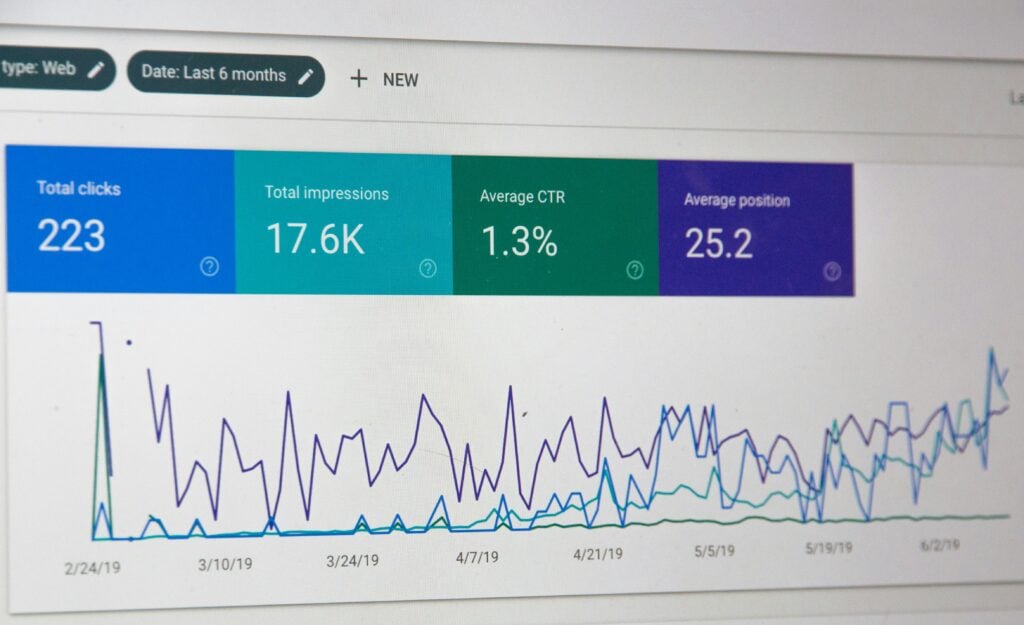
Niche selection. This is the single biggest variable in how quickly an affiliate operation generates income. Choosing a profitable, low-competition niche with high buyer intent can reduce your timeline to first sales by 50 to 70%, while broad, saturated niches may take 2 to 3 times longer to generate meaningful commissions. Niches in health, personal finance, software, and relationships consistently show higher conversion rates because people arrive with intent to solve a specific problem.
Traffic source. The traffic sources with the strongest conversion rates for affiliates in 2026 are email, YouTube, and SEO content, specifically review-style posts that rank for buying-intent searches. Short form video on TikTok and Instagram Reels is the fastest-growing traffic source for affiliate sales, particularly in creator commerce and influencer marketing adjacent categories.
Google Ads and paid ads on Meta can compress timelines significantly but require capital, ad creatives, and ongoing optimization to remain profitable. Email marketing to an existing list can generate results immediately. Social media sits in the middle, faster than SEO but less durable than owned traffic channels.
Content quality and publishing consistency. Publishing one thoroughly researched, genuinely useful piece of high quality content per week consistently outperforms five thin articles, both in search engine rankings and in audience trust. Content quality is also what determines whether you attract affiliate partnerships with premium affiliate products.
Brands with strong programs are selective about which affiliates they approve, and engaging content with clear audience alignment is what gets applications accepted. Inconsistent publishing, with bursts of activity followed by long silences, is one of the quietest timeline killers in affiliate marketing.
Program selection. Programs with competitive commission rates, long cookie windows, and strong conversion rates on the advertiser’s side produce better EPC (earnings per click) for affiliates and make the model work faster. Digital products like online courses, ebooks, and software typically offer greater commissions because they have no production costs. High-ticket programs in software, finance, and real estate can generate significant affiliate income with relatively modest traffic volumes.
When evaluating affiliate programs, most successful affiliates prioritize EPC, cookie duration, and how well the affiliate products match their target audience and existing content.
Existing audience and assets. The single fastest shortcut to affiliate income is an existing audience. If you already have an email list, YouTube channel subscribers, or social media followers who trust your recommendations, you can add affiliate links to relevant affiliate products and generate affiliate sales almost immediately.
Using existing content to add affiliate links is one of the most underused shortcuts in affiliate marketing. Many affiliates overlook the revenue potential sitting in content they already published.
The Most Common Reasons Affiliate Marketing Takes Longer Than It Should
Whether you are a brand running an affiliate program or a creator building one, the same patterns consistently add months to the timeline:
For brands:
Launching without active recruitment and waiting for publishers to find the program. Listing on an affiliate network is not the same as recruiting. Quality affiliate partners need to be found and contacted directly across multiple traffic channels and traffic sources. A passive listing on affiliate networks will attract mainly coupon and cashback publishers, not the high quality content creators and influencers who drive the most valuable affiliate sales.
Setting commissions below category benchmarks. An uncompetitive commission rate is a quiet but powerful deterrent for quality publishers who have options about which programs to prioritize.
Treating affiliate marketing as a passive channel. Programs that are not actively managed, with fresh creative assets, regular publisher communication, performance reviews, and commission optimization, stall rather than compound. Affiliates focus their promotional effort on programs that communicate regularly, provide updated affiliate products information, and make it easy to generate affiliate sales through well-structured landing pages and clear brand messaging.
Read our post on what affiliate marketing reports to ask your agency for to understand how to keep an active finger on the pulse of your program.
Inadequate tracking infrastructure. If your attribution is broken or incomplete, you cannot identify what is working, which means you cannot optimize, which means you cannot accelerate. Getting server-to-server tracking right from day one is significantly more efficient than retrofitting it after launch.
For publishers and creators:
Quitting between months 2 and 4. Giving up during the quiet period before the compound effect kicks in is what separates successful affiliates from those who conclude the channel does not work. The affiliate marketing timeline rewards consistent effort far more than it rewards talent, and most affiliates who eventually generate meaningful affiliate income simply stayed consistent through the quiet months.
Choosing a niche based on interest rather than market demand. Personal passion for a topic is valuable, but a niche with no buyer intent, dominated by high-authority competitors, or with commission rates too low to justify the traffic required will extend your timeline dramatically regardless of how consistent you are.
Switching niches or strategies too early. After three or four months with minimal results, the temptation to start over somewhere else is real and usually counterproductive. Measure success by leading indicators: search engine rankings improving, organic traffic growing, and engagement on social media posts increasing. These signal that the affiliate marketing efforts are compounding, even if affiliate sales have not started yet.
Targeting keywords or topics that are too competitive. Beginners consistently overestimate how quickly they can compete for high-volume search terms owned by sites with years of authority. Targeting longer, more specific search phrases where the competition is lighter produces results much faster, and allows newer creators to build search engine rankings, drive traffic, and generate affiliate sales without competing head-to-head with established sites.
Focusing on a specific niche within a broader category is one of the most reliable ways to accelerate the affiliate marketing timeline without relying on paid ads or paid media.
Relying on a single traffic source. Publishers who diversify across SEO, email, and social media are more resilient to algorithm changes and build income faster than those entirely dependent on one channel. This has become especially relevant in 2026, with AI Overviews in Google reducing organic click-through rates for content-heavy affiliate sites, a shift that saw Wirecutter’s search visibility drop over 60% between May and August 2025 according to EMARKETER.
Affiliates who focus on owned traffic channels, including email lists, YouTube channels, and communities, alongside SEO are significantly more resilient to these shifts. AI assisted content creation tools are also helping many affiliates maintain content creation output across multiple traffic sources without proportionally increasing time investment.
Can You Accelerate the Timeline?
Yes, in both cases. The variables that determine the timeline are not fixed.
For brands, the most reliable accelerants are:
- working with a specialist affiliate agency that brings an existing publisher network rather than building from scratch
- setting commissions at or above category benchmarks from launch rather than adjusting upward later
- prioritizing active partner recruitment and publisher outreach across multiple traffic sources rather than passive program listing
- building tracking infrastructure correctly from day one
- equipping affiliate partners with high quality content assets and brand messaging from the start
At Vivian Agency, these are the consistent differentiators between programs that compound in 3 to 4 months and programs that stall for 9 to 12.
If you want to understand what a realistic timeline looks like for your specific brand and category, book a free call and we can map it out.
For publishers and creators, the most reliable accelerants are:
- leveraging an existing audience rather than building from zero
- using existing content by adding affiliate links retroactively
- choosing a specific niche with genuine buyer intent and manageable competition
- publishing high quality content and short form video consistently rather than in bursts
- investing in SEO fundamentals and understanding search engine rankings from day one
- tracking performance with analytics tools and data driven insights
- selecting affiliate programs with strong conversion rates and competitive commission structures on affiliate products that genuinely match your target audience
According to Shopify’s affiliate marketing guide, brands are collaborating with 33% more micro-influencers year over year, meaning the opportunity for smaller creators to find meaningful brand partnerships is growing.
Frequently Asked Questions
How long does it take to see the first results from an affiliate program?
For brands running an affiliate program with active management and competitive commissions, first attributed sales typically appear within 2 to 6 weeks of launch. For publishers and content creators building from scratch, the first commission usually arrives somewhere between 60 and 90 days with consistent effort, or sooner with an existing audience.
First results and consistent affiliate sales are different milestones in the affiliate marketing timeline. Most programs need 3 to 6 months before affiliate revenue is consistent enough to be strategically meaningful rather than sporadic.
Is 6 months a realistic timeline for affiliate marketing to work?
For brands, 6 months of active program management typically produces a well-functioning program with consistent publisher-driven revenue, a growing publisher network, and enough performance data to make confident optimization decisions.
For publishers building from an SEO-first content strategy, 6 months is often the point where results begin to compound rather than the point where they are complete. Sustainable affiliate income typically takes 6 to 12 months, with meaningful scale at 12 to 24.
What is the fastest way to get results from affiliate marketing?
For brands: prioritize active publisher recruitment over passive network listing, set commissions at or above category benchmarks, and ensure tracking infrastructure is server-to-server rather than cookie-dependent. Working with an agency that brings an existing network of vetted publishers and affiliate partners is the most reliable way to compress the affiliate marketing timeline from 6 to 12 months down to 3 to 4 months.
For publishers and creators: leverage an existing audience if you have one, use paid ads to test affiliate products before investing months in organic content creation across multiple traffic sources, and focus on high-commission programs in niches with genuine buyer intent.
Why is my affiliate program not making money after 3 months?
Three months is rarely enough time to make a conclusive assessment. The more useful question is whether the right activities are happening. Are you actively recruiting publishers or waiting for them to find you? Is your commission rate competitive in your category? Do your top publishers have the creative assets and support they need to promote effectively? Is your tracking accurately attributing conversions?
Most programs that are not generating revenue at 3 months have a recruitment or commission problem rather than a fundamental problem with the channel. For a deeper look at how to structure an affiliate marketing strategy that generates affiliate sales faster, see our guide on how to set up an influencer affiliate program or read our breakdown of what affiliate marketing reports to request from your agency to understand what data should be driving your affiliate marketing efforts.
Does affiliate marketing still work in 2026?
Yes. US affiliate marketing spend is projected at $13.81 billion in 2026, up 11.3% year-over-year according to EMARKETER, a growth rate significantly higher than overall US retail e-commerce growth. The channel now generates an estimated $241.03 billion in US e-commerce sales annually. What has changed is the nature of what works.
Thin content, generic social media posts, passive program management, and affiliate campaigns with no real audience alignment produce far weaker results than they did five years ago. Most successful affiliates in 2026 combine AI assisted content creation for volume with genuine expertise and user generated content for trust, and use short form video alongside long-form SEO content to cover multiple traffic sources simultaneously.
How long does affiliate marketing take compared to paid advertising?
Paid advertising can generate results within hours and is significantly faster to initial revenue than affiliate marketing. The tradeoff is that paid traffic stops the moment the spend stops, while affiliate-generated content continues driving attributed revenue long after it was published.
The most effective affiliate marketing strategy uses both in combination: paid ads and paid media for immediate revenue and lead generation, and affiliate channels for compounding long-term growth. Many affiliates and brands also use paid ads to drive traffic to landing pages optimized for affiliate programs, which gives them data on which affiliate products convert before committing to months of content creation.
This path forward, testing with paid ads and scaling with organic affiliate marketing efforts, is what most successful affiliates and performance-focused brands settle on once they understand the affiliate marketing timeline.
For further reading on building and scaling affiliate programs, see our guides on how to set up an influencer affiliate program, how to find affiliates for your brand, affiliate contract compliance, how to reach out to affiliates, and what affiliate marketing reports to request from your agency.