
Most affiliate programs underperform for the same reason: the affiliate program incentives were set at launch and never revisited.
A commission rate that was competitive in 2022 is often uncompetitive in 2026. Likewise, flat commission structures that work well for content creators often work poorly for coupon sites, and vice versa.
And a program that fails to motivate affiliates by treating every affiliate the same, regardless of what they drive, how they drive it, or how long they have been in the program, is a program that loses its best partners to competitors who pay more attention.
In 2025, affiliate marketing has become increasingly sophisticated. Businesses are recognizing that one-size-fits-all reward structures no longer work in competitive markets.
Choosing the right affiliate incentives is no longer optional. It is what determines whether affiliates stay engaged, produce their best work, and prioritize your program when they have limited promotional capacity.
This guide covers every category of affiliate reward available, when each one works best, how to stack them for maximum partner motivation, and the mistakes that consistently cost brands their top performing affiliates.
Table of Contents
Overview
| Incentive Type | Best For | Risk Level | When to Use |
|---|---|---|---|
| Flat percentage commission | All affiliate types as a baseline | Low | Always |
| Tiered commission structure | High-volume partners, creator affiliates | Low | Programs with 20+ active affiliates |
| Recurring commissions | SaaS, subscription products | Low | Any subscription-based business |
| Performance bonuses | Launch periods, promotional windows | Medium | Tactical pushes, seasonal campaigns |
| Milestone bonuses | Long-term partner retention | Low | Ongoing programs |
| Non-monetary rewards | Creator affiliates, brand advocates | Low | Always, alongside cash commissions |
| Exclusive commission rates | Top performers, strategic partners | Low | Partners driving 10%+ of program revenue |
| Hybrid base plus commission | Influencer-affiliates, content creators | Medium | Creator-led affiliate programs |
Why Affiliate Incentives Matter More Than You Think

Affiliates have choices.
A content creator in the beauty space has access to dozens of affiliate programs in their category. A comparison site covering SaaS tools is approached by new programs every week. The right affiliate incentives answer a question your program either addresses deliberately or by default: are you worth their promotional effort?
Affiliate and influencer programs have moved from the margins of marketing to the center of e-commerce strategy. In 2024, US merchants spent $13.63 billion on affiliate marketing, up nearly 50% since 2021. But standing out with your affiliate rewards in a crowded field takes more than signing up partners and hoping for traffic.
It takes carefully structured affiliate program incentives that keep affiliates engaged, loyal, and productive.
The reward structure you set does not just determine how much you pay. It determines:
- Which affiliates apply to your program
- How actively affiliates promote your products to their audience
- How long affiliates stick with your program
- Whether affiliates prioritize your program over competitors when they have limited promotional capacity
Getting the right affiliate incentives in place from the start is significantly more efficient than trying to fix a reward structure after you have already built relationships on a structure that does not serve anyone well.
Done correctly, affiliate program incentives drive exponential growth that compounds as affiliates recruit more referrals from their audience and reward you with consistent, motivated promotion.
The Core Commission Models
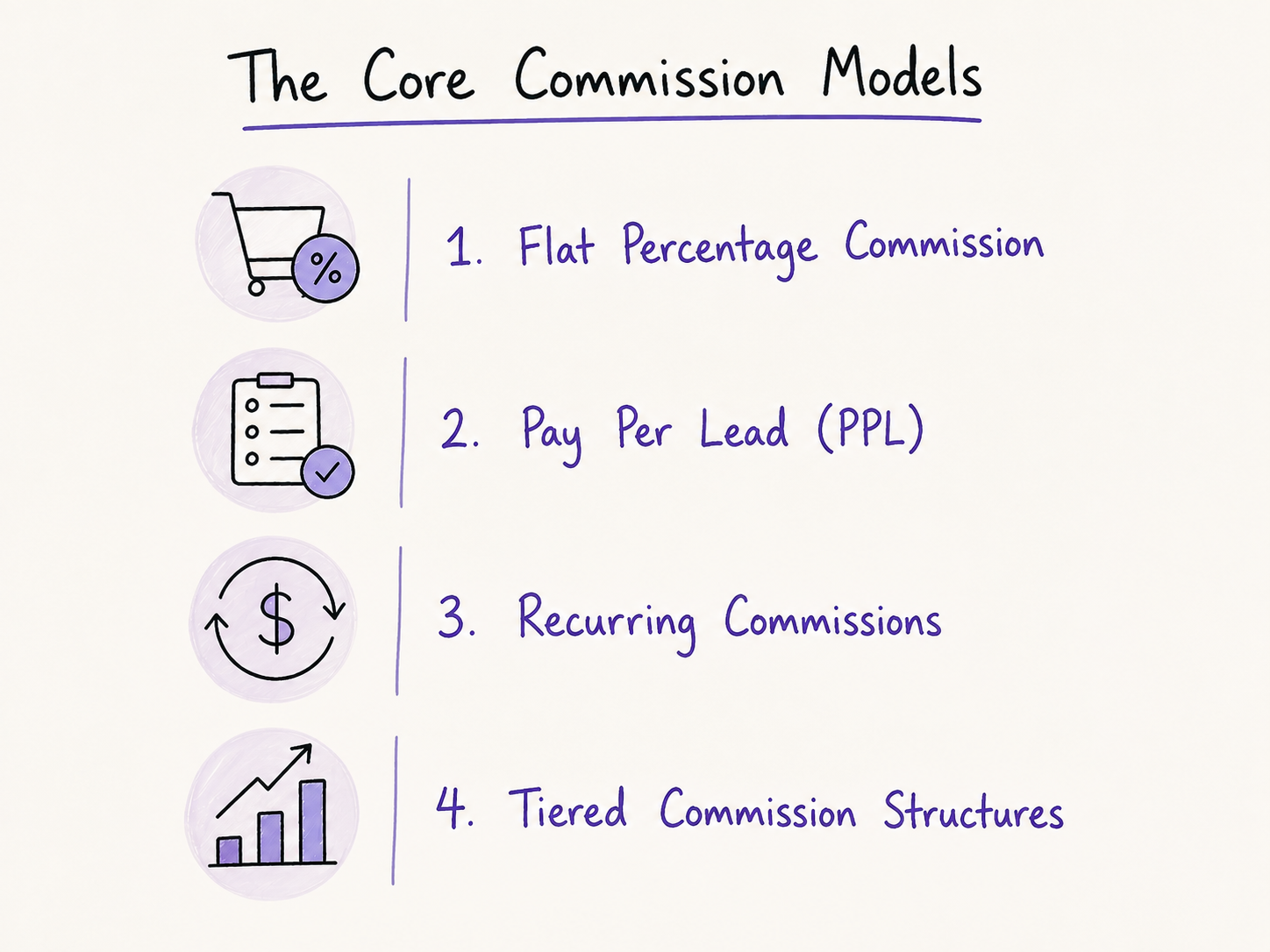
Flat Percentage Commission (Pay Per Sale)
This is the most common affiliate reward structure and the one almost every successful affiliate program starts with.
Pay-per-sale is the most common model, where affiliate partners earn a percentage of each sale or a flat fee per transaction. A practical starting point for e-commerce is 10 to 15% of the sale or a flat $10 to $15 for new-customer orders. The advantage is that you only pay affiliates when actual revenue is generated, making it a performance based incentive that aligns financial success for both the affiliate and the brand.
Flat percentage commissions are simple to communicate, easy for affiliates to calculate their expected earnings from each affiliate link, and widely understood across affiliate networks.
For most programs, this is the right baseline to motivate affiliates to start promoting.
The challenge is that flat commission structures are undifferentiated. They pay the same reward to a content creator who wrote a 2,000-word review that generates new customers, and to a coupon site that captured an existing customer at checkout. These two affiliates are not generating equivalent value for your business goals, and paying them identically sends the wrong signal about what your program prioritizes.
Category benchmarks for flat percentage commissions:
- E-commerce and DTC brands: 10 to 15%
- Beauty and skincare: 15 to 25%
- Health and supplements: 20 to 40%
- SaaS and software: 20 to 50% (often recurring)
- Finance and insurance: varies, often pay per lead
- B2B professional services: 10 to 30% or flat fee per qualified lead
Use flat percentage commissions as your baseline. Layer every other affiliate reward on top.
Pay Per Lead (PPL)
Pay per lead rewards affiliates for generating qualified actions short of a purchase: free trial signups, email subscriptions, quote requests, demo bookings, or form submissions.
This model is particularly relevant for:
- SaaS businesses with free trial or freemium models
- High-consideration B2B products with long sales cycles
- Financial and insurance products where the full sale happens offline
- Any product where a qualified lead has clear calculable value for business goals
The risk with PPL is lead quality. Without tight definitions of what constitutes a qualified lead, affiliates can generate volume that costs you money without producing revenue.
Define lead quality criteria explicitly in your program terms, track conversion rates from lead to customer by affiliate, and adjust or remove affiliates whose referred customer quality consistently underperforms.
Recurring Commissions
For subscription-based businesses, recurring commissions are one of the most powerful affiliate incentives available.
A recurring commission rewards affiliates with a percentage of every renewal payment for as long as the referred customer remains a subscriber. This transforms the incentive calculus completely.
An affiliate who refers a customer to a $49/month SaaS tool at a 20% recurring commission earns $9.80 every month that customer stays. After twelve months, that single referral has generated more affiliate payments than most one-time payouts. After twenty-four months, the reward becomes genuine passive income that requires zero additional effort.
The practical implications for your program:
- Affiliates in recurring commission programs are significantly more selective about the customers they refer, because a referred customer who churns quickly ends their income stream
- Affiliates stick with your program longer because leaving means forfeiting recurring rewards on past referrals
- Affiliates become genuine advocates for customer success, not just for customer acquisition
Lifetime commissions take this model even further, rewarding affiliates for the full customer lifetime regardless of renewal cycles. This is less common but highly effective for products with high retention and strong customer lifetime value.
If your product has a subscription component and you are not offering recurring commissions, you are making it consistently harder to motivate affiliates than competitors who do.
Tiered Commission Structures
Tiered rewards increase affiliate engagement by nearly 50% compared to flat commission structures, according to research data.
A tiered commission structure rewards affiliates at higher rates as they hit specific volume thresholds. The most common design looks like this:
- Tier 1 (baseline): 10% on all sales up to $1,000/month attributed revenue
- Tier 2 (growth): 13% on all sales from $1,001 to $5,000/month
- Tier 3 (performance): 17% on all sales above $5,000/month
The motivating effect of commission tiers comes from threshold psychology. An affiliate who is close to the next tier has a strong financial reason to push harder, promote more actively, or try new channels before the period resets.
This is particularly effective during launch windows or promotional periods where a targeted burst of affiliate activity has outsized value for driving most sales.
Raising commissions can boost affiliate participation by 20%, which makes commission tiers one of the highest-ROI changes you can make to incentivize affiliates who are already performing but not yet at their ceiling.
The tier structure also creates natural segmentation in your affiliate roster. Your super affiliates, the ones who consistently hit higher commission tiers, reveal themselves through the data. These are the affiliates who deserve more active relationship investment, exclusive opportunities, and bespoke rate conversations.
Beyond Base Commissions: Performance Incentives
Performance Bonuses
Performance bonuses are one-time or time-limited cash bonuses, prizes, or commission bumps you offer affiliates for hitting specific milestones during a promotion.
They are separate from your base commission rate and separate from commission tiers. They are designed to create a short burst of extra effort at exactly the moment you need it most.
The psychology is straightforward. Your affiliates have a dozen things competing for their attention. A standard commission reward is a background fact they already know. A bonus commission that expires in four days is a reason to open a promotional calendar and start creating content.
Raising commissions for underperforming affiliates has been shown to boost sales by 20%, which tells you how much untapped capacity exists in most programs when the right incentives are offered at the right moment.
Performance-based incentives work best in these formats:
Launch bonuses. A time-limited cash bonus for affiliates who drive their first successful referral within 30 days of joining. This solves one of the most persistent problems in affiliate programs: affiliates who join and never activate. A launch bonus creates urgency and gives new affiliates a concrete financial reward to prioritize your program immediately during the onboarding process.
Sales milestone bonuses. A one-time reward when an affiliate crosses a cumulative revenue threshold: a $5,000 sales milestone earns a $250 bonus commission. A $25,000 sales milestone earns $1,000. These bonus commissions reward longevity and benefit your top affiliates in a way that the standard reward structure does not.
Contest and leaderboard bonuses. A defined prize for the top one to three affiliates during a specific promotional window. These generate genuine competitive energy in your affiliate network, particularly effective during product launches, seasonal campaigns, or rebranding periods.
Performance bonuses and contests can create urgency to boost sales in a way that no passive reward can replicate.
The programs that get the most out of performance-based incentives layer all three: commission tiers as the baseline, contests for big launches, and bonus commissions deployed tactically throughout the year.
Milestone and Loyalty Rewards
Milestone rewards reward affiliates not just for volume but for longevity and sustained performance over time.
Common structures include:
- A one-year anniversary reward for affiliates who have been active in the program for 12 consecutive months
- An annual loyalty review where top performing affiliates are offered a bespoke commission increase
- Exclusive product access or early launch rights for affiliates who hit specific tenure milestones
These rewards address a problem that most affiliate programs ignore: they spend significant energy recruiting new affiliates and almost no energy keeping existing affiliates engaged.
Your most valuable affiliate is not the one you recruited last month. It is the one who has been generating consistent higher sales for the past two years. Milestone rewards acknowledge that value explicitly and help affiliates stick with your program long-term.
Non-Monetary Rewards for Affiliates
Creative rewards and non-cash incentives are consistently underused. Research shows that affiliates offered a mix of cash commissions and non-monetary rewards report higher satisfaction and longer program tenure than those on commission-only structures.
The most effective non-monetary rewards in 2026:
Free products and free samples. Provide affiliates with free products from your range so they can create authentic, first-hand content for their audience. Affiliates whose audience trusts their genuine experiences convert significantly better than those promoting something they have never used.
Free samples and free products in the onboarding process are also a small upfront investment that pays back in more authentic affiliate’s content. Product gifting allows your affiliates to capture their experience at different stages of their user journey, from unboxing to tutorials and reviews.

Branded merchandise. Branded merchandise strengthens the affiliate’s sense of identity with your brand and gives them something tangible to feature in their content. It is a creative reward that costs little but signals genuine partnership.
Exclusive product access and early launches. Affiliates who get products before the general public can create review content before competitors can. This early access reward is genuinely valuable for creator affiliates whose earnings depend on being first to their affiliate’s audience.
Coupon codes and custom promo codes. Custom promo codes improve conversion rates and make affiliates feel valued as genuine brand partners.
When an affiliate has their own coupon codes or custom promo codes, it deepens the sense of ownership over their affiliate link and their promotional relationship with your brand. Product-specific incentives like exclusive coupon codes can focus affiliate efforts on high-margin or priority items.
Dedicated account management. Most affiliates self-serve through a dashboard. Affiliates who have a named contact at the brand who responds quickly to questions and flags upcoming campaign opportunities are significantly more productive and less likely to leave. This is one of the most undervalued affiliate incentives available and requires only time, not budget.
Elevated reward rates for specific content types. Flat commission structures overpay bottom-funnel partners and underpay partners that create demand earlier in the affiliate’s audience journey. Offering a higher reward specifically for affiliates who produce long-form content, video reviews, or tutorial content rewards the affiliates who are building your brand at the top of the funnel, not just capturing demand at the bottom.
Co-marketing opportunities. Being featured in the brand’s own content, newsletter, or social media is genuinely valuable to growing affiliates. This two-sided incentive benefits both the affiliate (audience growth, credibility) and the brand (authentic content, reach into the affiliate’s audience). It is non-monetary for you and career-accelerating for them.
The Hybrid Model: Base Fee Plus Commission
For creator-led affiliate programs, the pure commission model has a significant structural problem: it fails to motivate affiliates to produce predictable content output.
Affiliates in a pure commission model will only post when they expect high conversion rates from their affiliate’s audience. This makes your content cadence unpredictable and makes affiliates reluctant to invest time in content whose conversion rates depend on factors outside their control: your landing page quality, offer pricing, competitor activity.
The hybrid model has become the default structure for brands that want predictable content without abandoning performance accountability. This two-sided incentive pairs a base fee with a 10 to 15% commission, plus commission tiers that affiliates unlock as they hit specific sales milestones.
The base fee solves the content unpredictability problem. Affiliates produce the agreed content because they are rewarded for producing it, not just for converting. The commission layer aligns their incentive with your revenue goals. The tiered reward creates upside that motivates effort beyond the minimum.
This structure is particularly important for affiliates in categories where conversion rates depend heavily on factors outside their control. For brands building creator-led affiliate programs from scratch, the hybrid model is almost always the right starting structure.
For mature programs with long-established affiliates and proven conversion rates, the balance can shift toward a higher commission share with a smaller base.
Common Affiliate Incentive Mistakes
Setting the reward structure once and never reviewing it. The market moves. A competitor launches a program with a higher cash commission in your category. Your product margins improve. New affiliate types emerge. Reward structures that are not reviewed annually become uncompetitive by default and fail to motivate affiliates who are tracking what competitors offer.
Using flat commission structures for every affiliate type. A coupon site that captures last-click attribution on existing customers and a content creator who introduces your brand to new customers are not generating equivalent value.
Paying them identically with flat commission structures undercompensates the creator and overcompensates the coupon site. Segment your affiliate rewards by type and by where in the customer journey the affiliate brings value to their affiliate’s audience.
Paying bonus commissions on total revenue rather than incremental revenue. A sales milestone bonus triggered by total attributed revenue can reward affiliates who are capturing existing demand rather than creating new customers.
Tie bonus commissions where possible to new customer rates or first-time buyer conversion, not just total commission volume. This is what makes your affiliate program incentives genuinely aligned with business goals.
Neglecting the onboarding process. Most affiliate programs provide affiliates with access to a dashboard and a commission rate and expect them to figure out the rest. A structured onboarding process that provides affiliates with creative assets, coupon codes, talking points, and a clear explanation of the reward structure motivates affiliates to activate faster and produce better content for their affiliate’s audience.
Overlooking the retention reward entirely. Most affiliate incentive conversations focus on recruitment and activation. Almost none focus on keeping existing affiliates engaged. If your top five affiliates left your program today, what would happen to your revenue? Building explicit milestone rewards and loyalty incentives for your top performing affiliates is one of the highest-ROI changes you can make to your program and one of the least-commonly made.
Making the reward structure opaque. Affiliates who cannot easily calculate what they will earn from each affiliate link will promote a competitor instead. Commission tiers, bonus commissions, and affiliate payments schedules should be presented clearly on your affiliate landing page and in your onboarding process.
Transparency about how affiliates earn is itself a competitive advantage in affiliate recruitment. For a detailed breakdown of what your affiliate program landing page should communicate, see our guide on referral landing page examples.
How to Review and Improve Your Current Reward Structure
If your affiliate program is already running and you suspect the affiliate program incentives are underperforming, here is the diagnostic process:
Step 1: Pull your active-to-approved affiliate ratio. If fewer than 20% of your approved affiliates have generated a sale in the past 90 days, your reward structure is likely failing to motivate affiliates to activate. The cash commission rate may be below category benchmarks, the program terms may be too restrictive, or the onboarding process may be leaving affiliates without the right tools to promote effectively.
Step 2: Calculate your reward distribution by affiliate type. What percentage of your affiliate payments go to content creators versus coupon sites versus loyalty platforms? If more than 60% of your affiliate rewards are concentrated in last-click coupon affiliates, your incentive structure is likely not competitive enough for content creator affiliates. Increasing creator reward rates while introducing incremental measurement for coupon-type affiliates can rebalance toward higher-quality new customers.
Step 3: Collect affiliate feedback from your top ten affiliates. Ask them directly: what would make you promote this program more? What is missing from the affiliate program incentives that would change your behavior? Affiliate feedback is the most direct and most consistently underused research available to affiliate program managers. The answers are almost always actionable and will help you choose attractive incentives that actually move the needle.
Step 4: Benchmark against two or three category competitors. Join a competitor’s affiliate program as a test affiliate. Review their cash commissions, bonus commission structure, onboarding process, and communication cadence. The gap between your reward structure and a competitor with strong recruitment is a direct indicator of how your program is perceived in the market.
At Vivian Agency, we build affiliate incentive structures that attract and retain the right partner types for each specific brand and category. If you want an honest assessment of whether your current reward structure is competitive, book a free call and we will walk through it.
Frequently Asked Questions
What are affiliate incentives and why do they matter?
Affiliate incentives are the rewards, cash commissions, bonus commissions, non-monetary rewards, and creative rewards you offer to motivate affiliates to promote your products actively and consistently. They matter because affiliates have choices. In most categories, your affiliates are simultaneously enrolled in multiple programs.
The right affiliate incentives determine whether affiliates prioritize your affiliate link over a competitor’s, whether they create their best content for your brand’s products, and whether they stick with your program long enough to generate exponential growth through compounding referrals.
Research shows that well-designed affiliate program incentives can increase affiliate participation by 20% and improve conversion rates significantly across the program.
What is a good affiliate commission rate in 2026?
It depends on your category and product margin. For e-commerce and DTC brands, 10 to 15% is the standard starting point for new-customer orders. Beauty and skincare programs typically offer 15 to 25%. Health and supplements give 20 to 40%. SaaS and software programs offer 20 to 50%, often on a recurring basis.
The right reward rate is the one that is competitive enough to attract and engage quality affiliates in your category while preserving enough margin to make the channel profitable. If you are unsure what is competitive in your specific category, see our guide on how to find affiliates for your brand for a breakdown of what successful affiliate programs are offering in 2026.
What non-monetary rewards work best for affiliates?
The most effective non-monetary rewards are free products and free samples (so affiliates can create authentic content for their audience), custom coupon codes and promo codes (which improve conversion rates and make affiliates feel valued), early access to new product launches, branded merchandise, and dedicated account management.
Research shows that affiliates offered a mix of cash commissions and non-monetary rewards report higher satisfaction and longer program tenure than those on commission-only structures. Non-cash creative rewards are also a small upfront investment relative to the improvement in affiliate engagement they generate.
For further reading on building affiliate programs that attract and retain the right partners, see our guides on how to find affiliates for your brand, how to set up an influencer affiliate program, affiliate contract compliance, what affiliate marketing reports to ask your agency for, and how long affiliate marketing takes to work.