Affiliate marketing compliance refers to the full set of legal requirements, disclosure requirements, and ethical practices your affiliate marketing programs must meet to protect consumers, maintain consumer trust, and stay on the right side of relevant laws across every market you operate in.
In 2024, the Federal Trade Commission cracked down on violations. The EU rolled out tougher digital rules, and new privacy laws took hold in several regions. Entering 2026, affiliate marketing compliance has moved from a legal footnote to a strategic priority, one that shapes whether your affiliate marketing programs can operate, scale, and survive regulatory scrutiny without exposing your brand’s reputation to legal action.
Civil penalties for FTC violations can reach up to $51,744 in 2026, with each non-compliant post counted separately. A single creator with 10 undisclosed affiliate posts risks fines exceeding $500,000. In 2025, a major brand settled for $4.2 million after multiple violations. Meanwhile, GDPR fines have surpassed €4.5 billion in total since 2018, and complaints filed with EU data protection authorities rose 34% year-over-year in 2025.
Whether you’re launching a new affiliate program or auditing an existing one, this checklist covers every compliance area brands need to manage in 2026, from FTC disclosure rules and GDPR data privacy requirements to contract obligations, fraud prevention, platform-specific rules, and ongoing monitoring.
Use it as both a launch checklist for new programs and an audit tool for programs already running.
Table of Contents
Overview
| Area | What It Covers | Key Risk if Missed |
| FTC Disclosure | Affiliate marketing disclosures: affiliate partners must clearly disclose commercial relationships to protect consumers | Fines up to $51,744 per violation |
| GDPR / Privacy Laws | Cookie consent, data processing, cross-border transfers | Fines up to €20M or 4% of global revenue |
| Program Terms & Contracts | Rules affiliates must follow, brand IP usage, prohibited tactics | Financial liability for affiliate misconduct |
| Fraud Prevention | Cookie stuffing, click fraud, coupon leaks, attribution theft | Commission losses, program integrity |
| Platform-Specific Rules | Instagram, TikTok, YouTube, Amazon disclosure requirements | Account bans, content removal, FTC referral |
| AI & Emerging Content | AI-generated endorsements, virtual influencers, UGC moderation | New FTC enforcement, reputational damage |
| Ongoing Monitoring | Content audits, affiliate performance reviews, contract updates | Accumulating violations, regulatory exposure |
Section 1: FTC Disclosure Compliance
The foundation of affiliate marketing compliance in the US is the Federal Trade Commission’s Endorsement Guides. Affiliate marketing compliance refers to a clear set of disclosure requirements that govern how affiliate partners, social media influencers, and brands must communicate commercial relationships in all affiliate marketing practices, from blog posts to live streams.
Brands and agencies are just as responsible as the affiliate partners they work with. To ensure compliance, you must build compliance expectations into your affiliate marketing programs from the start: educating affiliate partners on what constitutes proper disclosure, reviewing affiliate content before it goes live, and using monitoring tools to track whether honest marketing practices are being followed after publication.
FTC Disclosure Checklist
- [ ] Every affiliate has an agreed-upon contract that explicitly requires FTC-compliant disclosure on all content where affiliate links or commission relationships exist
- [ ] Disclosure language is provided — give affiliate partners specific pre-approved phrases such as “I earn commissions from purchases made through this link” rather than leaving them to improvise
- [ ] Disclosures appear before the fold — not buried in hashtags, footnotes, or below the “more” cut on Instagram. The FTC assesses disclosures based on whether a “reasonable consumer” would notice and understand them. If a significant number of people might miss the disclosure, it fails to meet the requirements
- [ ] Video content includes both verbal and on-screen disclosure — for YouTube, TikTok, and Instagram Reels, a text overlay alone is insufficient if it disappears before viewers process it
- [ ] Stories and ephemeral content are covered — disclosures in Stories must appear throughout the content, not just on the first frame
- [ ] Live streams include real-time verbal disclosure — the FTC’s 2026 updates expand disclosure rules to cover new formats like live streams and short-form video, with mandatory thumbnail disclosures now required in certain contexts
- [ ] Free products and gifted items are disclosed — any compensation, free products, or affiliate commissions require clear disclosure. If an affiliate posts about a product they received for free, disclosure is mandatory regardless of whether there was an explicit requirement to post
- [ ] Platform-native disclosure tools are used but not relied on exclusively — platform tools like Meta’s “Paid Partnership” or TikTok’s “creator earns commission” alone are typically not sufficient under FTC guidelines
- [ ] Affiliate program policies prohibit misleading claims — affiliate partners must only make claims about your products that are truthful, non-misleading, and supported by evidence. Advertisers are responsible for ensuring influencer claims are truthful and substantiated, including disclosure of typical results when atypical outcomes are shared
- [ ] AI-generated content is flagged and disclosed — the FTC makes clear that “virtual endorsers” are subject to the same rules as human endorsers. If AI is used to simulate endorsements, the FTC requires disclosure of any such material connection
- [ ] Correction process is documented — if a non-compliant post is discovered, your program has a clear process: contact the affiliate, add disclosure, and document the correction. Demonstrating good faith correction efforts helps your case if discovered by the FTC
- [ ] Affiliate managers are briefed on compliance requirements — the person managing your affiliate marketing programs day-to-day needs to understand FTC guidelines, disclosure requirements, and how to identify non-compliant affiliate content before it goes live. Compliance efforts shouldn’t sit with legal alone
Section 2: International Disclosure Requirements
FTC rules apply to US-facing content, but your affiliate partners likely reach audiences in other jurisdictions too. Each major market has its own disclosure framework.
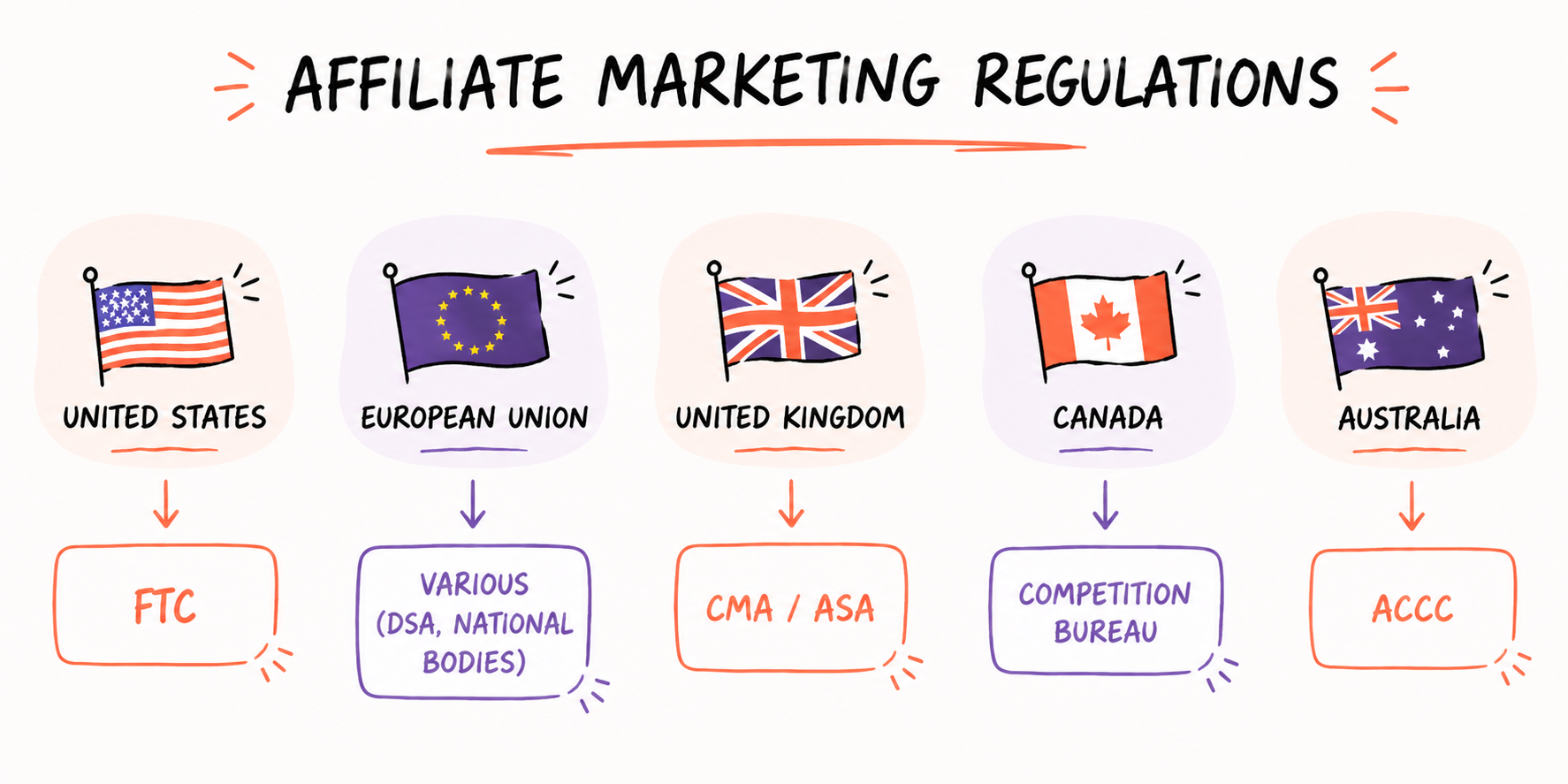
| Jurisdiction | Regulator | Key Requirement |
| United States | FTC | “Clear and conspicuous” disclosure of any material connection |
| European Union | Various (DSA, national bodies) | Paid partnerships must be clearly identified; DSA requires transparency in commercial content promotion |
| United Kingdom | CMA / ASA | Disclosures must be “unavoidable, understandable, and unambiguous” |
| Canada | Competition Bureau | Material connections must be disclosed clearly |
| Australia | ACCC | Sponsored content must be identifiable as advertising |
Maintaining compliance across multiple jurisdictions is one of the most complex aspects of running international affiliate marketing programs. Your compliance strategy must account for the fact that the same affiliate content — a single Instagram post, a YouTube review, a newsletter — may be subject to different legal requirements depending on where the viewer is located.
International Disclosure Checklist
- [ ] Identify which jurisdictions your affiliate partners operate in and ensure their disclosure standards meet the strictest applicable requirement
- [ ] UK affiliate partners follow CMA guidance — the CMA in 2026 is targeting influencer marketing and cross-border e-commerce, with new guidance focusing on affiliate activities in regulated sectors including finance and healthcare
- [ ] EU affiliate partners comply with the Digital Services Act — the DSA now requires more transparency in how commercial content is promoted and tighter moderation of affiliate ads
- [ ] Regulated categories have stricter requirements — health, wellness, supplements, finance, and insurance affiliate partners face additional substantiation and disclosure requirements in most jurisdictions. Your affiliate program policies should reflect this
- [ ] Default to the strictest standard — treat the strictest regulation (usually GDPR) as your baseline for everyone. It’s easier to over-comply in a lenient market than to get caught under-complying in a strict one
Section 3: Data Privacy and Cookie Compliance
The “Wild West” era of affiliate marketing is over. Third-party cookies — for years, the glue holding the affiliate ecosystem together — are dissolving. Browsers like Safari and Firefox blocked them years ago, and Chrome is introducing strict user controls that limit their reliability.
Affiliate marketing programs handle significant volumes of personal data through tracking pixels, click IDs, and conversion events. Data privacy compliance is now inseparable from affiliate compliance: how you handle user data responsibly, what data collection practices your affiliate partners use, and how you ensure compliance with data privacy regulations in every market you operate in all carry direct financial and reputational consequences.
Getting data privacy laws wrong puts your brand’s reputation and finances at risk regardless of how clean your affiliate marketing disclosures are.
GDPR / Privacy Compliance Checklist
- [ ] Cookie consent fires before tracking pixels — your affiliate conversion pixel must not fire until valid consent is captured. Use your Consent Management Platform (CMP) to gate it.
- [ ] Data Processing Agreements (DPAs) are signed with every affiliate partner — if affiliate partners touch conversion data, a signed DPA is required under GDPR. This is the most common data privacy gap in affiliate marketing programs. Unsigned = violation
- [ ] Privacy policy explicitly covers affiliate tracking — users must be informed that affiliate links set tracking cookies. Most privacy policies don’t specifically mention this
- [ ] Affiliate agreements include a data handling clause — specify what data affiliate partners can collect, retain, and use. Standard affiliate agreements typically don’t cover this adequately
- [ ] Data minimization is documented — collect only what you need for attribution: click ID and conversion event. Not browsing history, not device fingerprint
- [ ] Server-to-server (S2S) tracking is implemented or evaluated — S2S tracking recovers approximately 85% of measurement data lost to cookie blocking while being significantly cleaner from a data privacy standpoint under GDPR’s data minimization principle
- [ ] Cross-border data transfers are covered — if you’re US-based with EU affiliate traffic, data transfers must be covered by Standard Contractual Clauses (SCCs) or the EU-US Data Privacy Framework
- [ ] CCPA compliance is addressed — California’s CPRA raised intentional violation fines to $7,988 per incident. 19 US states now have their own full-scope privacy laws with requirements that overlap with and in some cases exceed GDPR’s consent requirements
- [ ] Google Consent Mode v2 is implemented if you manage Google Ads or Analytics for EEA and UK traffic — this became mandatory in 2026
- [ ] Data retention policies are defined — personal data collected through affiliate tracking must have automatic deletion schedules documented and enforced
- [ ] Audit logs are maintained — record all clicks, conversions, and postbacks with timestamps and source information, enabling fraud investigation and demonstrating compliance to regulators
- [ ] Customer data handling is documented and communicated to affiliate partners — affiliate partners who collect any customer data through their own platforms must understand what they’re permitted to collect, store, and use under data privacy regulations. This should be explicit in your affiliate program policies — not left to assumption
Section 4: Affiliate Program Terms and Contracts
Your affiliate program policies and agreements are the legal foundation of your affiliate compliance framework. A strong compliance program doesn’t just protect you after something goes wrong. It prevents unethical affiliates from damaging your brand’s reputation in the first place.
Affiliate marketing compliance at the contract level means setting clear compliance expectations before any affiliate partners start promoting, so non-compliance is addressed before it becomes a legal issue rather than after.
The FTC makes clear that companies cannot avoid liability for unfair and deceptive marketing practices by relying on affiliate marketers instead of conducting marketing in-house. Your contract needs to do more than protect you. It needs to actively prevent compliance failures from happening.
Contract Compliance Checklist
- [ ] FTC disclosure obligations are explicitly stated — the contract must require affiliate partners to disclose material connections on every piece of affiliate content that includes affiliate links or promotes your brand
- [ ] Misleading ads and misleading claims are explicitly prohibited — your affiliate program policies must state clearly that affiliate partners cannot make false or unsubstantiated claims about your products in their marketing materials, affiliate content, or any other marketing efforts. Misleading ads damage consumer trust and expose both the affiliate’s reputation and your brand’s reputation to regulatory action and legal action
- [ ] Prohibited promotional tactics are listed clearly, including:
- Coupon code sharing beyond intended channels (coupon leaks)
- Bidding on your brand keywords in paid search (trademark bidding)
- Cookie stuffing or any form of attribution manipulation
- Making unsubstantiated product claims
- Using unauthorized brand assets or modified logos
- [ ] Payment schedules are clearly defined — affiliate partners should know exactly when and how they’ll be paid. Vague payment schedules create disputes and erode customer loyalty to your program. Specify the payment cycle, minimum threshold, and method in your affiliate program policies
- [ ] Commission clawback provisions are included — if a sale is reversed, if fraud is detected, or if a compliance violation is discovered, your contract should allow commission recovery
- [ ] Usage rights for brand assets are defined — trademarks must be used with permission and within guidelines. Copyrighted content needs proper licenses. User-generated content requires clear rights agreements
- [ ] Termination clauses cover compliance violations — you need the ability to immediately terminate an affiliate relationship if they violate disclosure rules, make false claims, or engage in fraudulent activity
- [ ] Indemnification clause is included — affiliate partners should indemnify you for losses resulting from their violations of the agreement, applicable laws, or third-party rights
- [ ] Governing law and jurisdiction are specified — particularly important for international programs
- [ ] Affiliate partners must re-accept terms when updated — when updating terms for 2026, require all affiliate partners to re-accept the new policies in your affiliate portal to ensure their legal consent is current
- [ ] GDPR data handling obligations are built into the contract — don’t rely on a separate DPA alone; the main affiliate agreement should reference data privacy obligations explicitly
- [ ] Compliance requirements are communicated at onboarding — don’t assume affiliate partners will read the full agreement. Affiliate managers should walk new affiliate partners through key compliance expectations — disclosure requirements, prohibited marketing practices, content approval processes, and payment schedules — before they publish any affiliate content
For a deeper breakdown of what to include in affiliate program terms, see our post on affiliate contract compliance.

Section 5: Fraud Prevention
With the affiliate marketing industry expected to hit $27.78 billion by 2027, it’s alarming that 20% of traffic is fraudulent. In 2023 alone, affiliate fraud drained marketers of over $84 billion worldwide, accounting for more than 22% of all digital ad spending. 58% of merchants report direct experiences with affiliate fraud.
Affiliate compliance isn’t just a financial problem — paying commissions to unethical affiliates on fraudulent activity means your affiliate marketing programs are rewarding deception, which creates compliance risk alongside direct financial losses. Affiliate policy monitoring and fraud detection are inseparable from maintaining a compliant, legitimate affiliates-only program that protects your brand’s reputation and consumer trust.
Fraud Prevention Checklist
- [ ] Cookie stuffing detection is enabled — cookie stuffing is where fraudsters sneak tracking cookies onto a user’s browser using hidden scripts or iframes, allowing them to claim unearned commissions. Most affiliate platforms have this built in — verify it is active
- [ ] Click fraud monitoring is running — automated scripts generating fake clicks inflate your cost-per-click metrics and commission payouts without any genuine traffic. IP risk scoring and device fingerprinting are effective countermeasures
- [ ] Attribution theft safeguards are in place — attribution theft hijacks the buying process by replacing a legitimate affiliate’s last-click cookie. Server-to-server tracking significantly reduces this risk
- [ ] Coupon leak alerts are configured — your affiliate platform should flag when a coupon code is being used at volumes inconsistent with the affiliate’s typical traffic. A code appearing on deal sites it was never intended for is a clear signal
- [ ] Trademark bidding is monitored — run regular searches for your brand name in Google and Bing to check whether any affiliate partners are bidding on your brand keywords in paid search, which is typically prohibited and distorts your paid search economics
- [ ] Reversal rate is tracked by affiliate partner — a high reversal rate (sales that are later refunded or cancelled) from a specific affiliate partner can indicate incentivized purchases, loyalty program abuse, or outright fraud
- [ ] New affiliate onboarding includes vetting — review the affiliate’s website, content quality, audience authenticity, and promotional methods before approving their application. See our guide on how to find affiliates for a full vetting methodology
- [ ] Geo-targeting checks are run — fraudsters often use “reverse IP-geo-targeting” to hide their activities from your location. Combat this by using proxy servers or VPNs to view affiliate ads from different regions
- [ ] Fraud thresholds trigger automatic review — set rules in your affiliate platform that flag any affiliate partner whose metrics spike abnormally (traffic surge, click rate spike, or conversion rate outlier) for manual review before commission payment
- [ ] Automated tools are configured to monitor affiliate activities — manual review doesn’t scale. Use automated tools and monitoring tools within your affiliate management platform to track affiliate activities, flag anomalies, and enforce compliance across your full network of affiliate partners without requiring a human to check every piece of affiliate content
- [ ] Brand monitoring software is in place to catch affiliate policy violations — tools like BrandVerity and its alternatives scan paid search ads, websites, and social platforms to detect trademark bidding, unauthorized brand asset usage, and other affiliate policy breaches in real time. For a full breakdown of what’s available, see our guide to BrandVerity alternatives for affiliate policy monitoring — it covers TUNE, Impact, Partnerize, LinkTrust, and CAKE side-by-side so you can identify the right tool for your program’s scale and compliance needs
- [ ] Compliance violations trigger a defined response — when your monitoring tools flag a compliance violation, your affiliate managers need a documented process: warn, remediate, or terminate based on severity. Unethical affiliates who repeat compliance violations should be removed from your affiliate networks
Section 6: Platform-Specific Compliance
Each major social media and content platform has its own disclosure requirements that overlap with but aren’t identical to FTC guidelines.
Affiliate marketing disclosures on Instagram look different from those on YouTube, and affiliate links in a newsletter are treated differently from affiliate links in a TikTok caption. Your affiliate partners — especially social media influencers — need platform-specific guidance as part of their compliance expectations, not just general FTC disclosure rules.
| Platform | Key Requirement | Common Failure |
| Disclosure must appear before the “more” cut in captions | Disclosure buried in hashtags at end of caption | |
| TikTok | Verbal + on-screen disclosure in video; “Branded Content” toggle | Toggle used without verbal disclosure in video |
| YouTube | Paid promotion checkbox in settings + verbal disclosure | Checkbox ticked but no verbal mention in video |
| Amazon | Paid promotion box in video settings; storefront disclosure | No disclosure on Amazon Live streams |
| Blogs / Websites | Disclosure at top of article, near affiliate links | Disclosure in footer only |
| Newsletters | Disclosure in the email body near affiliate links | Disclosure only on linked page |
| Podcasts | Verbal disclosure within the episode | Disclosure only on the linked page |
Platform Compliance Checklist
- [ ] Instagram: Disclosure appears before the “more” cut. “Paid partnership” tag is used but not relied on exclusively as the sole disclosure
- [ ] TikTok: Both verbal (“this is a paid partnership”) and on-screen text disclosure appear in the video. TikTok’s “Branded Content” toggle is enabled. For TikTok Shop affiliate links, creators explicitly state they earn a commission
- [ ] YouTube: The paid promotion checkbox is checked in video settings. A verbal disclosure appears in the first 30 seconds of the video. The video description includes a written disclosure near affiliate links
- [ ] Amazon Creator Connections / Amazon Live: Creators disclose their affiliate relationship at the start of live streams and in storefront bios
- [ ] Blog and website content: Disclosure appears at the top of each article containing affiliate links — not in the footer, not at the bottom of a long post
- [ ] Email newsletters: Disclosure appears in the email body before or immediately adjacent to affiliate links
- [ ] Podcasts: A verbal disclosure is included in the episode itself, not just the show notes
Section 7: AI and Emerging Content Compliance
This is the fastest-evolving area of affiliate marketing compliance in 2026. Affiliate marketing practices involving AI-generated content, virtual influencers, and automated endorsements sit in a regulatory gray zone — but one that relevant laws and the Federal Trade Commission are rapidly moving to formalize. Maintaining compliance in this area requires affiliate managers to stay ahead of emerging rules rather than waiting for enforcement to clarify them.
AI-powered compliance tools now scan affiliate content for missing disclosures, false claims, fraudulent activities, and brand violations at scale. But AI also creates new issues — labeling AI-generated content and addressing privacy risks in AI-driven targeting — and new AI disclosure rules are expected to appear in major markets through 2026.
AI Compliance Checklist
- [ ] AI-generated affiliate content is disclosed — if an affiliate uses AI to write reviews, generate images, or produce content that promotes your products, the AI-generated nature must be disclosed alongside the commercial relationship. For AI-generated content, always include a transparent disclosure that clarifies the virtual or AI nature of the endorsement, such as “Virtual character. #ad”
- [ ] AI-generated testimonials or “typical results” claims are substantiated — AI tools can generate plausible-sounding but entirely fabricated product experiences. Your affiliate program policies must explicitly prohibit unsubstantiated AI-generated claims
- [ ] Synthetic influencer partnerships are disclosed — if you work with a virtual or AI-generated influencer persona, the non-human nature of the endorser must be disclosed. The FTC has signaled that virtual endorsers are subject to the same disclosure standards as human ones
- [ ] AI content monitoring is implemented — consider implementing automated scanning rather than relying solely on manual review as your affiliate network grows. This is especially important for affiliate marketing programs with large numbers of active affiliate partners producing high volumes of affiliate content
- [ ] UGC produced by affiliate partners is moderated before being repurposed — when affiliate partners produce user-generated content that you plan to repost, feature in ads, or use in Amazon product listings, that content must be reviewed for compliance before it carries your brand’s name. Unmoderated UGC can expose you to copyright infringement, false advertising claims, and platform violations. Our guide on why content moderation matters for user-generated campaigns covers the risks of leaving UGC unmoderated — including campaign hijacking, disinformation spread, and legal liability — and the moderation practices that prevent them
- [ ] Amazon’s automated moderation requirements are understood — Amazon flags unverified medical claims, AI-generated misinformation, and deceptive “before/after” visuals. Affiliate partners promoting your products on Amazon must be briefed on these specific restrictions
Section 8: Ongoing Compliance Monitoring
Affiliate compliance isn’t a launch task; it’s an ongoing operational discipline. Affiliate marketing compliance requires regularly reviewing affiliate activities, updating affiliate program policies as relevant laws evolve, and using monitoring tools to track affiliate activities and monitor compliance in real time. The brands with the healthiest affiliate marketing programs in 2026 treat compliance monitoring as a core part of performance marketing, not a separate legal function.
Brands must require compliance clauses in contracts, including correction rights, monitor posts in real time rather than after campaigns end, ensure disclosures are visible across formats, and review how AI tools are used in content creation.
Ongoing Monitoring Checklist
Monthly:
- [ ] Run a sample audit of 10–20 pieces of affiliate content across your top performers — check disclosure placement, claim accuracy, and brand guideline adherence
- [ ] Review your affiliate dashboard for fraud signals: reversal rate spikes, traffic anomalies, coupon code usage patterns
- [ ] Check for trademark bidding violations on Google and Bing
- [ ] Verify cookie consent is functioning correctly on your site and that tracking pixels aren’t firing before consent is captured
- [ ] Monitor affiliate activities for new compliance risks — check whether any affiliate partners have changed their content format, started operating in new markets, or shifted their marketing practices in ways that affect your compliance requirements
Quarterly:
- [ ] Full affiliate partner performance review — identify underperformers, reward top performers, and flag any compliance concerns
- [ ] Review your affiliate program policies for regulatory changes and update as needed
- [ ] Audit your DPAs and privacy policy to ensure they still accurately reflect your data practices
- [ ] Brief active affiliate partners on any regulatory updates relevant to their markets
- [ ] Review affiliate program policies for alignment with current legal requirements — data privacy regulations, FTC guidelines, and platform-specific disclosure requirements all evolve. Your affiliate program policies should regularly review and reflect the legal requirements of every jurisdiction where your affiliate partners operate
- [ ] Audit your affiliate management platform to ensure monitoring tools, fraud detection, and data collection practices still meet data privacy compliance requirements
Annually:
- [ ] Full compliance audit across all program areas — FTC disclosure, GDPR data practices, contract terms, fraud prevention, and platform-specific requirements
- [ ] Require all active affiliate partners to re-accept updated program terms
- [ ] Review your affiliate agreement with legal counsel, particularly if you’ve expanded into new markets or categories
- [ ] Assess whether your tracking infrastructure (S2S vs cookie-based) still meets current privacy requirements
- [ ] Audit your affiliate contracts against our full compliance checklist — our dedicated guide to affiliate contract compliance covers every clause brands should include in affiliate agreements: FTC disclosure obligations, prohibited tactics, clawback provisions, data handling requirements, IP usage rights, and termination conditions. Use it annually to verify your contracts reflect current legal requirements and platform rules
Running an affiliate program and not sure if it’s compliant?
Take our quick quiz and get a personalized assessment of your program’s compliance posture, along with recommendations based on your category, markets, and affiliate mix.
The Brand’s Liability: Why You Can’t Delegate Compliance to Affiliate Partners

One of the most common mistakes brands make in affiliate marketing is treating affiliate compliance as the affiliate partner’s sole responsibility. Affiliate marketing compliance is a shared legal obligation — and the Federal Trade Commission makes that unambiguously clear.
The FTC makes clear that companies cannot avoid liability for unfair and deceptive marketing practices by relying on affiliate marketers instead of conducting marketing in-house. Companies can face liability — and have faced liability — for their affiliate marketers’ mistakes.
In 2025, the FTC made it clear: brands and agencies are just as responsible as the affiliate partners they work with. If a mistake is made, it’s the brand’s job to take immediate corrective action — whether by having the affiliate update a caption, issue a clarification, or remove the content entirely. Brands that fail to show due diligence can be held liable, even if they weren’t directly involved in the content creation.
The practical implication is that compliance has to be built into your program infrastructure — not bolted on after a regulatory flag. That means:
- Pre-campaign briefing documents that explain disclosure requirements to every affiliate partner before any affiliate content goes live
- Content approval workflows that include a compliance monitoring check before publication
- Real-time transaction monitoring tools rather than post-campaign audits
- A documented correction process with evidence of corrective action taken
- An affiliate management platform with built-in monitoring tools that track affiliate activities, flag misleading ads, and surface compliance violations before they compound into legal issues or regulatory action
DIY Compliance vs. Managed Program Support
In-house, managing affiliate marketing compliance well is possible for programs with a small number of legitimate affiliates operating in a single market. But as your network of affiliate partners grows — more markets, more content formats, more data privacy regulations to navigate — the compliance risk compounds faster than most in-house affiliate managers can track.
Leverage automated tools to catch violations like trademark bidding, cookie stuffing, and link cloaking. And for affiliate marketing programs managing international affiliate relationships across regulated categories, consider whether specialist support — through dedicated monitoring tools, an affiliate management platform, or an experienced affiliate marketing agency — is the more efficient way to maintain compliance and protect your brand’s reputation long-term.
Vivian Agency builds and manages affiliate programs with compliance built into every stage of the process — from contract templates and affiliate briefing documents, to content review workflows and ongoing monitoring. Our programs are structured to protect the brands we work with, not just drive revenue. See what that looks like across different categories in our case studies, or book a free call to discuss what your program’s compliance posture needs.
Ready to build a compliant affiliate program from the ground up?
Our team handles the full process — from contracts and briefing to ongoing monitoring. Book a free call → and let’s talk about what a properly structured program looks like for your brand.
FAQs
Who is legally responsible for affiliate marketing compliance — the brand or the affiliate?
Both. The FTC makes clear that companies cannot avoid liability for their affiliate marketers’ mistakes. Companies can face liability even when they contractually engage independent third-party marketers to promote their products.
Joint liability means that when an affiliate partner fails to disclose properly or makes a false claim, the brand that benefits from the promotion can be held equally accountable. This is why affiliate managers need to treat compliance monitoring as a core operational function — not a reactive one.
Every affiliate marketing program needs built-in compliance efforts to ensure compliance across all affiliate partners, regardless of how good their affiliate agreements look on paper.
What exactly does “clear and conspicuous” disclosure mean under FTC rules?
Disclosures must be easily noticeable and understandable to the average person. They should not be hidden or difficult to find, must use straightforward language that a typical consumer can easily understand, and should stand out using adequate size, color contrast, and placement near the relevant content.
The FTC assesses disclosures based on whether a “reasonable consumer” would notice and understand them — if a significant number of people might miss the disclosure, it fails to meet the compliance requirements.
Do affiliate cookies require GDPR consent?
Most affiliate cookies do require consent under GDPR and the ePrivacy Directive. The only exception is if an affiliate cookie directly enables a transaction specifically requested by a user — such as a cashback or loyalty program — in which case it may qualify as strictly necessary.
For standard affiliate links, explicit consent is required before the tracking cookie is placed. This is one of the most commonly missed legal requirements in affiliate marketing programs operating in the EU.
What are the most common affiliate fraud tactics brands should watch for?
Cookie stuffing — where fraudsters sneak tracking cookies onto users’ browsers using hidden scripts or iframes — is the most widespread. Attribution theft hijacks the buying process by replacing a legitimate affiliate’s last-click cookie. Click fraud uses bots or automated scripts to generate fake clicks. Coupon leaks occur when affiliate partners share discount codes publicly beyond their intended audience.
All of these result in paying commissions on sales that weren’t genuinely driven by the affiliate partner’s promotional effort — making fraud prevention a core part of affiliate compliance.
For further reading on building and protecting your affiliate program, see our guides on how to set up an influencer affiliate program, how to find affiliates for your brand, how to reach out to affiliates, affiliate marketing vs referral marketing, BrandVerity alternatives for affiliate policy monitoring, and why content moderation matters for user-generated campaigns.