
An influencer deal carries two prices. The first covers making the post. The second covers everything a brand does with that post afterwards. And this second price is where most negotiations fall apart.
US creator ad spend was projected to reach $37 billion in 2025 , a 26% year-over-year increase, according to the Interactive Advertising Bureau. A growing share of that money buys distribution rights rather than filming days.
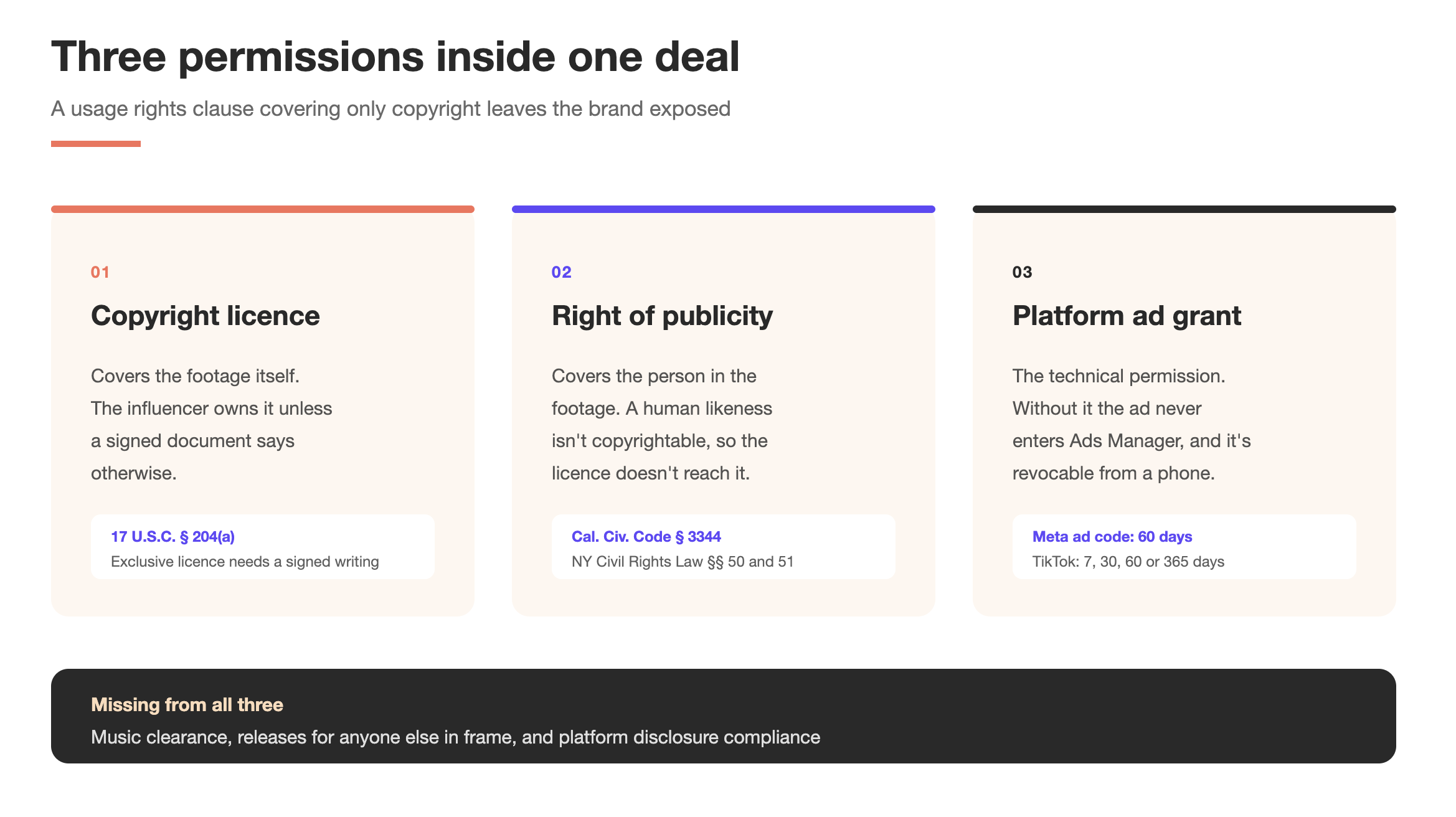
Three things change hands in these deals: the copyright licence, the likeness consent, and the platform-level ad permission.
Table of Contents
What Influencer Whitelisting Is
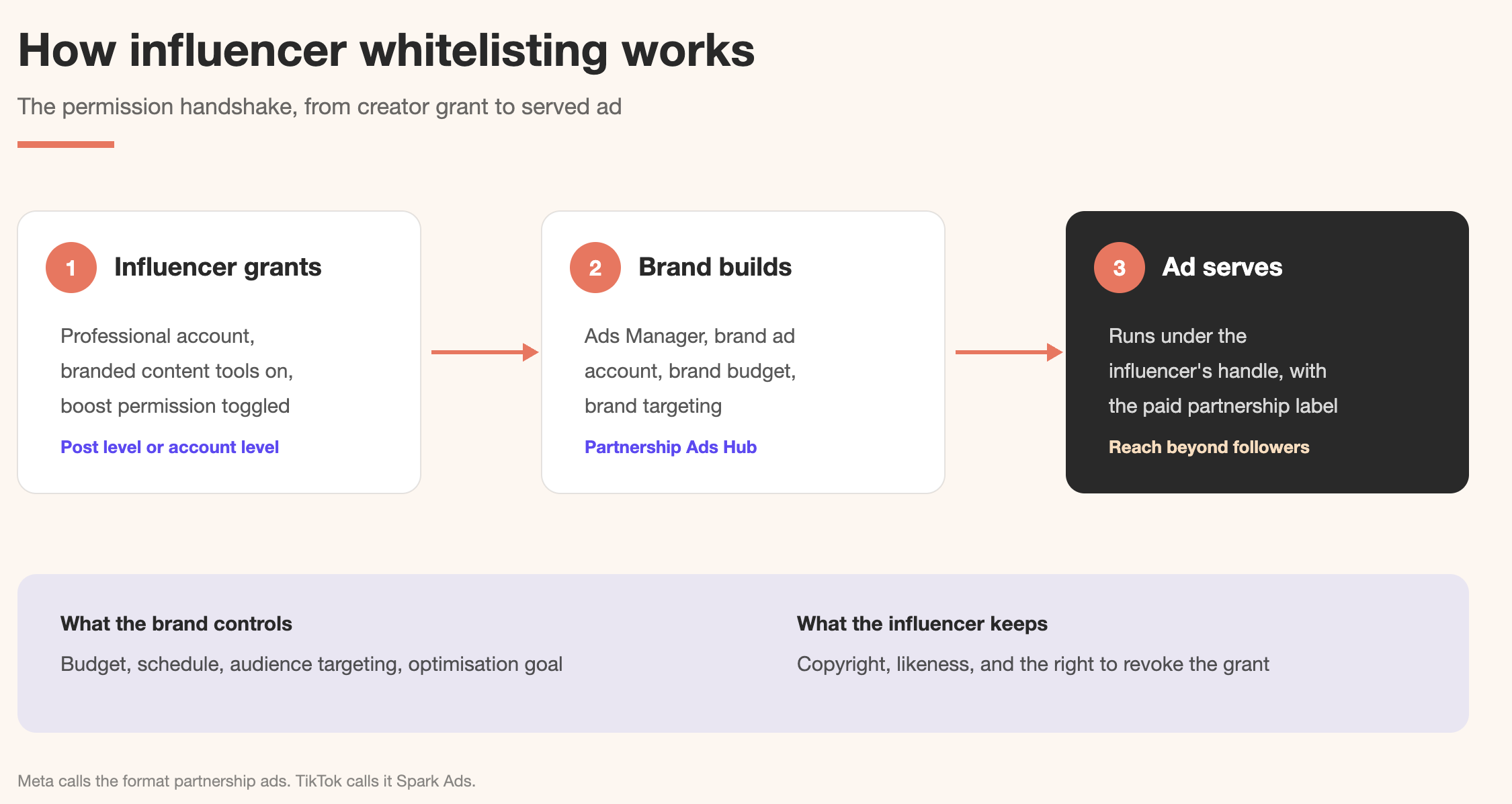
Influencer whitelisting is a permission grant that lets a brand run paid ads using the influencer’s content, served from the influencer’s account. Viewers see the influencer’s handle as the sender. The brand sets the budget, the targeting, and the optimisation goal.
Meta calls its version partnership ads, renamed from branded content ads in 2022; TikTok calls its product Spark Ads. The commercial arrangement is the same on both social media platforms: the influencer hands over advertising access, and the brand pays for it separately from the content fee.
Whitelisting influencers extracts more value from one asset than sponsored posts alone. The organic version reaches followers on social media; the whitelisted version reaches a larger audience, giving brands targeting controls they lose on organic.
What Whitelisting Changes about Distribution
Whitelisting extends the life and reach of influencer content beyond the initial posts. The same file in an ad account runs as long as the authorisation holds.
It also allows precise targeting of ads to relevant audiences: interests, geographies, and lookalike audiences the brand picks.
Ads running under an individual’s handle post higher click-through rates and return on ad spend than brand-produced creative, because ads using influencer content feel more authentic to viewers. Meta reported 19% lower CPAs and 13% higher CTR from partnership ads, in sales intelligence data shared with Marketing Dive in December 2025.
How the Permission Handshake Works on Meta
Three things must be true before a partnership ad runs. The influencer needs a professional account with branded content tools switched on, the brand needs that account approved for tagging, and the influencer has to grant boost permission on the specific post or at account level.
Influencers grant post-level permission by toggling “Allow brand partner to boost” under the paid partnership label. Account-level access runs through the Partnership Ads Hub in Meta Ads Manager, inside the brand’s business manager, and it’s broader than most influencers realise. Account-level access also lets the brand create ads from the influencer’s handle using material the influencer never posted.
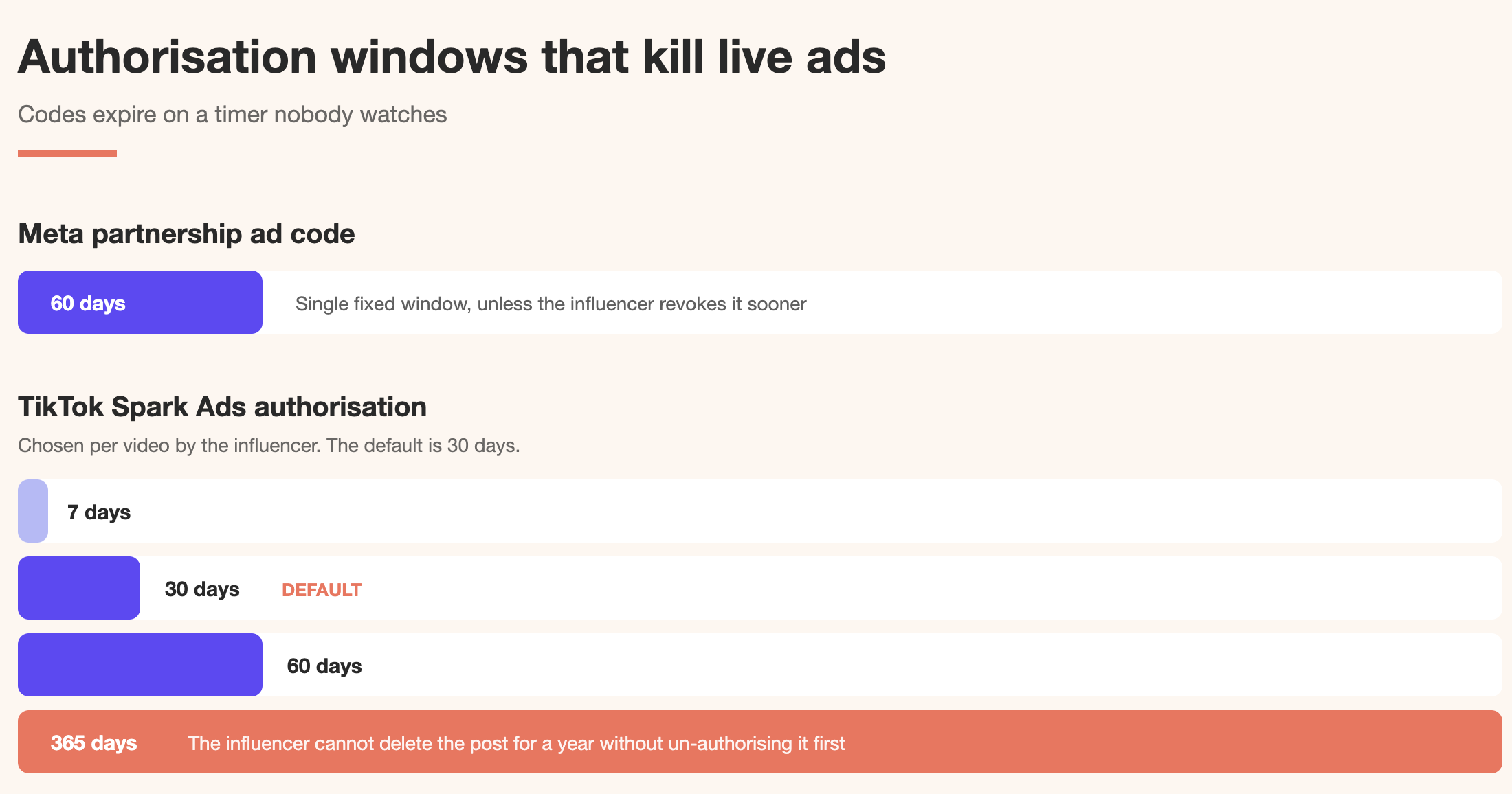
Ad codes are the third route. An influencer shares a code generated in their professional dashboard, and the brand enters it in its ad account. Billo’s creator documentation puts the validity window at 60 days unless the influencer revokes it sooner, and brands that find influencers through Creator Marketplace can handle discovery and permissions in the same place.
How Spark Ads Work on TikTok
TikTok’s flow runs through a per-video authorisation code. The influencer opens the video, taps the three dots, enables ad authorisation, and picks a duration. The options are 7, 30, 60, or 365 days, with 30 days as the default.
TikTok’s own documentation, last updated June 2026, adds limits worth knowing before you plan influencer whitelisting campaigns. Sparked videos cap at 10 minutes. Each TikTok ad account supports a maximum of 10,000 Spark Ads. A video has to be un-authorised before the influencer can delete it from their organic account.
That last rule matters more than it sounds. A 365-day authorisation means the influencer can’t remove that post for a year without coordinating with the brand first.
Whitelisting Compared with Content Licensing
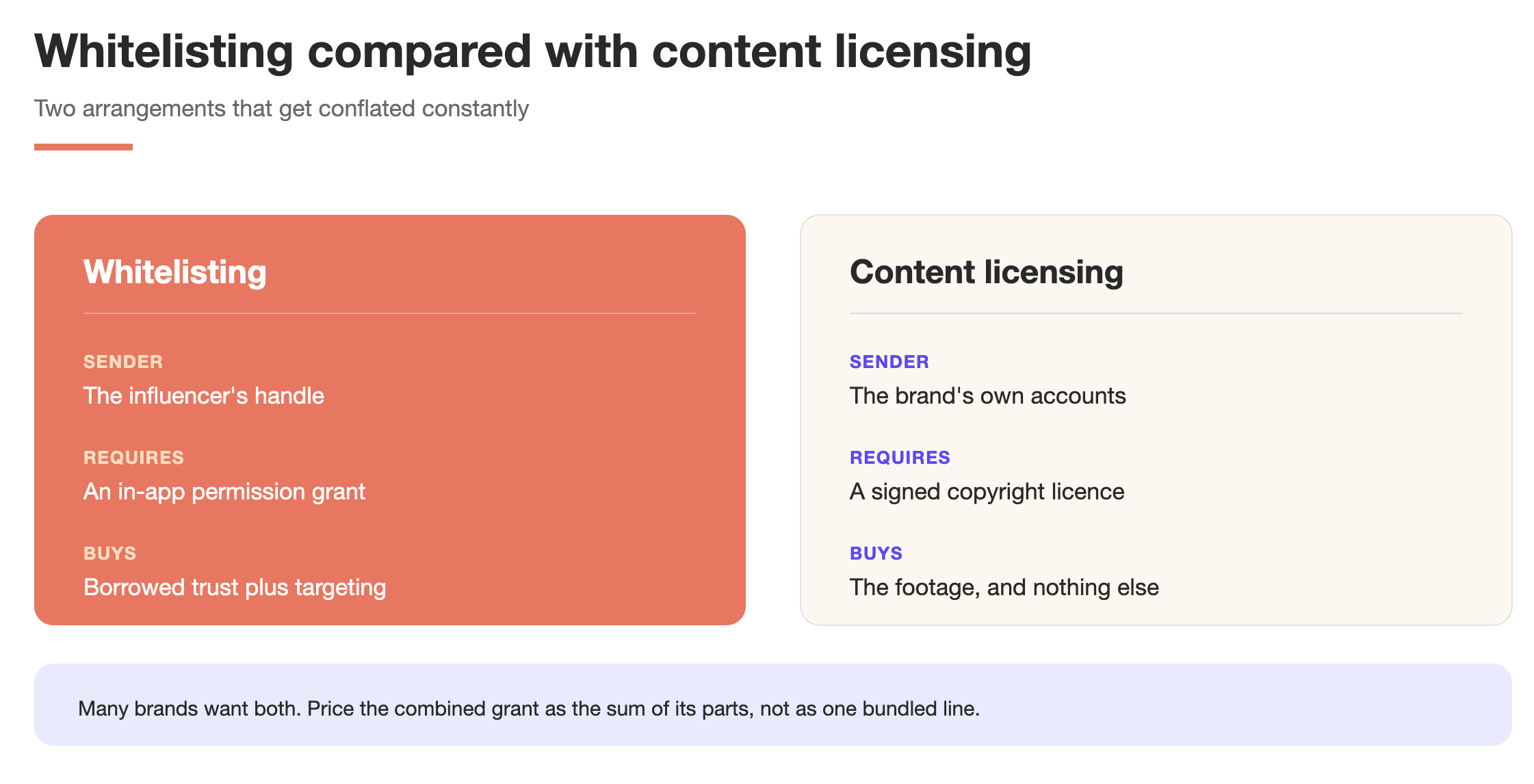
Two arrangements get conflated. Whitelisting puts the ad under the influencer’s handle; content licensing lets the brand run the same footage from its own accounts, with no influencer handle attached.
Many brands want both, and the combined grant should be priced as the sum of its parts rather than folded into one line. Either route produces more authentic ads than studio creative, because the footage started as authentic content shot by someone with an audience.
Usage Rights, Defined by What They Permit
Influencer content usage rights define where, how, and for how long a brand can use the influencer’s content. They’re a spectrum rather than a switch, and the gap between the cheapest and the most expensive tier is wide.
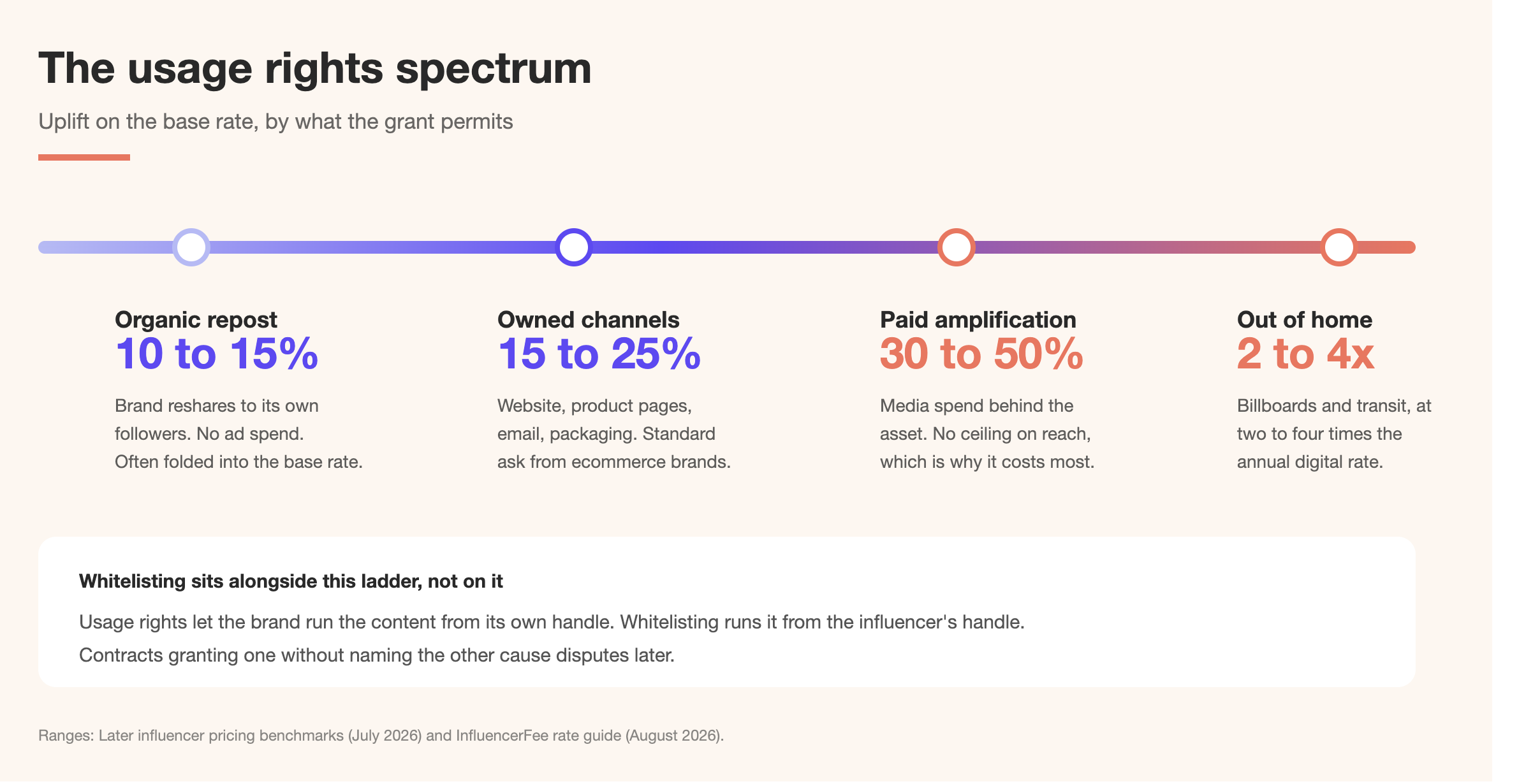
Brands typically negotiate three types of usage rights: organic reposting, owned channels, and paid amplification. Each carries different commercial value because each reaches a different number of people.
Organic Usage Rights
Organic usage rights let the brand reshare the influencer’s content as social media posts on its own accounts, with no ad spend behind it. The audience is the brand’s existing followers. Commercial value is low, and many influencers fold this into the base rate or charge 10% to 15%.
Charging for organic usage hinges on reach asymmetry. An influencer with 8,000 followers, reposted by a brand with 400,000, is getting exposure back.
Paid Usage Rights
Paid usage rights let the brand put media spend behind the material. Paid distribution has no ceiling, which is why this tier costs the most: a single Reel can be served to millions of people the influencer has never reached.
Paid usage covers the brand running ads from its own handle. Whitelisting covers the brand running ads from the influencer’s handle. Contracts that grant one without naming the other cause disputes later.
Content Usage Rights on Owned Channels
Owned-channel rights let the brand place the influencer’s content on the website, product pages, email, and packaging. InfluencerFee’s August 2026 rate guide puts this tier at 15% to 25% above the base rate for a set period, and calls it a standard request from ecommerce brands building social proof on product detail pages.
Out-of-home and broadcast sit far above that: two to four times the annual digital rate for any billboard or transit placement, per the same guide.
UGC Usage Rights and How They Differ
UGC creators produce authentic content built for ad use, which the brand runs itself. This creator content never appears on the maker’s own feed, so there’s no organic post, no influencer handle on the ad, and no audience being borrowed.
Influencer whitelisting bundles the organic endorsement with the advertising grant, so UGC usage rights cost less for similar production effort.
The Three Separate Permissions Inside One Deal
A clause covering only copyright leaves the brand exposed. Three permissions are in play, governed by different bodies of law.
The Copyright Licence
The influencer owns the copyright in the content created unless a signed document says otherwise. Under 17 U.S.C. § 204(a), any transfer of copyright ownership, including an exclusive licence, is invalid unless it’s in writing and signed by the rights holder.
A verbal agreement or a DM thread grants a non-exclusive licence at best. Running content beyond the scope of what was granted is copyright infringement, not a contract dispute, and the remedies differ.
The Right of Publicity
Copyright covers the footage. It doesn’t cover the person in it. California Civil Code § 3344 creates a cause of action for anyone whose name, voice, signature, photograph, or likeness is used for advertising without prior consent.
New York goes further. Civil Rights Law § 50 makes using a living person’s name, portrait, picture, likeness, or voice for advertising without written consent a misdemeanor, and § 51 gives a civil remedy. A human likeness isn’t copyrightable, so a copyright licence alone doesn’t reach it.
The Platform-Level Ad Permission
The third permission is technical. Neither the copyright licence nor the likeness consent puts an ad into Ads Manager; that requires the in-app grant, which the influencer can revoke at any time from their phone.
Treat the platform grant as a deliverable with a deadline. It controls the brand’s ability to launch on schedule.
What the Licence Doesn’t Cover
Music
TikTok’s Commercial Music Library holds roughly one million pre-cleared tracks and exists because the general library is licensed for personal use, not commercial use. Music is the most common gap.
An influencer who scores an organic post with a chart track has cleared nothing for advertising, and the exposure lands on the brand. Briefs should require Commercial Music Library audio, or separately cleared music, before whitelisting is discussed.
Other People in Frame
Anyone identifiable in the footage holds their own right of publicity, so a partner, a child, or a friend behind the counter each needs a release once the material becomes ad content.
Disclosure
The FTC revised its Endorsement Guides at 16 CFR Part 255 in June 2023. Disclosure is required whenever a material connection exists, and the form of payment is irrelevant. Free product, affiliate commission, and a shot at winning a prize all count.
Advertisers carry liability for an endorser’s failure to disclose. Separately, the FTC’s Rule on the Use of Consumer Reviews and Testimonials at 16 CFR Part 465 took effect on 21 October 2024 and authorises civil penalties of up to $51,744 per violation, adjusted annually for inflation.
Sponsored content must also comply with advertising disclosure requirements on each platform. Influencer content promoting a brand on Facebook or Instagram has to run in Meta’s partnership ads format, and unlabelled ad campaigns styled as organic posts get classified as a deceptive practice violation.
Duration and When the Clock Starts
Usage rights can last from 30 days to perpetuity, and length drives the price harder than any other variable. Later’s 2026 pricing guide puts usage rights at 30% to 50% above the base rate as a general benchmark, rising with both duration and placement.
Most influencers charge an additional 20 to 50 percent for usage rights. Rates vary widely depending on tier, platform, category, and how well the influencer negotiates.
The Start Date Problem
An agreement for three months of rights raises a question: three months from when? Delivery, publication, and first repurposing are three different dates, sometimes weeks apart.
The workable default: the clock starts when the brand will use the asset in one of its own paid channels or owned properties. Write the trigger for influencer usage rights into the influencer contract with an estimated date, and both sides stay on the same page.
Short Terms with Priced Extensions
Michael Todner, Influencer Marketing Manager at Gear4music, argues for short initial windows in an interview with Modash:
After the first month, if the influencer content hasn’t performed well, we’re obviously not going to want to use it any further. So, it’s better to commit for a shorter period of time and then review the contract later if the content performed really well.
The counter is real: renewing from proven performance weakens the brand’s hand. Agree the extension rate at signature, fixing month four through twelve up front, and you remove that problem without buying a year of influencer usage rights nobody uses.
Perpetual Rights, Buyouts, and Unlimited Usage
A buyout sounds efficient: perpetual rights, unlimited usage, no renewal admin. In practice, evergreen content rarely survives past a year in a live ad account, since products change and creative fatigues.
A buyout at 150% to 300% of base is defensible for high performing content with a long shelf life. For most influencer marketing campaigns it’s insurance nobody claims on.
Influencer Exclusivity
Exclusivity is standard in influencer marketing, and it’s a separate purchase from proper usage rights. Usage rights say what the brand can use. Exclusivity says what the influencer can’t do for other brands, and it removes future income.
Defining the Category
Category definition decides the price. “No competing brands” should mean direct competitors; locking an influencer out of all beauty work is a blackout and should be priced as one.
Scope across social media platforms matters too. An influencer restricted on Instagram but free on TikTok keeps most of their earning capacity, and fair compensation should reflect that.
What Lock-Out Costs
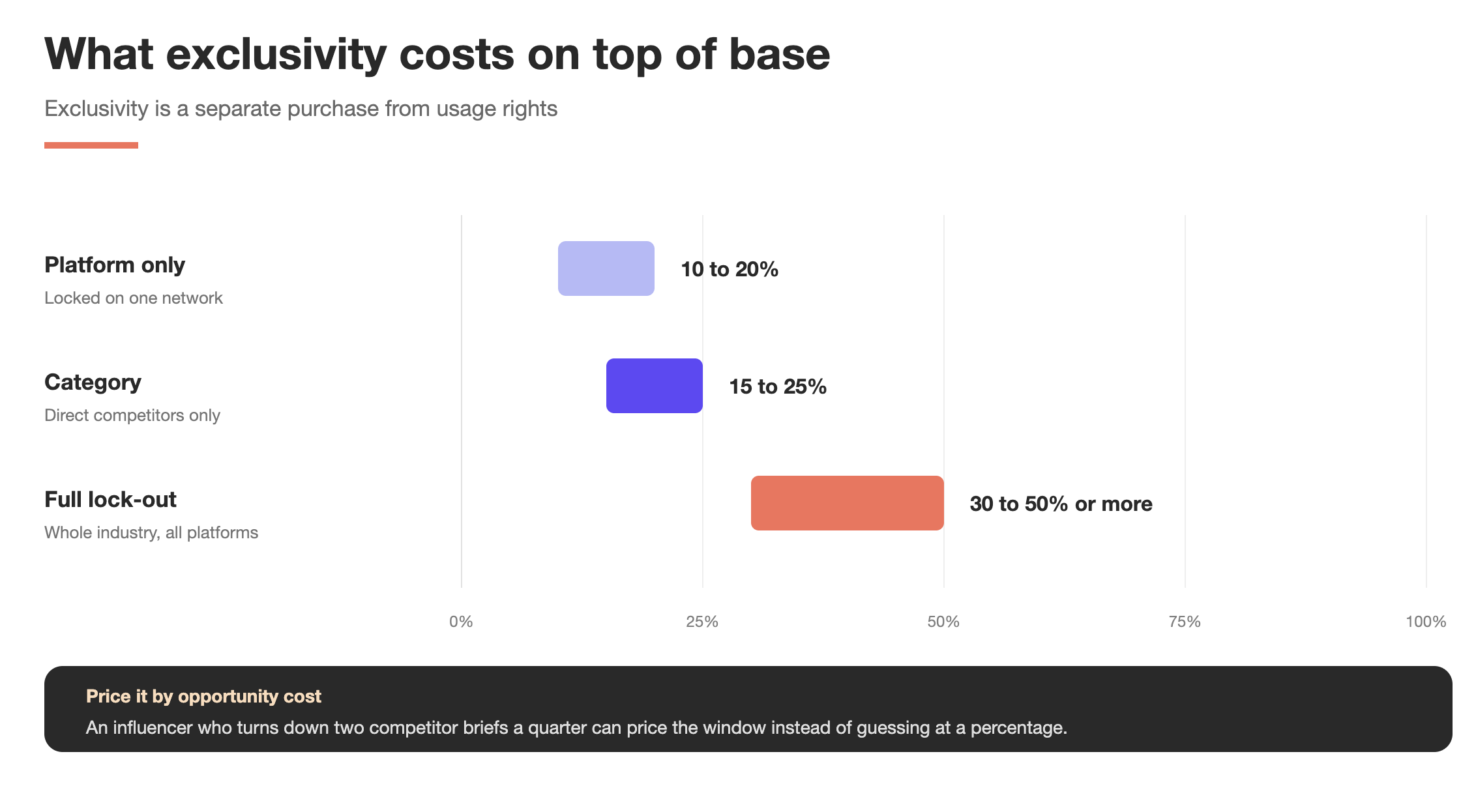
InfluencerFee’s 2026 exclusivity data puts category exclusivity at 15% to 25% above base, platform exclusivity at 10% to 20%, and full exclusivity at 30% to 50% or more. Ranges widen past 30 days, with exclusivity clauses adding 20% to 100% depending on scope and length.
The defensible method is opportunity cost. An influencer who turns down two competitor briefs a quarter can price the window instead of guessing at a percentage.
Pricing: How Much to Charge for Usage Rights
How much to charge for usage rights comes down to two structures, and how you negotiate usage rights matters more than the arithmetic does.
Percentage of Base Fee
Percentage pricing scales with the influencer’s rate. Creator business coach Kristen, cited by Modash, suggests charging nothing for organic usage over a set period, 25% to 30% of base for influencer whitelisting for 30 days, and 15% to 20% for paid media usage rights for 30 days.
Other creators quoted in the same piece charge 30% of base per month of content usage. Influencer coach Jessica Sloann advises free organic usage for three to six months, $1,000 for 30 days of paid usage rights, and $250 to $500 for 30 days of website usage.
Flat Monthly Fee
Flat fees suit brands that want budget certainty. Presenting the number as a bundle rather than a line item reduces friction: one figure covering three Reels, one Story, and a month of digital usage rights reads as a single approval.
Write the scope as digital rather than social if the brand plans to use the asset in email or on product pages. Social is the narrower term & it will be read narrowly.
Seasonality and the Budget Question
Brands typically expect to pay more during peak shopping seasons, because Q4 competes for the same influencers and placements. A rate quoted in March and honoured through November leaves money on the table.
Asking about the brand’s budget first can maximize earnings. A number quoted before the brand states its range anchors the deal at the influencer’s guess.
Whitelisting Rate Benchmarks
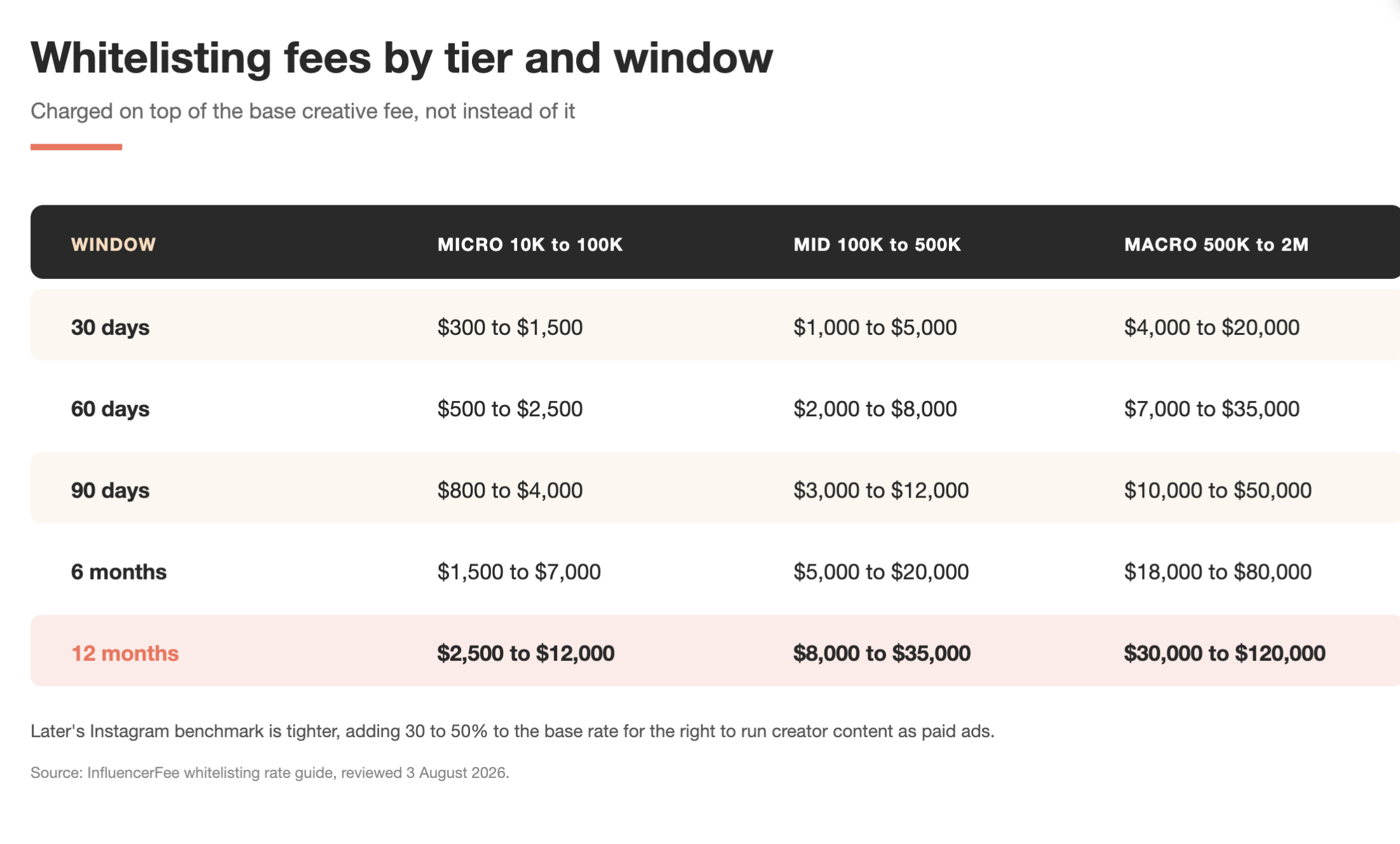
InfluencerFee’s rate table, reviewed 3 August 2026, gives 30-day whitelisting fees by tier, charged on top of the base fee:
- Micro (10K to 100K followers): $300 to $1,500
- Mid-tier (100K to 500K): $1,000 to $5,000
- Macro (500K to 2M): $4,000 to $20,000
At twelve months the same tiers run $2,500 to $12,000, $8,000 to $35,000, and $30,000 to $120,000. Later’s Instagram benchmark is tighter, adding 30% to 50% to the base rate for the right to run the influencer’s content as paid ads.
How Brands Should Budget
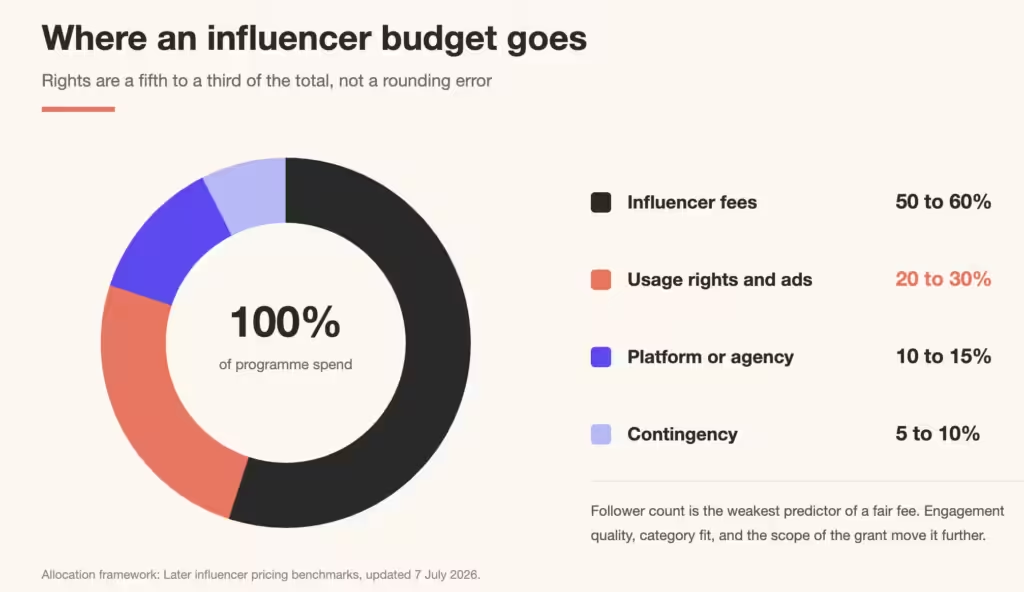
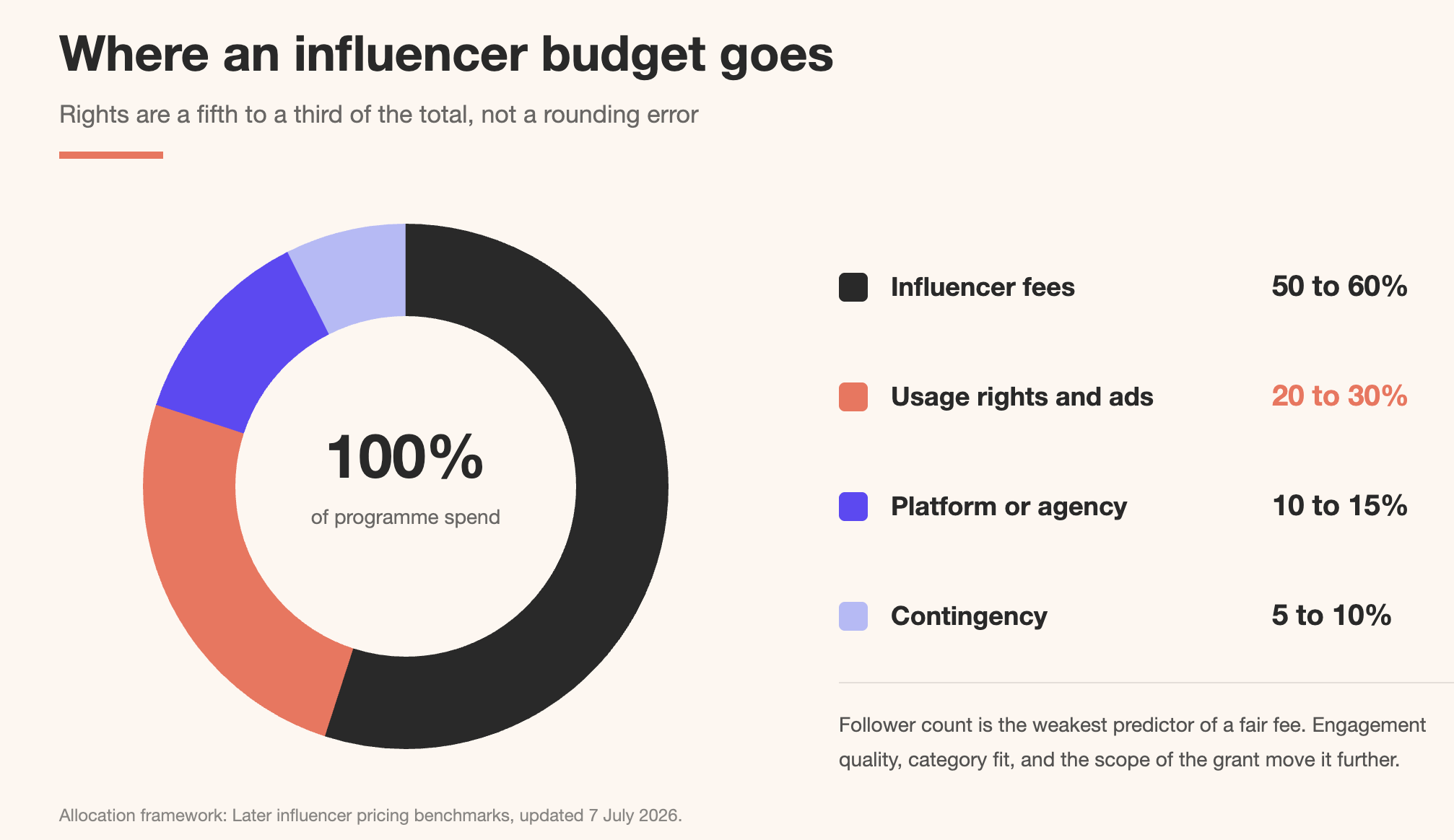
Later’s allocation framework splits an influencer marketing budget into influencer fees at 50% to 60%, usage rights and amplification at 20% to 30%, platform or agency costs at 10% to 15%, and 5% to 10% contingency. Rights are a fifth to a third of the total in influencer whitelisting campaigns, not a rounding error.
Follower count is the weakest predictor of a fair fee. Engagement quality, category fit with your target demographic, and the scope of the grant move the final number further.
The Influencer Marketing Contract
An influencer marketing contract covering whitelisting partnerships and influencer content usage rights has to answer six questions in writing.
- Which assets are licensed, identified by post URL or file name
- Which distribution channels the licence covers, including Instagram Stories and feed
- The term, and the event that starts it
- Whether the licence is exclusive, and in what category
- Whether the brand can edit, cut, or re-caption the material
- The renewal rate, agreed before signature
Rights to modify get overlooked. Trimming a discount code out of a Reel is one thing; recutting an influencer’s words into a claim they never made is another. Name the permitted edits and both sides get legal protection.
Approval and Takedown
Influencers wanting final approval on the ad cut should ask explicitly, with a review window in business days, and add a takedown clause to the influencer contract so both sides have a defined route to pull whitelisted ads.
Common Whitelisting Mistakes
The expensive failures in influencer marketing start in the paperwork.
Expired Authorisation Codes
Codes expire on a timer nobody watches, and whitelisting campaigns die quietly when they do: a TikTok authorisation left at the 30-day default kills live ads on day 31, with no error message.
Track expiry dates against flight dates, ask for 365 days on TikTok when the media plan runs longer, and price it accordingly.
Asking for Rights After the Post Is Live
Retroactive requests are some of the weakest negotiating environments available. The brand has already seen that the influencer’s content performs, and the influencer knows it.
Rights belong in the brief. Deciding after publication that a post should become ad creative means paying a premium.
Signing “Full Usage Rights” Language
“Full usage rights” and “all usage rights” sweep in paid advertising, out-of-home, and perpetuity. Influencers who sign that language hand over advertising value worth several times the creative fee.
A cleaner counter, when a brand asks for everything: organic repost and owned channels included in the base rate, paid amplification available as a priced add-on for a stated term the brand will use.
Did the Rights Pay for Themselves? Let us find out.
Whitelisting produces the kind of marketing intelligence organic influencer posts can’t. Ads running from the influencer’s feed report into Ads Manager with impressions, clicks, conversions, and cost per acquisition attached, and the same audience data supports lookalike audiences built off converters.
Compare the influencer’s content against brand-produced paid media creative on the same target audience, for awareness or for direct sales. If customer acquisition costs drop and the influencer’s version holds a lower CPA across two or three weeks, the renewal decision makes itself.
Meta’s reported lift is an average across advertisers. Your account will produce its own number, and it should set next quarter’s rights budget.
36% of consumers say influencer posts persuade them to try products, and Sprout Social‘s 2024 Influencer Marketing Report found 49% make daily, weekly, or monthly purchases because of them, across 2,000 consumers surveyed in the US and UK. Trust is the asset being licensed. Price it like one.
Book a call with Vivian Agency and let us build your influencer marketing from the ground up. Or roast, evaluate, and refresh your existing strategy. We do it all!
About the author: Jan Suski builds backlink profiles and SEO content for tech companies. And sometimes for himself like with MITools.
Sources
- Interactive Advertising Bureau creator ad spend projection, via Marketing Dive, 11 December 2025
- Meta partnership ads performance data (19% lower CPAs, 13% higher CTR), via Marketing Dive, 11 December 2025
- TikTok Business Help Center, About Spark Ads, last updated June 2026
- TikTok Commercial Music Library
- Later, How to run Instagram partnership ads, updated 18 April 2026
- Later, Influencer pricing benchmarks, updated 7 July 2026
- Billo Help Center, Instagram Partnership Ad Codes
- InfluencerFee, Influencer Whitelisting Rates 2026, reviewed 3 August 2026
- InfluencerFee, Influencer Exclusivity Pricing 2026
- Modash, Navigating Usage Rights in Influencer Marketing, 12 March 2026
- 17 U.S.C. § 204
- California Civil Code § 3344
- New York Civil Rights Law §§ 50-51
- FTC Endorsement Guides, 16 CFR Part 255
- FTC Rule on the Use of Consumer Reviews and Testimonials, 16 CFR Part 465
- Sprout Social 2024 Influencer Marketing Report, 25 April 2024