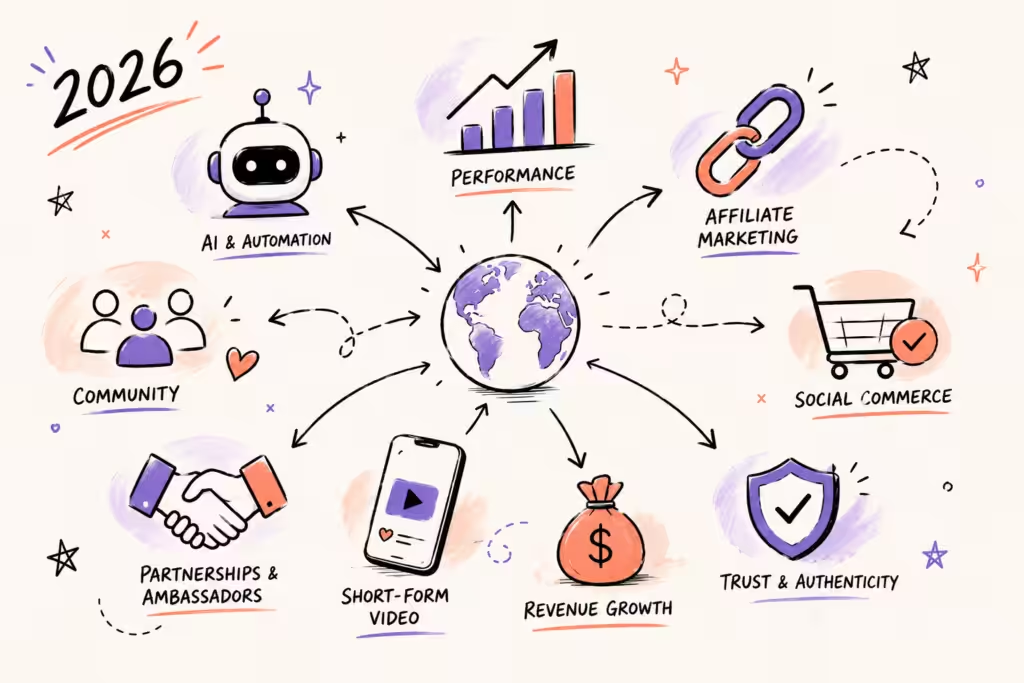

Influencer marketing grew from a $1.7 billion niche in 2016 to a $32.55 billion industry in 2026, representing 19x growth in a decade. But the headline number is almost beside the point when it comes to the top influencer marketing trends shaping the industry right now.
The more important story is what’s happening inside that number: where the growth is coming from, which creator tiers are driving real results, how payment structures are evolving, and why the brands that understood the channel five years ago need to update their assumptions right now.
Influencer marketing in 2026 is no longer limited to social media visibility. It sits across the full customer journey: discovery, education, consideration, conversion, and even retention are now influenced by creators.
That structural shift is what separates the current moment from the influencer marketing of three years ago, and it’s what makes most of the “trends for 2026” content you’ll find online feel thin.
In this article, we cover the 10 most significant influencer marketing trends in 2026, with current data supporting each and practical implications for how brands should respond. Whether you’re refining your influencer marketing strategy or building a creator marketing program from scratch, these are the marketing trends that will define the channel this year.
Table of Contents
Overview
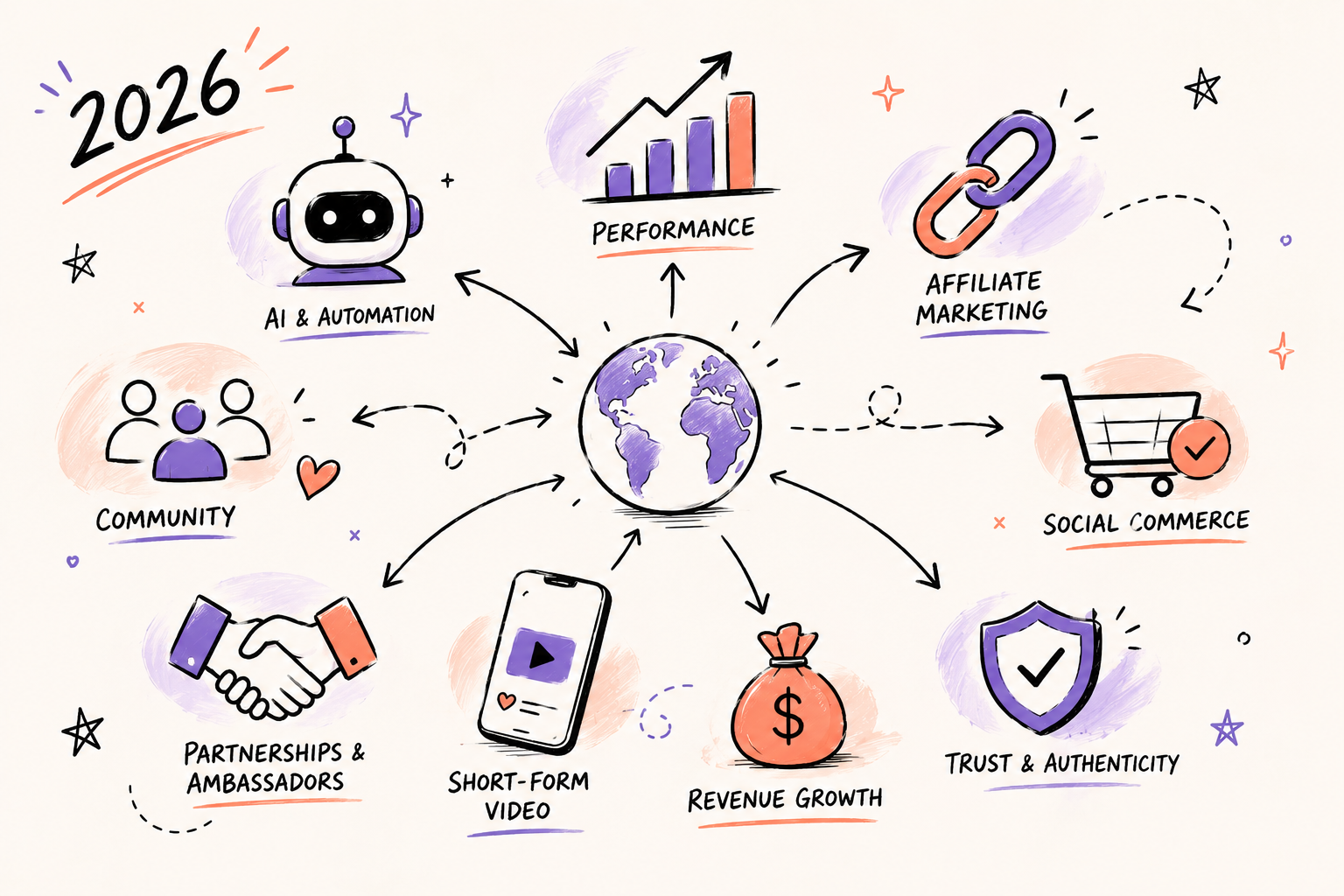
| Trend | The Shift | What It Means for Brands |
| Performance over flat fees | Hybrid base + commission structures becoming standard | Negotiate commission clauses into every creator deal |
| Micro and nano dominance | Smaller creators outperforming on every measurable metric | Reallocate budget from fewer large deals to more small ones |
| Short-form video maturity | TikTok, Reels, and Shorts now drive measurable conversion | Treat short-form as a performance channel, not just awareness |
| Social commerce integration | Creator content is now shoppable at point of inspiration | Build creator programs with direct purchase paths built in |
| Long-term ambassador programs | Repeated creator-brand association outperforms one-off posts | Shift from campaign thinking to partnership thinking |
| AI-powered campaign management | AI now handles discovery, forecasting, and fraud detection | Use AI tools for scale; preserve human judgment for strategy |
| B2B influencer marketing | B2B creators on LinkedIn and YouTube are driving purchase decisions | Build B2B creator programs around subject-matter experts |
| Creator professionalization | Mid-tier creators now run their channels like businesses | Treat creators as partners with business goals, not just channels |
| Fraud and authenticity pressure | Nearly 60% of brands have experienced influencer fraud | Vet every creator and build fraud clauses into contracts |
| Creator-led communities | Owned communities are replacing broadcast audiences as the highest-trust channel | Prioritize creators with active communities, not just large follower counts |
Trend 1: Performance-Based Deals Are Replacing Flat Fees
This is the most structurally significant shift in the industry in 2026, and it’s happening faster than most brands realize.
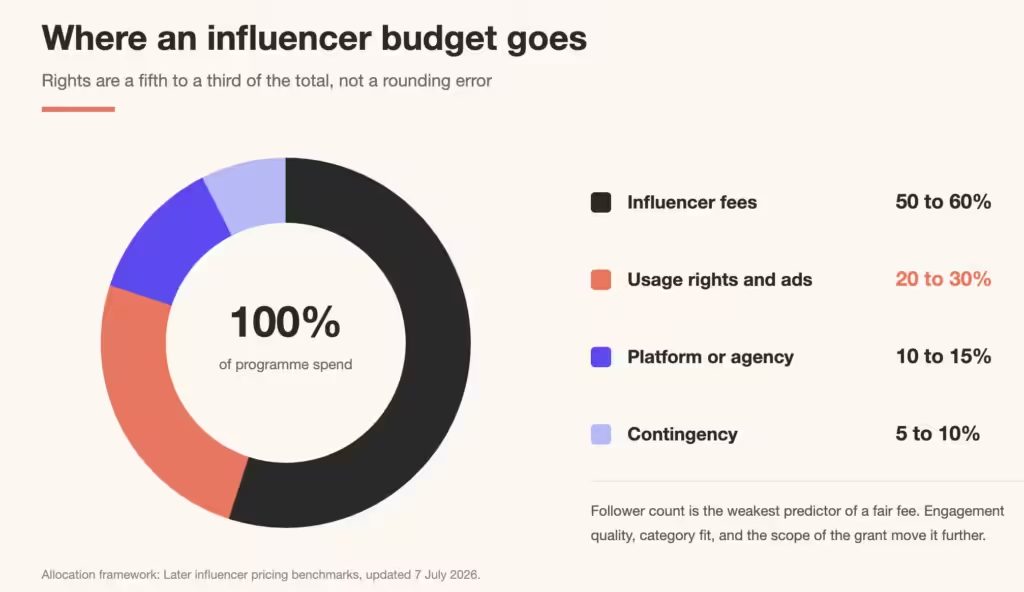
The biggest shift of 2026 is the industry’s break from vanity metrics. Likes and impressions no longer justify budget. Hybrid compensation is now non-negotiable: base fees plus 10 to 15 percent commissions plus tiered bonuses align creator incentives with results.
A flat fee pays a creator for content regardless of whether it converts. A commission structure pays them for outcomes. Brands that have moved to hybrid models, a base fee that covers the creator’s production cost and time plus a commission on every attributed sale, are consistently reporting better influencer marketing ROI than those still running flat-fee campaigns.
Creators are more commercially sophisticated and view their influence as a business with a growth strategy. Performance-minded creators are becoming some of the most valuable partners a brand can work with. Many now run their channels like full-fledged businesses, studying their analytics and building recurring revenue streams through affiliate partnerships.
What This Means for Brands
If you’re still negotiating flat fees for all creator partnerships, you’re leaving two things on the table: better-aligned creator incentives and a performance data trail that tells you which creators actually drive conversion.
Start building hybrid compensation into your standard creator brief. The creators who push back on commission clauses are often the ones who know their influencer content doesn’t convert. Smart brands are using attribution tools to measure which creator mentions actually drive actual sales, rather than relying on reach or impressions alone.
For a detailed breakdown of how to structure commission rates by category, see our guide on how to set up an influencer affiliate program.
Trend 2: Micro and Nano Influencers Are Pulling Further Ahead
The performance advantage of smaller social media influencers isn’t new, but in 2026, the data is more decisive than it’s ever been. As one of the defining influencer marketing trends of the decade, the shift from celebrity influencers and macro influencers toward micro and nano creators continues to accelerate across every major social media platform.
Micro-influencers (10K to 100K followers) generate an average engagement rate of 3.86%, compared to 1.21% for mega-influencers (1M+). Combined with per-post costs that are 60% lower, micro-influencer campaigns consistently deliver the highest ROI in the category.
This performance gap is widening as audiences increasingly reward perceived authenticity over reach.
Nano influencers now represent 75.9% of Instagram’s influencer base and achieve 2.71% engagement rates, which is 50% higher than micro influencers and dramatically outperforming macro-tier creators.
Nano creators in particular are proving their value in niche communities that macro influencers simply cannot reach authentically. A nano creator with 8,000 highly engaged followers in a specific niche audience, say sustainable homeware or plant-based fitness, will consistently outperform a macro influencer with a broad, diffuse following on customer acquisition cost, niche relevance, and actual sales.
Niche creators are increasingly how smart brands access niche audiences that generic influencer collaborations miss entirely.
The numbers make a compelling case for reallocation. If a macro influencer with 1M followers charges $20,000 per post and achieves 1.2% engagement, that’s 12,000 engaged viewers. Twenty micro and nano influencers at $1,000 per post each, the same budget, achieve an average 3.86% engagement against an average 50,000 followers, generating 3,860 engaged viewers per creator, or 77,200 total. At 60% lower cost per engagement, the math consistently favors distribution over concentration.
The caveat: this requires operational infrastructure that most brands don’t have in-house. Managing 20 creator relationships, briefing, onboarding, content review, payment, and campaign performance tracking, is a fundamentally different operation than managing 2. This is where specialist agencies and influencer marketing platforms become genuinely necessary rather than just convenient.
What This Means for Brands
Audit your current creator spend. If more than 60% of your influencer budget is going to macro influencers or celebrity influencers with over 500K followers, you almost certainly have room to improve influencer marketing ROI by redistributing toward micro and nano influencers.
You’ll need better creator sourcing systems and the infrastructure to manage more creator relationships simultaneously, which is why most brands either invest in influencer marketing platforms or work with specialist agencies to find creators at this tier efficiently.
Trend 3: Short-Form Video Has Matured Into a Performance Channel
Short-form video is no longer an awareness play. In 2026, it’s a full-funnel performance channel, and the brands treating it as such are significantly outperforming those that don’t.
UGC campaigns grew 133% on the Collabstr platform while TikTok-specific brand campaigns dropped 48%, a signal that brands are shifting from platform-native campaigns to content-first strategies that can be deployed across multiple short-form social channels simultaneously.
Short-form video remains the highest-performing influencer content format in 2026. But the nature of that performance has evolved. The early short-form era was about reach and virality. The current era is about conversion: shoppable links, affiliate tracking, direct-to-cart integrations, and performance metrics that tie influencer content to revenue.
For B2C brands, Instagram and Facebook dominate in ROI, cited by 47.4% of B2C marketers each. YouTube follows at 43.9% and TikTok at 35.2%. The platform mix matters less than the format: short-form video from social media influencers consistently outperforms long-form and static across all social platforms on awareness and mid-funnel metrics, while the addition of direct purchase paths closes the conversion gap that previously kept short-form in the awareness bucket.
What This Means for Brands
Stop siloing your short-form influencer content. The same UGC video, briefed correctly, can run as organic creator content, a TikTok Spark Ad, an Instagram Reel, and a Facebook video ad, with different performance expectations at each touchpoint.
Brief for the full deployment from the start, not just for the organic post. High-performing creator content, briefed for paid amplification from day one, outperforms organic-first content across every paid channel.
Trend 4: Social Commerce Is Making Influencer Content Directly Transactional

The separation between content discovery and purchase is collapsing. In 2026, influencer content doesn’t just drive traffic to a purchase page. It increasingly is the purchase page.
Social commerce is a core strategy for any brand running influencer marketing campaigns with a direct-to-consumer component.
Social commerce is turning influencer content into direct sales through platforms like TikTok Shop and YouTube Shopping. Authenticity drives purchasing decisions, and audiences trust real, unscripted content over polished productions.
TikTok Shop, in particular, has changed the economics of creator marketing. A creator can now demonstrate a product, link it directly in the video, and a viewer can purchase without leaving the app in a single session. The friction that previously existed between inspiration and transaction has been eliminated. For brands selling consumer products, this is one of the most significant distribution shifts since the rise of Amazon.
Amazon’s own creator ecosystem is evolving in parallel. Amazon Creator Connections and Amazon influencer storefronts give brands access to a performance-based creator marketing system where every piece of influencer content is trackable to a confirmed sale.
At Vivian Agency, we’ve been building programs in this space since early in its development. The Kokido and Sposie case studies show what the results look like when Amazon Creator Connections is run as a structured, managed program rather than a set-and-forget campaign.
What This Means for Brands
Map your creator marketing strategy against your social commerce presence. If you’re running influencer marketing campaigns on TikTok but don’t have TikTok Shop set up, you’re generating awareness with no direct conversion path. If you’re selling on Amazon but not using Creator Connections, you’re leaving a performance-based creator channel entirely unused.
Social commerce is now a central part of any serious influencer marketing strategy, not an experiment or an add-on.
Trend 5: Long-Term Ambassador Programs Outperform One-Off Campaigns
Long-term ambassador programs deliver the highest influencer marketing ROI. Aspire‘s 2026 benchmark data identifies brand ambassador programs as consistently highest-performing versus campaign-by-campaign partnerships. The compounding effect of repeated creator-brand association builds trust that single-post campaigns cannot replicate.
This is one of the most consistent findings across 2026 benchmark data, and it runs counter to how most brands still structure their influencer spend. Long term creator partnerships are not just a nice-to-have for brand visibility. They are what separates the influencer marketing campaigns that drive meaningful engagement from the ones that generate a one-week spike and nothing else.
The typical approach is campaign-by-campaign: brief social media influencers for a product launch, pay the flat fee, then that’s it. The problem is that audiences don’t trust a creator’s enthusiasm for something they’ve mentioned once. Trust is built through repetition. The third time an audience sees a creator mention a product, the conversion rate is dramatically higher than the first.
Creators are becoming more selective about brand alliances. As professionals, they view long term partnerships as more valuable than one-off campaigns, because repeated association builds their credibility alongside the brand’s. This alignment of incentives is what makes ambassador programs structurally superior to campaign-by-campaign partnerships for both parties.
What This Means for Brands
Identify your top 5 to 10 performing social media influencers from the past 12 months and approach them about ambassador arrangements.
Long-term creator partnerships give creators the creative freedom to develop their association with your brand naturally, which produces more authentic influencer content and stronger audience trust than rigidly briefed one-off campaigns. The per-post rate will typically be 10 to 20% lower than one-off campaign rates, and campaign performance will compound significantly over the partnership duration.
Trend 6: AI Tools Are Transforming Creator Sourcing, Vetting, and Campaign Management
AI’s role in influencer marketing has shifted from experimental to operational in 2026. It’s no longer a feature you evaluate in a platform comparison. It’s infrastructure that determines whether a creator marketing program can scale efficiently. As influencer marketing continues to grow in complexity, AI tools are becoming as fundamental to the marketing mix as the creators themselves.
57% of B2B marketers are already using AI to help create influencer content, and 44% say AI is the emerging trend to watch for making that content even better.
For most brands, the most immediate value from AI tools is in creator sourcing and fraud detection. Finding creators manually across social platforms is time-consuming and doesn’t scale. Vetting influencers for fake followers manually is unreliable. AI tools solve both problems simultaneously, making it possible to find creators, vet influencers for audience authenticity, and forecast campaign performance before any budget is committed.
The most meaningful applications of AI in influencer marketing in 2026 are:
Creator discovery and matching. AI-powered platforms can now match creators to brands based on audience data, engagement quality, brand safety history, and predictive performance, not just follower count and niche. What previously took a human researcher days can be done in hours, at scale.
Fraud detection. Influencer fraud, including fake followers, synthetic engagement, and bot-driven metrics, affects nearly 60% of brands running influencer marketing campaigns. AI-powered fraud detection tools analyze follower growth patterns, engagement velocity, comment quality, and behavioral signals to identify inauthentic accounts before brands commit budget to them.
Performance forecasting. Predictive AI models now estimate campaign performance, including expected reach, engagement, click-through, and conversion, before a campaign launches, based on historical data from similar creators in similar categories. This gives media buyers a ground-level check on whether a proposed creator partnership is likely to deliver at the rates being negotiated.
Content compliance scanning. AI tools scan influencer content for missing disclosures, misleading claims, brand guideline violations, and platform-specific compliance issues at a scale that no human review team can match.
What This Means for Brands
Use AI for creator sourcing, vetting influencers, and monitoring at scale. Preserve human judgment for relationship management, creative strategy, and the nuanced assessment of whether a creator’s niche audience is actually the right fit for your brand’s values, not just its demographic targets.
The most successful creators in 2026 want to work with brand partners that understand them, and that requires a human on the other side of the relationship, not just an algorithm.
Trend 7: B2B Influencer Marketing Is Having Its Moment
B2B influencer marketing has been the most consistently underrated opportunity in the channel for the past three years. In 2026, that’s changing.
64% of B2B marketers report stronger brand credibility when working with influencers, particularly when influencer marketing campaigns feature recognized industry experts rather than traditional lifestyle creators. In B2B environments, audiences tend to value practical expertise and professional reputation.
LinkedIn is scaling its BrandLink program with new creator-led shows and partnerships with publishers including BBC Studios, TED, and The Economist. Since rebranding from the Wire Program, BrandLink revenues have grown nearly 200% quarter-over-quarter, while creator and publisher payouts more than tripled year-over-year. With US B2B video ad spend up nearly 18%, LinkedIn is positioning BrandLink as a premium marketplace balancing enterprise polish with creator authenticity.
This is also where virtual influencers are starting to appear in B2B contexts. AI-generated personas positioned as thought leaders in specific verticals are a marketing trend worth watching, particularly for brands that want consistent messaging across a niche audience without the unpredictability of human creators.
The B2B creator marketing model is fundamentally different from B2C. It’s not about reach. It’s about credibility. A single subject-matter expert with 15,000 LinkedIn followers in a specific industry vertical can influence purchasing decisions worth millions of dollars, in a way that a lifestyle creator with 2 million followers never could. The key differentiator is perceived expertise and peer trust: B2B buyers buy from people they believe understand their problems, not from people with large follower counts.
For B2B brands, Instagram (48.4%), YouTube (40.5%), and Facebook (36.9%) are the social platforms delivering the highest ROI from influencer marketing. LinkedIn sits alongside these as the primary platform for thought-leader influencer content that influences enterprise buying decisions.
What This Means for Brands
If you’re a B2B brand that hasn’t built a creator marketing program, you’re behind on what will be one of the most important channels of the next five years.
Start with LinkedIn. Identify five to ten subject-matter experts whose social channels and niche audience overlap with your buyer persona, and approach them about influencer collaborations that prioritize their expertise, not your brand messaging.
B2B creator marketing works when it feels like a genuine peer recommendation, not traditional advertising in disguise.
Trend 8: The Creator Economy Is Professionalizing at the Mid-Tier
The creator landscape in 2026 looks different from the one that existed three years ago. The hobby creator who posts occasionally and accepts brand deals with whatever terms are offered is being replaced, at least at the mid-tier, by a new generation of creator-entrepreneurs who treat their social channels like businesses.
Creators’ focus on video production (22.4%) and branding (20%) reveals a strategic pivot towards professionalization and tailored brand identities in 2026. The largest audience segment across all social media platforms is now 25 to 34, signaling a maturing creator economy that makes this age group the primary target audience for cross-platform brand campaigns.
Creator professionalization is accelerating in 2026. Successful creators study their analytics, negotiate their contracts, build recurring revenue streams through affiliate partnerships, and are increasingly selective about which brand partners they work with, because the wrong brand association can damage their audience relationships in ways that are hard to recover from.
This professionalization has two implications for brands. First, the quality of influencer content has improved significantly. Professional creators produce content that requires less revision and performs better as paid media. Second, the negotiation dynamic has shifted. Most successful creators have better audience data on their own performance, clearer expectations about deal terms, and more options than they did two or three years ago.
Brands that approach creators with low offers and inflexible terms increasingly find themselves unable to close the influencer collaborations they want.
What This Means for Brands
Treat mid-tier creator negotiations the way you’d treat any other professional service negotiation. Come prepared with market rate knowledge, clear deliverables, a genuine value proposition beyond just the fee, and creative freedom built into the brief.
The most successful creators in 2026 are choosing their brand partners as carefully as brands are choosing them, and they consistently gravitate toward brand partners who trust their understanding of their own niche audience.
Trend 9: Fraud Pressure Is Forcing a Vetting Reckoning
Influencer fraud, including fake followers, synthetic engagement, and bot-driven metrics, affects nearly 60% of brands running influencer marketing campaigns. Fraudulent activity remains one of the most consistent drains on influencer marketing budgets.
This is one of the influencer marketing trends that most brands underestimate until they’ve been burned. Fake followers don’t just waste your influencer marketing budget. They corrupt your campaign performance data, skew your influencer marketing ROI calculations, and damage your brand’s reputation if the association with a fraudulent account becomes public.
The sophistication of fraud has also increased. AI-generated content from synthetic influencer personas now exists at scale, complete profiles with contextually plausible content histories, engagement patterns that mimic real accounts, and follower bases built through coordinated bot networks. A brand that only performs surface-level vetting, checking follower count and glancing at a media kit, can be easily deceived.
The fraud problem is compounding: as detection tools improve, fraud tactics evolve in response. The current frontier is engagement pod networks and AI-generated comment farms that produce comments indistinguishable from organic engagement to the naked eye. Only behavioral analysis, looking at comment timing, velocity, sentiment variation, and cross-account patterns, reliably surfaces these.
What This Means for Brands
Fraud vetting can no longer be a manual spot-check. It needs to be a systematic process built into every creator evaluation, combining automated tools for initial screening with human review of the flagged accounts.
Build fraud protection clauses into your creator contracts, and establish a clear policy for what happens when fraud is discovered post-campaign. Vet influencers systematically, not just for the obvious red flags like sudden follower spikes, but the subtler signals like engagement pod activity, comment timing patterns, and audience data that doesn’t match the creator’s claimed niche audience.
For a full vetting methodology, see our post on how to tell if someone bought followers on Instagram.
Trend 10: Creator-Led Communities Are Replacing Broadcast Audiences
One of the quieter but most consequential influencer marketing trends of 2026 is the shift from broadcast to community. The creator economy is moving away from the one-to-many model that defined social media influencers for the past decade, toward something fundamentally different: tight, owned communities where meaningful interactions happen outside the main social media feed.
Community is the new algorithm. Creators are shifting to owned spaces where engagement and loyalty run deeper than anything a platform feed can produce. Discord servers, Substack newsletters, private Instagram groups, Patreon communities, and WhatsApp channels are where the most valuable creator-audience relationships now live.
The implication for brands is significant. A creator with 200,000 Instagram followers and a 3,000-member Discord community is not a single asset. They are two entirely different influencer marketing opportunities with different audience dynamics, different content formats, and different performance expectations.
The Discord community, though dramatically smaller, contains the creator’s most loyal and highest-intent followers. These are the niche communities that act on recommendations fastest, generate the most user generated content, and have the highest average order value when converted through creator partnerships.
Brands are treating influencers less like media placements and more like strategic partners. Influence in 2026 is no longer about who is loudest, but who is most trusted. Creator-led communities are where that trust is most concentrated, and where influencer marketing campaigns that prioritize meaningful engagement consistently outperform those optimized purely for reach. ADOPTER Media
This shift also changes how smart brands approach long term creator partnerships. A creator who gives brand partners access to their community, not just their feed, is offering something qualitatively different from a sponsored post. Community access, whether through a dedicated product channel in a Discord server, an exclusive offer in a newsletter, or a live Q&A in a private group, drives the kind of meaningful interactions that turn followers into customers and customers into advocates.
The creator community model is also more fraud-resistant than traditional social media influencer campaigns. Fake followers cannot meaningfully participate in a community. Engagement pod activity does not translate to Discord messages or newsletter replies. The authentic engagement that communities generate is inherently verifiable in a way that feed-level metrics never are.
What This Means for Brands
When evaluating social media influencers for long-term creator partnerships, look beyond their public follower count and feed engagement.
Ask whether they have owned community assets and what the engagement looks like there. A creator with a smaller but highly active niche community is often a more valuable brand partner than one with a large but passive social media audience.
Build community access into your ambassador agreements, and treat it as a premium deliverable with its own pricing and performance expectations separate from standard influencer content.
What These Trends Add Up To
The ten influencer marketing trends above aren’t independent developments. They’re a coherent shift in how creator marketing works and what it’s becoming. The influencer marketing industry continues to mature, and the marketing trends shaping it in 2026 all point in the same direction: from experimental to essential, from awareness to performance, from one-off campaigns to long term creator partnerships.
The brands that will win in this environment share a few characteristics: they’ve moved from campaign thinking to program thinking; they’ve built the operational infrastructure to manage creator relationships at scale; they measure against conversion and revenue, not reach and impressions; and they’ve unified their influencer and affiliate functions into a single creator commerce operation.
The brands that will struggle are still treating influencer marketing the way it worked in 2021: celebrity influencers, flat fees, one-off campaigns, and success metrics built on social media impressions rather than actual sales. In a market where internet users are increasingly sophisticated about sponsored content, and where most successful creators have multiple brand partners competing for their attention, that approach is no longer sufficient.
Vivian Agency helps brands navigate this transition, from building the program architecture that combines influencer and affiliate into a unified creator strategy, to managing the day-to-day operations of creator sourcing, onboarding, influencer content oversight, and campaign performance tracking.
If you’re evaluating where your current program sits against where the market is heading, book a free call and we’ll walk through your specific situation and what a realistic 2026 program looks like for your brand.
FAQs
What is the biggest influencer marketing trend in 2026?
The shift from flat-fee influencer deals to performance-based hybrid structures, specifically a base fee plus commission on attributed sales, is the single most significant operational trend. It’s changing how creator deals are negotiated, how influencer content is measured, and how brands measure success against meaningful engagement rather than vanity metrics.
The influencer marketing campaigns generating the strongest returns in 2026 are the ones built around performance accountability, not reach.
Are micro influencers still worth it in 2026?
More than ever. Micro and nano influencers (10K to 100K followers) generate 3.86% average engagement compared to 1.21% for mega-influencers, at 60% lower cost per post. The performance gap is widening in 2026 as audiences increasingly reward authenticity over scale.
The main constraint isn’t influencer performance. It’s operational capacity to manage multiple influencer collaborations and creator relationships simultaneously, which is why creator sourcing infrastructure matters as much as the strategy itself.
How is AI changing influencer marketing?
AI tools are transforming four specific functions: creator sourcing and matching (finding the right creators faster and at greater scale), fraud detection (identifying fake followers and synthetic engagement before campaigns launch), performance forecasting (predicting campaign performance before spend is committed), and content compliance scanning (checking influencer content for disclosure violations and brand guideline adherence at scale).
What is the difference between influencer marketing and affiliate marketing in 2026?
The distinction is increasingly blurred. Traditional influencer marketing involved flat fees for influencer content creation regardless of sales results. Traditional affiliate marketing involved commission-only payment for actual sales driven through tracked links.
In 2026, the dominant model combines both: a base fee covers the creator’s production effort, and a commission on attributed sales aligns their incentives with brand performance. The social platforms enabling this, including TikTok Shop, Amazon Creator Connections, and Instagram’s affiliate tools, have made the technical implementation straightforward.
What social media platforms are performing best for influencer marketing in 2026?
For B2C brands, Instagram and Facebook lead in ROI (cited by 47.4% of B2C marketers each), followed by YouTube (43.9%) and TikTok (35.2%). For B2B brands, Instagram (48.4%) and YouTube (40.5%) lead, with LinkedIn growing rapidly as a B2B creator platform.
Short-form video performs consistently across all social channels as the highest-engagement influencer content format, but the most effective influencer marketing strategy treats social platforms as distribution channels for creator content rather than defining the content around platform-specific formats.
For further reading on building creator programs aligned with these trends, see our guides on how to find affiliates for your brand, how to set up an influencer affiliate program, TikTok influencer marketing, our Amazon influencer marketing agency capabilities, and our guide on influencer marketing ROI.