
Most brands searching for how to find micro influencers make the same mistake: they start with the tool instead of the strategy.
They open an influencer database, type in a category, filter by follower count, and contact whoever appears in the results. Then they wonder why the campaigns underperform.
Finding the right micro influencers is not a search problem. It is a matching problem.
The difference between a micro influencer who drives real sales and one who drives impressive screenshots is almost never visible in the follower count.
It lives in the quality of their audience, the specificity of their niche, the authenticity of their content, and whether any of that actually aligns with what your brand needs.
This guide walks through every method available to find micro influencers in 2026, what each method is actually best for, how to vet the profiles you find, and what to do once you have found the right micro influencers for your brand.
Table of Contents
Why Use Micro Influencers in 2026
Before getting into the how, the why is worth establishing clearly, because the data has shifted significantly.
Micro influencers deliver 3.2x higher engagement, 2.4x higher conversion rates, and a $7.14 ROI compared to $2.87 for celebrity influencers.
Brands pay $500 to $5,000 per micro influencer post compared to $10,000 or more for macro influencers and $100,000 or more for celebrities, while getting higher engagement rates and better conversion.
Micro influencers on Instagram achieve 3.86% engagement rates compared to just 1.21% for mega influencers, making smaller creators significantly more effective for brands prioritizing authentic audience connections.
73% of Gen Z trusts micro influencers more than larger influencers and brands.
This generation prefers real conversations and authentic voices over polished ads. Micro influencers deliver that. Their loyal audiences trust their recommendations in a way that macro creators simply cannot replicate at the same price point.
The case for micro influencers is not about marketing budget. It is about performance. Smaller followings, higher trust, better conversion, lower cost per result.
The challenge is knowing how to find micro influencers who are actually the right micro influencers for your specific brand, target market, and campaign goals.
Overview
| Method | Best For | Time Investment | Cost |
|---|---|---|---|
| Hashtag and keyword search | Any brand, any social media platform, zero budget | High | Free |
| Your own customer base | E-commerce brands with existing buyers | Medium | Free |
| Competitor audience analysis | Brands in established categories | Medium | Free to low |
| Influencer discovery tools and platforms | Brands managing multiple campaigns | Low | Paid |
| Google and YouTube search | Content-heavy categories, B2B | Medium | Free |
| Affiliate networks | Performance-focused programs | Low | Commission-based |
| Social listening tools | Brands wanting organic brand mentions | Medium | Paid |
| Influencer marketing agency | Brands wanting curated, vetted results | Very low | Agency fee |
Get Clear on What You Actually Need

The most common reason micro influencer searches produce poor results is that the brief was not specific enough before the search started.
Before you open any influencer database or run any search, answer these four questions:
What is the campaign goal? Brand awareness, conversions, user-generated content, and affiliate-driven sales all require different types of micro influencers. A creator who is brilliant for awareness content may be entirely wrong for a conversion campaign. Define the goal first, and let the goal define the profile.
Who is your target market? Not in general terms. Specifically: age range, social media platform preference, purchasing behavior, and the specific interests or problems your product addresses. The right micro influencers are those whose existing audience already looks like your ideal customer.
What platform does your target audience actually use? Micro influencers on Instagram typically have 5,000 to 50,000 followers. TikTok influencers operate in a different range, typically 100,000 to 250,000, because the platform’s algorithmic reach means smaller accounts can still achieve significant viewership.
YouTube influencers in the micro tier generally have 10,000 to 100,000 subscribers. The definition of micro shifts by social media platform, which affects who you are looking for and where.
What does good content look like in your category? Spend 30 minutes looking at the best-performing influencer’s content in your niche before starting any search. This gives you a reference point for evaluating content relevance and brand alignment when you find potential creators, and it tells you which formats, tones, and visual styles your target market already responds to.
How to Find the Right Micro Influencers: 8 Top Methods

Method 1: Hashtag and Keyword Search
This is the most accessible method to find micro influencers for any brand, on any marketing budget, on any social media platform. It is also the most time-intensive, but it consistently surfaces genuinely niche creators that influencer discovery tools and agencies often overlook.
On Instagram:
Start with the most specific relevant hashtags for your product, not the broadest ones.
If you sell a sustainable skincare product, do not search #skincare (over 150 million posts). Search #sustainableskincareroutine or #cleanskincarecommunity instead. The more specific the hashtag, the more likely you are to find instagram influencers whose entire content identity is built around your exact target market.
Use Instagram’s recommendation tool to discover similar creators once you find a strong match. Search relevant hashtags to find influencers in a specific niche.
Focus on topics to ensure influencers are genuinely interested in your niche. Filter by location to get local influencers for area-specific campaigns.
Once you find an instagram influencer who looks right, tap their profile. Instagram will surface similar creators in the “suggested” section. This is one of the fastest ways to find clusters of micro influencers in a specific niche, because Instagram’s algorithm has already mapped the network.
On TikTok:
Search your product category or niche keyword in the TikTok search bar. Filter by creator rather than content.
Look for TikTok influencers with 10,000 to 250,000 followers who are producing content consistently, have an established visual identity, and are generating real conversations in their comments, not just views.
TikTok’s Creator Marketplace also allows brands to search for TikTok influencers by category, follower count, average views, and audience demographics without paying a platform fee for discovery. And the best part is that it is free to access for brand accounts.
On YouTube:
Simple Google and YouTube search with niche-related keywords surfaces relevant YouTube influencers. Use the YouTube Trending section and filters for current popular content. Search for existing sponsored content to find creators who are open to collaboration.
Searching “best [product category] for [specific use case]” on both Google and YouTube will surface review-style content where YouTube influencers in your category tend to concentrate.
If a YouTube influencer has produced existing sponsored content, they are almost certainly open to collaboration. Their contact info is usually in their YouTube “About” section or linked from their channel.
Method 2: Your Own Customer Base
This is the most underused method to find micro influencers available to e-commerce brands, and it consistently produces the highest-performing partnerships.
Your existing customers who are also content creators already know and genuinely like your product.
Their influencer’s content will be authentic because their endorsement is real. Their audience demographics are almost certainly aligned with your target market because they are a version of your ideal customer.
A tool like Upfluence connects directly with your e-commerce store and identifies customers who are already creators, turning happy buyers into authentic brand advocates.
Without a platform, you can do this manually:
- Tag your product on Instagram and look through who is already posting about it organically
- Check who has tagged your brand in stories or posts
- Review your customer email list for names that appear in social media searches
- Ask your customer service team if any customers have mentioned they are creators or have shared their influencer’s content
When you approach a customer who is also a micro influencer, the conversation starts from a very different place than from cold outreach.
They already have a positive brand experience. Their content will be more authentic, more detailed, and more persuasive than that of a creator who has never used your product.
And the best part is that many of these creators will accept product gifting as compensation, particularly when the brand alignment is strong.
Method 3: Competitor Audience Analysis
If other brands in your category are already running micro influencer campaigns, their tagged content and comment sections are a direct map to the creator ecosystem in your target market.
Go to your competitor’s Instagram or TikTok profile. Look at:
- Who they have tagged in posts
- Who has tagged them in content in their tagged posts section
- Which micro influencers have commented enthusiastically from creator accounts
- Which creators have used their branded relevant hashtags
This surfaces micro influencers who are already engaged with your category, have an audience relevant to your product, and have demonstrated willingness to work with other brands in your space.
Tools like SparkToro let you input your target audience profile and see which creators that audience already follows.
This gives you a shortlist of micro influencers whose existing loyal audiences overlap with your potential customers, making influencer discovery significantly faster than manual search.
Method 4: Influencer Discovery Tools and Platforms
For brands managing multiple micro influencer relationships or running campaigns at scale, dedicated influencer discovery tools significantly reduce the time cost of discovery and vetting.
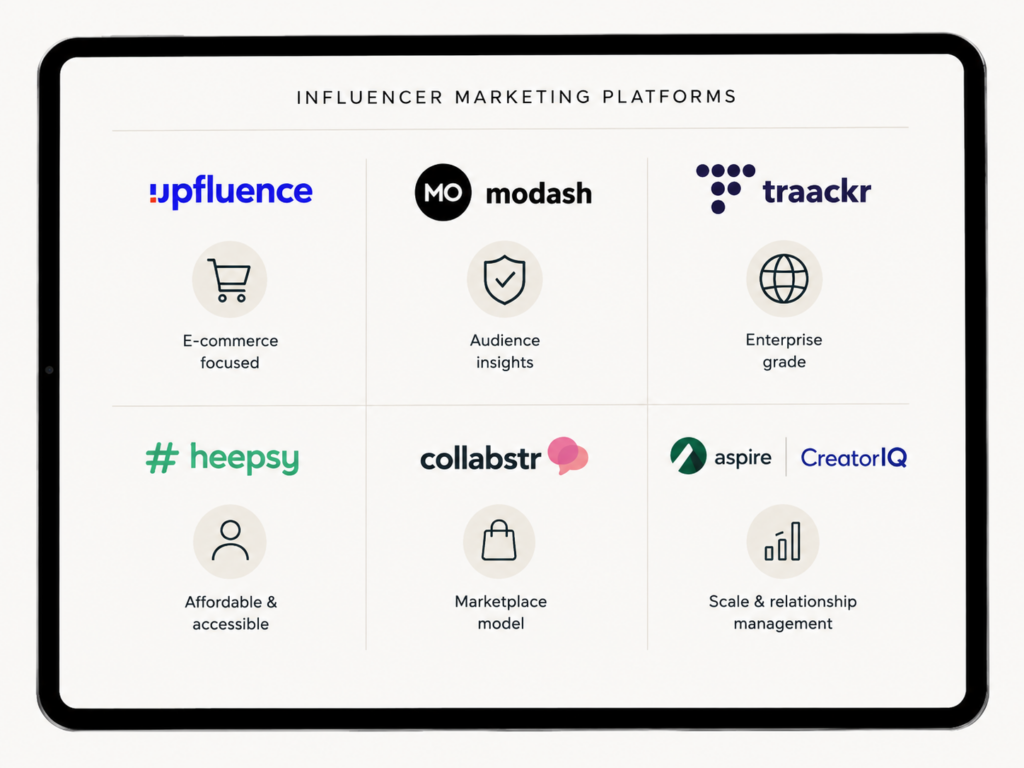
Here is an honest breakdown of what the major platforms actually do well:
Upfluence: Best for e-commerce brands that want to identify similar creators within their existing customer base. Integrates directly with Shopify and WooCommerce. Advanced filters let you find micro influencers based on niche, engagement rate, audience demographics, location, and brand alignment. Full campaign CRM for relationship management, contracts, gifting logistics, and post tracking.
Modash: Strong on audience authenticity verification and detailed creator analytics. Particularly useful for brands that need to vet engagement quality and check for fake followers before committing to a partnership. Covers instagram influencers, TikTok influencers, and YouTube influencers with filters for audience demographics by location, age, and gender.
Traackr: Designed for global brands that need precision, control, and transparency. Stands out with data-driven campaign planning and market-by-market spend optimization. Global influencer discovery tools across creators in over 50 countries. Best for enterprise brands managing micro influencer campaigns across multiple regions and target markets.
Heepsy: Lets you filter micro influencers by audience size, niche, location, and engagement rate. More accessible price point than enterprise creator databases. Good for brands running their first structured micro influencer marketing program before investing in more robust influencer discovery tools.
Collabstr: Marketplace model where micro influencers list themselves with rates and availability. Faster to a signed deal than relationship-first platforms. Better for one-off campaign needs than long-term ambassador programs.
Aspire and CreatorIQ: More robust options for brands managing multiple influencer relationships. Include analytics, vetting tools, and CRM-style dashboards. CreatorIQ in particular is designed for large marketing teams managing dozens or hundreds of micro influencers with advanced filters, historical data, and CRM integration.
What none of these influencer discovery tools replace: Human judgment on content relevance and brand alignment. Every influencer database will surface micro influencers who pass the data filters. Not every one of those creators will feel right for your brand. Spend time on their profiles, read their comments, watch their influencer’s content, and assess whether the voice, brand’s values, and audience actually align before reaching out.
Method 5: Google Search
Do not underestimate direct search to find micro influencers, particularly in content-heavy categories and B2B niches.
Search terms that surface micro influencers reliably:
- “[niche] influencer + [social media platform]” (e.g., “sustainable fashion brand influencer Instagram”)
- “best [product category] creators to follow”
- “[niche] blogger recommendations”
- “[your product] review [year]”
- “top [niche] YouTube influencers”
Listicle articles published by marketing blogs and niche media outlets regularly feature micro influencers who are active in specific categories. These lists are often compiled by people who have already done significant research into a target market, making them a useful starting point for influencer discovery.
Google also surfaces affiliate review content. Any creator who has published a review article optimized for search is signaling two things: they are creating content that drives purchase decisions, and they understand how to structure content around commercial intent.
Both are valuable signals for a brand looking to find micro influencers who can actually drive conversions from their loyal audiences, not just impressions.
Method 6: Affiliate Networks and Programs
This method is specifically valuable for brands building micro influencer marketing programs with a performance component.
Affiliate networks like ShareASale, Impact, and Amazon Associates contain large pools of content creators who are already set up to monetize their recommendations through tracked links and commission structures. Many of these creators are micro influencers who have built niche loyal audiences specifically because they produce genuine, helpful content that drives purchasing decisions.
The advantage of finding micro influencers through affiliate networks is alignment. Creators who are already operating in an affiliate model are comfortable with performance-based compensation, have the infrastructure to track and report on their performance metrics, and understand the commercial mechanics of the relationship.
For brands running or building affiliate programs, this overlap between micro influencer and affiliate is one of the most valuable opportunities in the influencer marketing industry. See our post on why you need affiliate influencer marketing for your business for a breakdown of how to structure this kind of program.
Method 7: Social Listening Tools
Social listening tools monitor brand mentions, keyword conversations, and content trends across social media in real time.
For micro influencer discovery, they surface something that standard influencer discovery tools miss: creators who are already talking about your brand, your product category, or the problems your product solves, without being prompted.
A micro influencer who mentions your brand organically is the most valuable kind of outreach target.
They already have a genuine relationship with your category, which means their influencer’s content about your brand will be more authentic and their loyal audiences will be more receptive.
Tools like YouScan, Mention, and Brandwatch track brand and keyword mentions across social media platforms and flag creators by reach and engagement rate.
Social listening tools help you find micro influencers who are genuinely interested in your niche, ensuring better audience alignment and more authentic content.
This method works particularly well for brands with some existing market presence. If nobody is talking about your brand or target market yet, the pool of organic mentions will be limited.
Method 8: Working with an Influencer Marketing Agency
For brands that want curated, vetted micro influencer recommendations without investing significant internal time in influencer discovery and vetting, working with a specialist influencer marketing agency is the most efficient path.
A good influencer marketing agency brings three things that influencer discovery tools and creator databases do not:
Existing relationships. Agencies that work regularly with micro influencers in your category have established relationships with creators who have already been vetted on content relevance, brand alignment, and professionalism. This significantly reduces the time between initial contact and signed agreement.
Category knowledge. The best micro influencers for a fashion brand are completely different from the best micro influencers for a B2B SaaS product. A specialist influencer marketing agency with genuine category expertise knows which creators perform in which contexts, not just which creators have the highest engagement rates.
Vetting infrastructure. Manual vetting of micro influencers at scale is time-consuming. Agencies that have developed systematic vetting processes across audience quality, past collaborations, brand alignment, and FTC compliance can compress what would take a brand weeks into a much shorter timeline.
At Vivian Agency, we source and vet micro influencers across beauty, health, lifestyle, and e-commerce with performance built into the brief from the start. If you want to talk through what a curated micro influencer marketing program would look like for your brand, book a free call.
How to Vet Micro Influencers Once You Find Them
Finding micro influencers is the first half of the process. The second half is determining whether they are actually the right micro influencers for your brand.
Here is the vetting framework we use for every creator we consider:
Check Engagement Quality, Not Just Engagement Rate
Engagement rate tells you the percentage of an audience that interacts with content. It does not tell you whether those interactions are real.
Look at the comment section manually.
Genuine high engagement looks like: specific questions about the product, personal anecdotes prompted by the influencer’s content, replies from the creator, and real conversations between followers. Fake followers leave generic phrases (“great post!”), emoji-only comments, comments in unrelated languages, and generate zero creator responses.
A micro influencer with a 4% engagement rate and meaningful conversations in their comments is worth far more than one with 6% engagement made up of generic reactions.
Verify Audience Authenticity
Tools like HypeAuditor, Modash, and Upfluence provide audience authenticity scores that flag accounts with suspicious follower count growth patterns, high percentages of fake followers, or engagement velocity that does not match organic growth curves.
HypeAuditor and Upfluence check if an audience is made up of real followers.
For any micro influencer you are seriously considering, running an audience audit through one of these influencer discovery tools before signing an agreement is non-negotiable.
Assess Niche Relevance
Look at the last 30 posts, not just the most recent 3.
You are trying to understand whether this creator is consistently creating content in your niche or whether your target market is one of many unrelated topics they cover. A micro influencer whose last 30 posts are coherently focused on sustainable living is worth far more to a sustainable product brand than a general lifestyle creator who occasionally posts sustainability content.
Content relevance and brand alignment are the filters that separate the best creator from a creator who merely passes the follower count threshold.
Review Past Collaborations and Existing Sponsored Content
Look at how the creator has handled previous brand partnerships. Specifically:
- Do they disclose partnerships properly per FTC requirements?
- Does their existing sponsored content feel authentic to their usual voice, or does it feel jarring and promotional?
- Do their loyal followers respond positively to brand partnerships, or does engagement rate drop significantly on sponsored posts?
- What other brands have they worked with, and does that brand alignment feel consistent?
A micro influencer who integrates brand partnerships naturally, discloses properly, and maintains high engagement on sponsored posts is both safer from a compliance perspective and more valuable from a performance perspective.
For a full breakdown of what FTC-compliant disclosure requires, see our affiliate marketing compliance checklist.
Check Platform Growth Trajectory
Consistent, gradual organic growth over 12 to 18 months is the pattern associated with micro influencers who have built genuine loyal audiences through content quality.
Flat or declining follower counts are not necessarily a red flag if engagement rate is strong. But sudden, sharp growth spikes are worth investigating, as they often indicate purchased fake followers.
Tools like Social Blade show historical follower count growth patterns that make organic versus purchased growth visible.
How to Approach Micro Influencers
The outreach message is where many brands lose micro influencers they could have partnered with.
Micro influencers in 2026 receive a significant volume of brand outreach. 83% of influencers are willing to work for product gifting alone if the brand alignment is right.
Brand alignment is the operative phrase.
The outreach message needs to demonstrate that you understand who the creator is, what their loyal audiences care about, and why the partnership makes sense for their community specifically.
A generic template that starts with “We love your content!” and ends with a commission rate will be ignored or declined.
A specific message that references a piece of their actual influencer’s content, explains clearly why your product is relevant to their target market, and leads with what the partnership offers the creator (not just what you want from them) will get a response.
Keep the initial outreach short. The goal of the first message is a conversation, not a signed contract. Cover:
- A specific reference to something they have created that is relevant to your product
- One sentence on why you think the partnership makes sense for their loyal audience
- What you are offering: product, rate, or both
- Their contact info for follow-up if they prefer email over DM
- A clear next step
See our guide on how to reach out to affiliates and manage responses for outreach templates and response management frameworks that apply directly to micro influencer outreach.
Red Flags to Watch For
Not every micro influencer who looks right on the surface is the right micro influencer. Here are the signals that should prompt a closer look or a pass:
Sudden follower count spikes. A micro influencer who gained 8,000 followers in a single week without a viral post has likely purchased fake followers.
Engagement rate that does not match follower count. A micro influencer with 50,000 followers and 30 likes per post has a problem. Either the audience is fake or the influencer’s content has lost its relevance.
No content relevance or niche consistency. A creator who posts about fitness, then cryptocurrency, then baby products, then travel has not built a focused audience. Their followers are a diffuse collection of people who followed at different points for different reasons, not a loyal audience in any specific niche.
No FTC disclosures on existing sponsored content. This is a compliance risk. If a micro influencer has not been disclosing their past collaborations with other brands, they may not understand the legal requirements, or they may not care about them.
Unwillingness to share audience demographics. A confident creator with real followers has no reason to withhold their audience demographics. Reluctance to share this data is a signal worth taking seriously.
Prices that do not match their performance metrics. A micro influencer charging macro influencer rates without the audience size or engagement rate to justify it has not calibrated their value accurately. This is not necessarily a reason to pass, but it is a negotiation signal.
Similar creators with very different results. If you can find similar creators in the same niche with stronger engagement rate and content relevance at a lower rate, that is worth factoring into your decision.
Building Long-Term Micro Influencer Relationships
The brands generating the strongest results from micro influencer marketing in 2026 are not treating it as a series of one-off transactions. They are building ongoing relationships with a core group of creators who become genuine authentic voices for the brand over time.
The recommended compensation model pairs a base fee with a 10 to 15 percent commission, plus tiered performance bonuses that creators unlock as they hit specific performance metrics and conversion milestones.
This structure aligns the creator’s financial incentives with your brand’s revenue goals, and it gives high-performing micro influencers a meaningful upside that a flat fee cannot offer.
Long-term relationships also produce compounding content value.
A micro influencer who has partnered with your brand for 12 months has published influencer’s content about your products that has accumulated views, saved posts, and social media platform visibility over time. That compounding content asset is significantly more valuable than 12 individual one-off campaign posts would be, even if the post count is the same.
For a full breakdown of how to structure micro influencer marketing programs with long-term value in mind, see our guide on how to set up an influencer affiliate program and our post on brands that work with micro influencers for real examples of how established brands have built these programs at scale.
Frequently Asked Questions
How many followers does a micro influencer have?
The definition varies by social media platform. Instagram influencers in the micro tier typically have between 10,000 and 100,000 followers. TikTok influencers operate in a different range, typically between 100,000 and 250,000, because the platform’s algorithmic reach means smaller follower counts can still achieve significant viewership.
YouTube influencers in the micro tier generally have between 10,000 and 100,000 subscribers. Some definitions set the lower boundary at 5,000 followers on Instagram, particularly for nano-influencer adjacent creators approaching the micro tier.
How much do micro influencers charge?
Influencer rates range from $10 to $100 per post for nano creators to $5,000 or more for macro influencers. 50% of influencers charge between $250 and $1,000 per post, and 83% are willing to work for product gifting alone if the brand alignment is right.
Instagram influencers in the micro tier typically charge $150 to $500 for a feed post and $200 to $700 for Reels. TikTok influencers typically range from $200 to $1,000 depending on niche and engagement rate. Creators in high-demand niches like finance, technology, and legal often charge significantly more.
What is the best social media platform for finding micro influencers?
It depends on your product category and target market. Instagram influencers remain the strongest option for nano and micro sponsored content and ambassador programs, with 80.8% of US marketers using it for influencer marketing campaigns. TikTok influencers deliver the highest short-term ROI and are essential for consumer brands targeting audiences under 35.
YouTube influencers provide the longest content lifespan, making them ideal for considered-purchase categories where in-depth reviews drive conversion. Pinterest works well for home, beauty, food, and lifestyle brands where visual discovery leads to purchase. Choose the social media platform where your target market actually makes purchase decisions, not just where they spend time.
How do I know if a micro influencer’s audience is real?
Run their profile through an audience authenticity tool like HypeAuditor, Modash, or Upfluence before committing to a partnership. Look at their follower count history on Social Blade for suspicious spikes. Manually review their comment section for signals of genuine high engagement: specific questions, real conversations between followers, and creator responses.
Also check the ratio of comments to likes. A healthy ratio on Instagram is typically 1 comment per 50 to 100 likes. Significantly lower comment ratios suggest low real follower engagement regardless of what the overall engagement rate appears to be.
Should I reach out to micro influencers directly or use an influencer discovery tool?
Both have their place. Direct outreach through Instagram DMs or email is more personal, shows genuine interest in the specific creator, and tends to result in stronger relationships. It is also time-intensive. Influencer discovery tools like Upfluence, Modash, or Collabstr reduce discovery and outreach time significantly but produce a more transactional initial dynamic.
For a first campaign with a small number of carefully selected micro influencers, direct outreach is usually the better approach. For scaling to 20 or more creator relationships, a platform or influencer marketing agency becomes necessary to manage the operational complexity.
For further reading on building creator programs that drive measurable results, see our guides on how to find affiliates for your brand, how to reach out to affiliates, why you need affiliate influencer marketing for your business, and how to set up an influencer affiliate program.