
Obviously, you cannot beat large companies by outspending them in ads because every single click still costs you as much as it does them and a limited budget may soon be spent.
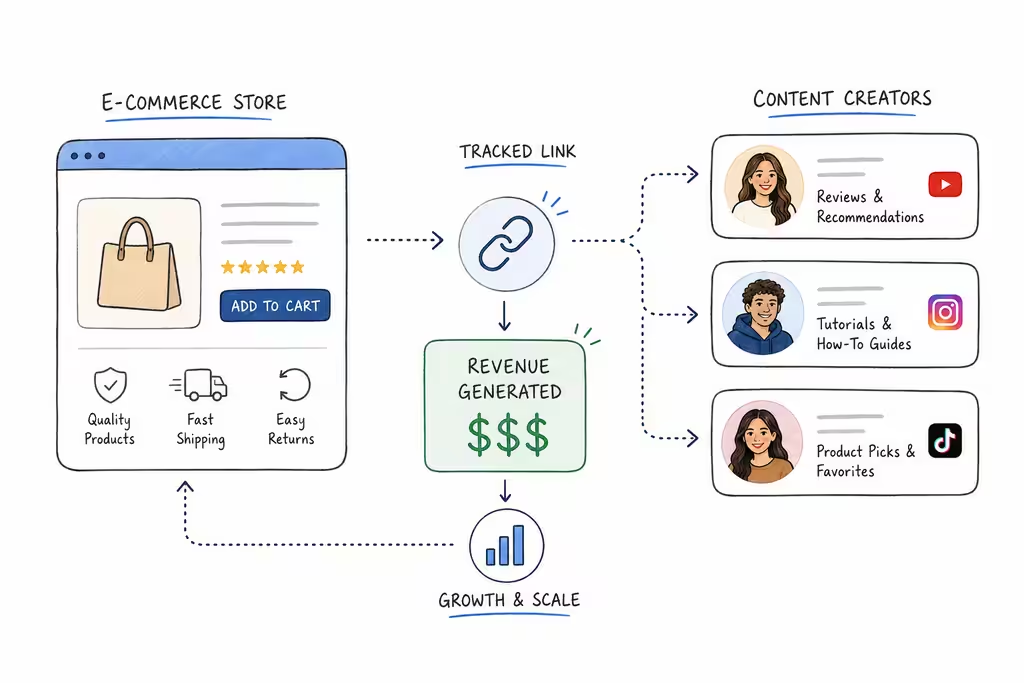
With affiliate marketing, however, you pay a certain commission after a sale, meaning your expenses will come second to income. This makes more sense for a smaller business to do.
That is why affiliate marketing for small brands deserves a different approach from a large retail launch. A small business affiliate program can begin with a handful of affiliate partners, a realistic commission structure and an affiliate marketing strategy built around products that already sell.
There are downsides of using affiliate programs too. The fact is that most small businesses operate on lower margins, are not well-known, and do not have enough personnel to launch an affiliate marketing campaign. All of the advice online is geared towards larger merchants and omits all three points.
The following manual is meant for the brands that struggle with these points. We will talk about calculating commissions, choosing a suitable structure, recruiting affiliates, the costs of different affiliate networks, and the terms and conditions that will allow a small affiliate marketing campaign to become profitable.
If you are setting up your own program, the aim is to find affiliates who can reach potential customers without adding more strain to your existing marketing efforts. A successful affiliate program starts with manageable costs, not the highest possible number of sign-ups.
Table of Contents
Overview
| Factor | What Small Brands Should Do |
|---|---|
| Initial budget | $0 if you use the free version or something like $30-$50 per month if you choose the paid version, plus a share of commission-based sales |
| Commission rate | 10% – 15% from the sale or fixed amount ($10-$15) for new customer orders |
| Window | 30 days sounds like a conservative choice |
| First affiliates | Your own customers, micro-creators from your niche, blog/letter/newsletter publishers from your category |
| Tools | Free or inexpensive affiliate program via an app which integrates with your online store |
| Payments | Monthly payments through PayPal or a bank account after the return period ends |
| Main risk | Discount stacking (both for customers and commission) that turns out to be negative for each sale |
| Results to start with | Expect a build-up period before you see compounding results |
Why Affiliate Marketing for Small Brands Makes Sense
First and foremost, affiliate marketing works best when you can’t afford to make guesses.
A commission fee is paid only when there is a transaction, therefore a low-income month will be pretty inexpensive for you. A low-income month spent on advertisement will be equal to a whole budget.
Unlike traditional advertising, this cost-effective form of digital marketing makes each sale easier to attribute to a particular affiliate link. It can complement other marketing channels rather than replace them, especially when a small business has limited cash to test campaigns.
Another benefit is that affiliates give you the trust of their audiences. A consumer who doesn’t know your brand yet might trust a person he follows in the blogosphere, on YouTube, or through their newsletter.
Good affiliate relationships come from people who already speak to your target audience. The right affiliate shares your product with their own target audience, while their recommendation provides social proof that your brand may not have built yet. This is where small businesses benefit from an existing community instead of trying to buy brand reach from scratch.
Not to forget about the content. Affiliates create reviews, comparisons, videos, and social posts, and you will get all the benefits of these pieces after they’ve been posted. No additional efforts required.
This promotional content could be a blog post, product comparison, YouTube channel review, or a series of social media posts. Some affiliate marketers also use email marketing and search engine optimization to drive traffic to product pages long after a campaign ends.
This is a large and developing channel. According to EMARKETER, US affiliate marketing spending in 2026 is predicted to reach 13.81 billion dollars, an 11.3% increase from 12.42 billion in 2025. According to the Performance Marketing Association, the average return on investment in 2025 was 12 for every dollar spent.
These are just the averages in the market. Yours depends on your margins and the affiliates you work with. Our affiliate marketing statistics page has the full picture.
Look Into Your Profit Margin First, When Deciding Commission Fee
Usually, small companies decide their commission fees depending on their competitors’ offers. Start with your own numbers.
For a small business, the most important question is what happens to profit margins after commissions, shipping, and discounts. It’s worth considering customer lifetime value as well: an initial order might introduce new customers who later make a subsequent purchase, depending on your attribution terms.
Let’s assume your product’s retail price is $60. The manufacturing cost is $18, shipping and packing – $6, and the transaction fee (2.9%) is $2.04. So, before any marketing expenses, you have $33.96 left.
A 15% commission is $9.00, leaving you with $24.96. And you got yourself a new customer without any clicks to pay for.
Now let’s add 10% customer discount that is usually given by affiliates. As a result, the product price is lowered to $54, and the processing fee is lowered to $1.87. 15% commission on the new price is $8.10. Now you get $20.03 left from the income.
Sure, this order remains profitable. However, the discount just took approximately one fifth of the profit you would receive otherwise. Apply two discounts or calculate the commission for already discounted products, and the profitability becomes very low.
Our recommendation is to set your rate according to the net profit. Determine your net profit per order, taking into account the cost of production, shipping and store fees, and pay 30% – 50% of it as a commission. For our example, it’s $10.19 – $16.98. The article suggests that you need at least 20% of net margin to pay 10% – 15% commissions.
Treat these calculations as a ceiling for your affiliate marketing program, rather than a reason to promise the highest commission in your category. A profitable program should account for refunds, promotional efforts, and the possibility that customers use more than one offer at checkout.
Before launching your affiliate program, take note of three important figures, as everything else will depend on them:
- Average order value
- Net profit per order before marketing
- Maximum commission per new customer
Commission Structures for Your Program
The simplest structures for small brands include three different models.
Your commission structure also shapes who will join the affiliate program. Before you recruit new affiliates, decide whether affiliates earn on completed sales only, or whether a verified qualified lead would ever count; not every small business needs a lead-based model.
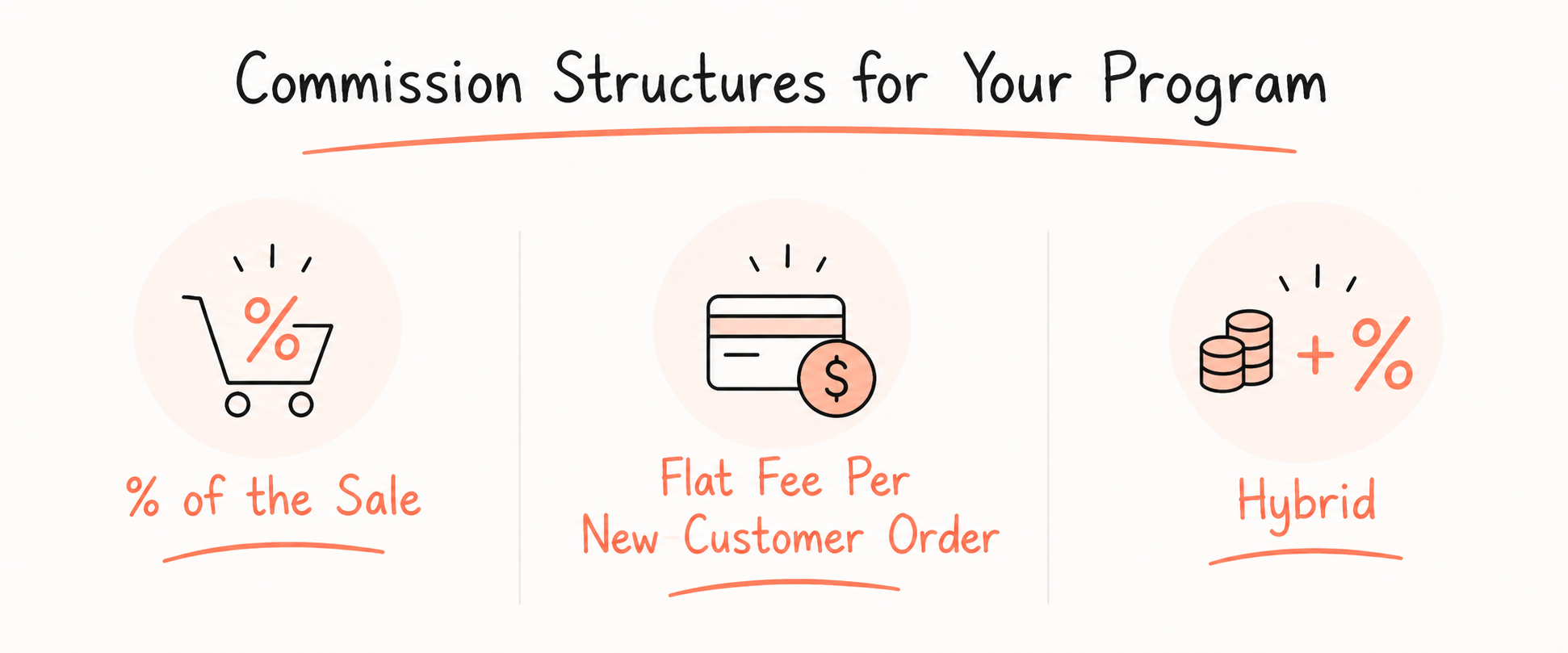
% of the Sale
The simplest model and the one your affiliates will expect, as ReferralCandy recommends, is a 10% to 15% of the sale baseline for most direct-to-consumer brands.
It’s flexible with the order size, meaning you are protected on low sales while incentivizing the creation of larger baskets.
For straightforward affiliate partnerships, paying a percentage per sale is easy to explain to affiliate marketers and simple to track. It also means affiliates earn more from higher-value orders without requiring separate rates for every product.
Flat Fee Per New-Customer Order
A flat fee of $10 to $15 per new-customer order is great for the brands with lower-priced products for which the percentage model will only pay an affiliate a few bucks. This also brings some predictability to the customer acquisition costs for you.
Hybrid
If your products come in a wide variety of price points, use the combination of a small flat bounty for the first order and a percentage-based structure for higher cart values. This way, small creators get their immediate reward, while your higher commissions work to reward them for larger baskets.
Two Early Refinements
Calculate your commissions exclusively on new buyers, so that you don’t have to pay the full commission to the affiliate on each purchase of your returning customers, who wouldn’t have bought your products without the affiliate anyway.
Exclude all sale items from the commissions – paying 15% on a product that is 30% off might end up costing you the money instead of making money on this order.
Check how consumer behavior affects repeat orders before changing your payout rules. For example, if customers often reorder, your affiliate agreement needs to specify whether a subsequent purchase qualifies for commission.
Benchmark Ranges for Commissions by Product Category
Below you’ll find the ranges that ReferralCandy published for new-customer orders. They should be used as a starting point and adjusted according to your own margins.
| Category | Commission Range |
|---|---|
| Apparel and accessories | 8%-15% |
| Beauty and personal care | 10%-18%, or a flat $10-$15 on entry products |
| Health and wellness | 8%-15% |
| Food and beverages | 8%-12%, or a flat $10-$12 |
| Electronics and gadgets | 5%-10% |
| Home and lifestyle | 8%-12% |
| Sport and outdoor | 8%-12%, up to 15% for high-value bundles |
| Pet Products | 10%-15%, or a flat $10-$15 |
Lower-margin product categories, like electronics, are at the bottom of these ranges as there is less margin to split. If you need more ideas of how to incentivize your affiliates with bonuses and tiers, see our guide to affiliate marketing incentives.
Two DTC Brands with Published Programs
Here are two examples of real affiliate programs from the brands that publish their terms online. In each case, the commission range falls within our benchmark range for the given category.
BeardBrand
BeardBrand is a men’s grooming company that pays 15% commission on each qualified buyer and operates under the 30-day cookie window. The program operates via AvantLink, and includes invitations to site owners, bloggers, YouTubers, and Instagram creators in the grooming and style niches. There is no information on payout timing or a minimum requirement.
Bite
Bite is a toothpaste tab brand that offers 15% to 20% commissions on all orders with 30-day attribution window. The affiliate program also includes a free welcome gift of products and access to new products and offers.
This kind of benefit costs a small brand very little and adds an extra incentive to your affiliate program over the commission rates alone.
Neither program has a complex structure. Each pays the simple percentage, operates under the standard window, and is very easy for a creator to agree with.
Recruiting: Who to Talk to First
Hundreds of affiliates don’t help you sell. Twenty or thirty that sell really well is all you need to start with.
When you find affiliates, look for audience relevance before reach. The best affiliates are often the ones who regularly help a niche audience choose products, rather than creators whose followers rarely buy. A smaller group of right partners can outperform a long list of inactive accounts.
Your Current Customers
Customers who buy from you understand the product and can sell it truthfully. And they know others who could use it. Reach out to your top clients via your thank-you email and order confirmation page. Their referrals are likely to be warm because people refer others like themselves.
Existing customers can become affiliate partners because they know why they bought the product. Keep the approval process simple, but make sure each applicant understands the promotional rules and the disclosures required. You don’t need to be in constant contact with every partner, but you should be available when they have questions.
Micro-Creators in Your Niche
Micro-affiliates are easier to contact than macros, and they are more willing to work for commission-only, especially if you throw in the product for free. Our detailed guide explains how to find affiliates.
Micro influencers are particularly useful when an affiliate marketing strategy overlaps with influencer marketing. Review their recent content, engagement, and audience fit during a short vetting process instead of choosing them based on follower count alone.
Niche Blogs and Review Sites
Small blogs ranking for “best [your category]” keywords can send you buyers for years. It takes some time to build a relationship with them, but this channel compounds.
A good review can attract potential customers who are comparing products already. These publishers may create content around a focused search query and link to your landing pages, which is why a small, relevant blog post can be valuable even without a huge audience.
Newsletter Writers & Community Owners
Imagine someone with 5,000 subscribers who are all interested in the same thing. This is a targeted audience and a trusted voice. One honest referral will perform better than a bigger and more chaotic social network.
Email marketing also gives affiliate partners a way to promote products to readers who opted in for their recommendations. The right publisher can explain a product in more depth than a brief social post.
Discount/Coupon Websites
It’s better not to use them at all. They attract buyers who were going to purchase anyway. And they usually bring discounts that eat into your margin. If you decide to work with these, pay them less commission and establish clear rules about when they can start promoting you.
The Price of Affiliate Software for Emerging Brands
There is no need to pay much money to launch the program. There are several tools offering free tier or a very low price point, and they integrate seamlessly with Shopify or other shopping carts. Below are published prices from each provider that were checked in October 2026.
| Platform | Entry Pricing | Paid Options | Additional Info |
|---|---|---|---|
| UpPromote | Free plan | Growth: $29.99/month + 2% referral sale fees; Professional: $89.99/month + 1.5%; Enterprise: $199.99/month + 1% | Paid tiers include 14 days free trial with no referral sales fee |
| GoAffPro | Free plan with unlimited affiliates and revenue | Premium: $49/month | Free plan has a branded affiliate portal, welcome emails, and analytics |
| Refersion | Free marketplace listing only | Launch: $39/month + 3% affiliate sale fee ($29/month with annual billing); Growth: $199/month + 2% | Tracking, approvals, and payouts require paid plan |
| Shopify Collabs | Free install | 2.9% fee on automatic payments is applicable | Provides creator recruiting pages, gifting, and automatic commission tracking |
| Awin | UK-based pricing, Access Plan: £99 + VAT/month with 3.5% fee per transaction | Accelerate Plan: £199 + VAT/month with 2.5% fee | Access Plan requires 3-month minimum term (first month free) |
For most emerging brands on Shopify, there is a question of whether to use free-tier software or move right away to their first paid plan. Start with the free tier if you’re just experimenting and have less than a dozen affiliates. Upgrade when you need a custom portal, bulk emailing capability, or advanced commission rules.
Compare affiliate marketing software by the features you will actually use: reliable tracking, clear reporting, the approval process and how payouts are handled. Different affiliate platforms vary in what their free plans include, so check the current terms before picking one for your own program.
Affiliate networks like Awin and Impact give access to a greater number of publishers, but they are designed for larger brands and for ongoing program management. If you run an in-house affiliate marketing program, you should choose a platform first. We are a Silver Impact Agency Partner and collaborate with UpPromote, so we build affiliate programs on both.
An affiliate network connects businesses to publishers, while standalone software helps a brand manage its own program. Both can work, but many programs become expensive when transaction fees and management time are added to monthly costs.
Building the Program One Step at a Time
Step 1: Calculate Your Commission and Ceiling
Use the math discussed above. Make decisions about the base rate, additional compensation of new customers, and exclusions.
For small business owners, this is also the point to decide what counts as a sale, whether returning customers qualify, and what affiliates earn when discounts apply.
Step 2: Select the Platform
Select the tool connecting to your store and performing functions like tracking, approval, and payment. You don’t have to develop spreadsheets, since there is a software that does the job.
Reliable tracking matters from day one. Test whether each specific link records clicks, attributes orders correctly, and stays visible in your reporting dashboard before inviting more affiliates.
Step 3: Create Clear Terms
Clear terms will protect you and clarify to the affiliates what they can and cannot do. It should include at least the following:
- Commission rate
- Tracking period, 30 days is sufficient
- Payout method, schedule and minimum balance
- Hold period equal to the return window
- Restrictions on using discount codes, competing with brand-name bidders and coupon websites
- Requirement to disclose the affiliate relationship
The details of a complete contract can be found in our guide to affiliate contract compliance and in FTC Endorsement Guide.
Treat these rules as the basis of your affiliate agreement. When you set expectations early, affiliate relationships are easier to manage, especially when partners want to discuss discount codes or upcoming sales.
Step 4: Develop Something for Your Affiliates
Your affiliates must be provided with a single page that gives them all the necessary information: what product is offered, what is the commission rate, etc. Product photos, a brief brand summary, allowed claims, and special offers should be provided too. Here are some examples of referral landing pages.
Your marketing materials should also include approved product images, a few clear talking points, and examples of promotional content. Make landing pages easy to navigate so visitors understand the offer after an affiliate shares a specific link. This helps creators promote products without guessing what they can claim.
Step 5: Recruit a Small Team of Affiliates First
Start with inviting five to ten people who you selected yourself. Provide free product where it is reasonable and personally follow up. You will learn much more from a small team you personally know than from a hundred strangers.
To find affiliates who are likely to stay active, start with people already discussing your category. Give new affiliates a short introduction, one or two useful ideas for social media posts, and enough room to create content in their own style.
Step 6: Launch and Monitor Every Week
Every week, for the first couple of months, check basic indicators: clicks, conversions, average order value, refunds and the portion of referred orders placed by new customers.
ReferralCandy recommends paying attention to earning per click, average order value, refunds, and the number of new customers weekly, and test changes to your base rate over 30-day periods. What metrics you can request is described in our guide to affiliate marketing reports.
Set aside a little time every week to track performance by partner and by marketing channel. A simple project management checklist can help you flag broken links, unanswered creator questions, and promotional efforts that drive traffic but fail to convert.
Pay Affiliates Regularly Without Hurting Your Cash Flow
Payout timing is especially important for a small brand because the financial consequences of even one bad month affect cash flow directly.
Set monthly fixed dates for payouts and provide such options as PayPal and bank transfer if the platform supports it. A low minimum balance will help affiliates receive payment earlier.
Keep every commission paid until the return window expires. Refund commissions for returned orders and specify it in your terms from the beginning.
Make a budget for commissions. An active affiliate program can lead to a spike in orders and therefore a large amount of commissions at the end of the month. You should estimate what commissions you can afford before launching the program.
Some people describe affiliate earnings as passive income, but most affiliates need to produce useful content and maintain their audiences to see consistent results. Clear payment schedules help maintain productive affiliate partnerships.
Affiliate Marketing Disclosure and Compliance
Affiliates are required to inform their readers about their affiliation and the presence of a commission. In the US, it is governed by FTC Endorsement Guides, while the UK and the EU have their own regulations.
Specify disclosure in your terms and provide affiliates with approved phrasing to use in different content forms. For instance, a short line placed near the link, like “I earn a commission if you buy through this link”, will work everywhere.
Make it clear where an affiliate link appears and what happens when someone buys through it. That way an affiliate marketing campaign isn’t relying on disclosures hidden elsewhere in the creator’s content.
More details on affiliate marketing disclosure and compliance are provided in our relevant guide.
Affiliate Marketing Mistakes that Small Brands Should Avoid
Giving Too Little to the Affiliate
It’s a waste of time if your commission rate leaves nothing for the affiliate. You should always make sure that the rate fits the margin.
Discount + Commission
Sometimes, people think they’re offering 20% off + a 30% commission. But this combo takes a whopping 40% of each order.
Building a Team of Inactive Creators
The number of followers means little for performance. It’s better to have five active affiliates than fifty inactive ones.
A strong small business affiliate program needs regular communication, not constant recruitment. Check whether affiliate marketers are posting, whether their content reaches the right target audience and whether they are sending qualified traffic.
Launching Without Tracking Test
Before sending the invitation emails to your prospective affiliates, make sure to place a test order through an affiliate link.
Not Engaging With the Best Performers
You’re likely to get the majority of your results from your best three affiliates. So talk to them, send samples, and increase their rates.
Use data to identify your top affiliates rather than assuming the largest account produces the most success. Your best affiliates may deserve early access to new products, better marketing materials, or different commission incentives.
Expecting Results Immediately After Setup
Affiliate marketing programs usually grow slowly. It takes time to create, rank, and promote content. Our guide on how long affiliate marketing takes to work will show you what to expect.
Why Partner With Us?
At Vivian Agency, we develop and manage affiliate programs for small brands that want results but don’t want to waste time on routine tasks. We deal with commission setup, platform integration, affiliate recruitment and management, payments, and reporting, so your small team focuses on the product development.
For brands without the in-house capacity for affiliate project management, outside support can help connect affiliate recruitment, reporting, and ongoing marketing efforts. The priority remains the same: increase sales while protecting the margins of your business.
If you would like to know what a realistic affiliate program may look like for your margins and industry, please book a free consultation call or visit our page with case studies.
FAQ
How much does it cost to start affiliate marketing for a small brand?
You may launch an affiliate program for $0 on a free tier of any of these platforms: UpPromote, GoAffPro. Paid tiers start at $30 to $50 a month with a percentage of affiliate sales. Your actual expenses will include commissions and any additional cost associated with free products that you will provide to creators.
What commission rate should a small brand offer?
The popular choice is 10%-15% commission from the sale or $10-$15 per new client. However, the ideal rate depends on your profit margin. You need to calculate the profit per order, and the commission shouldn’t be higher than 30% to 50%. Also, it shouldn’t include sales.
Do small brands need affiliate networks?
No, most small brands will do fine with a dedicated affiliate app. It integrates with their stores and is more affordable. Networks become more useful once you have the capacity to manage the affiliate program and need to access a larger pool of publishers.
The important question is not whether an affiliate network or a standalone tool is automatically better, but which one matches your budget, existing marketing channels, and capacity to manage partners.
Does affiliate marketing work for brands that nobody knows?
Yes, since affiliates rely on trust that their audiences already have in them. Just make sure that you have a good product page, an appealing offer, and a couple of reviews from creators within your niche.
How is affiliate marketing different from influencer and referral marketing?
The difference is that affiliates receive a certain percentage of each sale. Influencer campaigns pay a fixed fee for content regardless of whether there was a sale or not. As for referral programs, they reward your current customers for bringing new ones.
Many small brands use all of these marketing channels at once. Learn about how they differ from each other from our guide on affiliate marketing vs referral marketing.
Because affiliate marketing works through trackable outcomes, it can sit alongside influencer marketing, email marketing, and other digital marketing activities without demanding the same payment structure.
How many affiliates does a small brand need to start?
To test and understand the program, five to ten well-selected affiliates will suffice. Then you can add more once you understand which types of affiliates will bring you sales and how much you actually earn on each order.
Should I hire an agency or run the program myself?
You may successfully manage a small affiliate program on your own if you have the time. There are apps that are designed for self-management. Agencies become relevant when affiliate management starts taking too much time from you. Our guide on how to set up an influencer affiliate program shows how to do it both ways.
Read more about: affiliate marketing incentives, how to find affiliates for your brand, affiliate contract compliance, affiliate marketing reports and how to set up an influencer affiliate program.