
Yes. Affiliate marketing is a legitimate, legal, and well-established business model and online business opportunity, one that generates tens of billions of dollars in tracked, attributable revenue every year for brands ranging from solo DTC businesses to Fortune 500 companies.
Whether you are asking as a brand evaluating the channel or as a creator considering affiliate marketing as a path to passive income, the answer is the same: the model is real, and the income is real for those who approach it correctly.
But the question “Is affiliate marketing legit?” deserves a more thorough answer than a single word, because the skepticism behind it is entirely reasonable.
The affiliate marketing space does have bad actors. Affiliate marketing scams exist in several forms: fake gurus promising overnight wealth, pay-to-join schemes, fake affiliate programs that never pay out, and programs that encourage fraudulent affiliates to use fake leads or bot traffic to game commission systems. These are real affiliate marketing scams, and they are worth understanding in detail.
What they are not, however, is representative of the affiliate marketing industry. Affiliate marketing scams are a fringe problem in a mainstream channel, not the defining feature of it.

The global affiliate marketing industry is valued at $17 to $18.5 billion in 2025, with projections to exceed $20 billion in 2026. A market of that scale does not exist on the back of a scam. It exists because the underlying model works: brands pay for performance, publishers earn for results, and customers get product recommendations that help them make purchasing decisions.
This guide covers what legitimate affiliate marketing actually looks like, where affiliate scams live, how to avoid affiliate marketing scams, and what the channel genuinely offers both brands and creators in their affiliate marketing journey in 2026.
Table of Contents
Overview
| For Brands | For Publishers and Creators | |
|---|---|---|
| Is it legitimate? | Yes, performance-based marketing is one of the most accountable channels available | Yes, it is a real, legal income model used by millions of content creators worldwide |
| Who uses it? | 80%+ of brands, including Amazon, Shopify, Airbnb, NordVPN, and thousands of DTC companies | Bloggers, YouTubers, newsletter writers, social media creators, comparison sites, and niche publishers |
| How does it work? | Brands pay a commission only when a confirmed sale or lead is generated | Publishers earn a commission by promoting products through tracked affiliate links |
| Is it regulated? | Yes, by FTC guidelines in the US, GDPR in the EU, ASA CAP Code in the UK | Yes, affiliates must disclose their relationships with brands per FTC and equivalent international rules |
| What are the red flags? | Agencies promising guaranteed results overnight; networks with no transparent tracking | Programs requiring upfront fees to join; unrealistic income claims; no verifiable commission structure |
| Does it actually pay? | Yes, affiliate marketing returns an average of $12 for every $1 spent, per Shopify | Yes, 81.2% of committed affiliate marketers earn more than $20,000 per year |
What Affiliate Marketing Actually Is
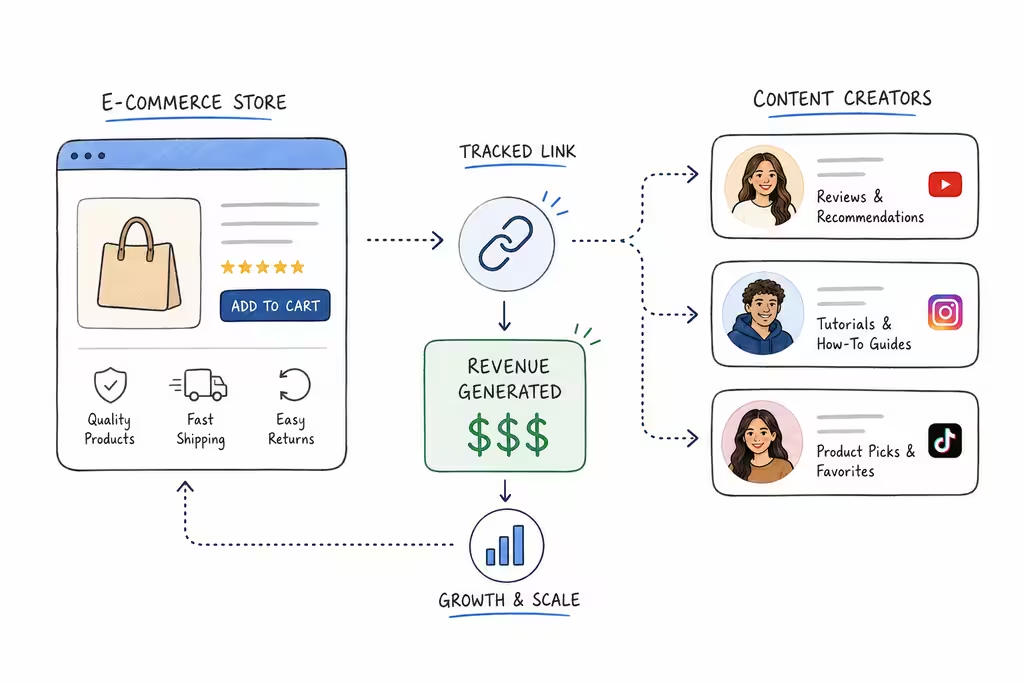
Affiliate marketing is a performance-based marketing model where a brand pays a commission to a publisher or creator every time that publisher drives a confirmed action – typically a sale, a lead, or a sign-up – through a tracked affiliate link.
Think about the last time you read a product review on a blog, clicked a link to buy something, and completed the purchase. The blog likely earned a small commission on that sale. You paid the same price you would have paid going directly to the brand’s website. The brand acquired a new customer without spending money on a click that might not have converted. The publisher earned income from content they created once and that continues generating traffic.
That is affiliate marketing in its most basic form. No deception. No upfront fees. No pyramid scheme. A brand pays for a result it received, and a publisher earns for website traffic it sent and sales generated through their unique tracking link. This is a pay per sale model, not pay per click or speculation, which is what makes it one of the most accountable performance-based marketing strategies available.
Affiliate marketing channels now influence 16% of US e-commerce transactions. Over 90% of e-commerce businesses are expected to leverage affiliate marketing by 2026, and 80% of brands already leverage affiliate programs to boost their sales.
These are not the footprints of a fringe scheme. They are the footprints of a mainstream marketing channel embedded in the commercial infrastructure of modern e-commerce. Is affiliate marketing real? The numbers answer that question clearly.
The Legal and Regulatory Framework
One of the clearest signals that affiliate marketing is legitimate is the regulatory framework that governs it. Illegitimate industries do not attract formal regulatory oversight from major government bodies. Affiliate marketing does.
In the United States, the Federal Trade Commission requires all affiliates to disclose their material relationship with brands in any content where they promote products in exchange for compensation. This means a blogger who earns a commission when readers click their link and buy a product must clearly disclose that relationship, typically with language like “this post contains affiliate links” or “I earn a commission if you purchase through this link.”
The FTC’s Endorsement Guides apply to any format: blog posts, YouTube videos, social media posts, email newsletters, and podcast mentions. Failure to disclose can result in civil penalties for both the affiliate and the brand. For a full breakdown of what compliance requires, see our affiliate marketing compliance checklist.
Legitimate affiliate programs operated by reputable brands and reputable companies in the US follow these guidelines as standard practice, and the presence of clear FTC disclosure requirements is itself evidence that affiliate marketing is a legitimate, regulated online business activity.
In the European Union, the General Data Protection Regulation (GDPR) governs how affiliate tracking cookies can be placed and what data can be collected through affiliate activity. Explicit consent is required before tracking cookies are placed on a user’s device.
In the United Kingdom, the Advertising Standards Authority’s CAP Code requires affiliate content to be clearly identifiable as advertising, with disclosure rules mirroring and in some areas exceeding the FTC’s requirements.
Tax obligations are also real. In the US, if you earn over $600 from a network, you will likely receive a 1099 form. Legitimate programs will ask for your tax information (W-9) before they pay you. Affiliate income is taxable income, reported and subject to self-employment tax in most jurisdictions. This is not how scams work. Scams avoid formal financial documentation.
The Numbers that Confirm Legitimacy
If there were any remaining doubts about whether affiliate marketing is legit as an industry, the data resolves it. These are not success stories from affiliate marketing gurus trying to sell you a course. They are figures from independent research firms and major industry bodies:
- The global affiliate marketing market is projected to reach $71.74 billion by 2034, representing a robust 15.2% compound annual growth rate.
- 83.15% of affiliate marketers believe in the potential of affiliate marketing to grow, according to Authority Hacker research.
- The global affiliate marketing industry reached a valuation of over $20 billion in 2024, demonstrating the increasing reliance of businesses on performance-based marketing strategies.
- Combining influencer and affiliate marketing tactics drives 46% more sales, according to Impact research from 2025.
- The majority of committed affiliate marketers, 81.2%, earn more than $20,000 per year, indicating that affiliate marketing delivers meaningful income for serious practitioners.
- 74% of brands increased their affiliate investment in 2025 due to rising costs in other marketing channels.
These numbers come from credible sources including the IAB, Grand View Research, EMARKETER, and Shopify, not from affiliate marketers promoting affiliate marketing. The industry is legitimate, growing, and increasingly mainstream.
Where the Scams Actually Live
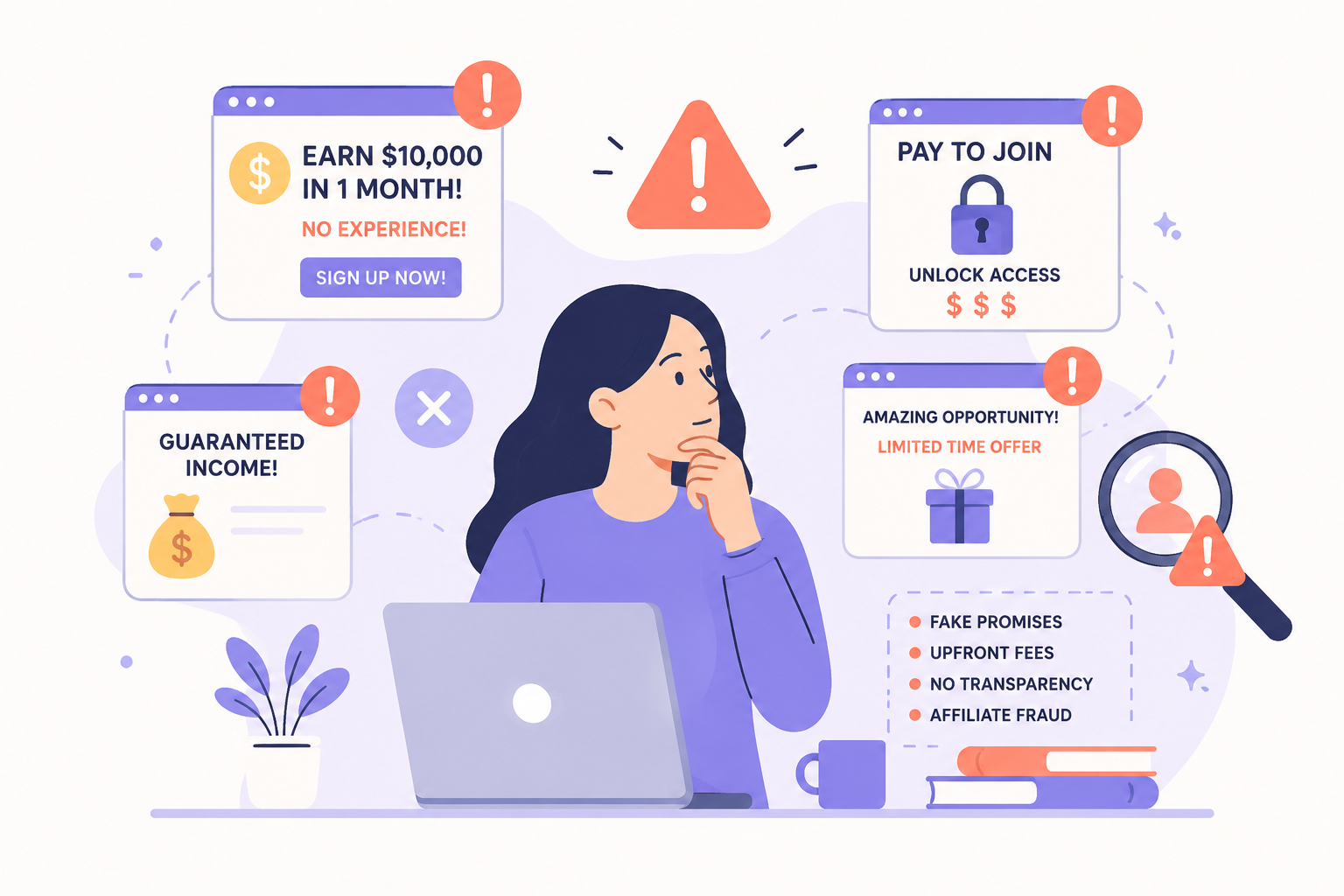
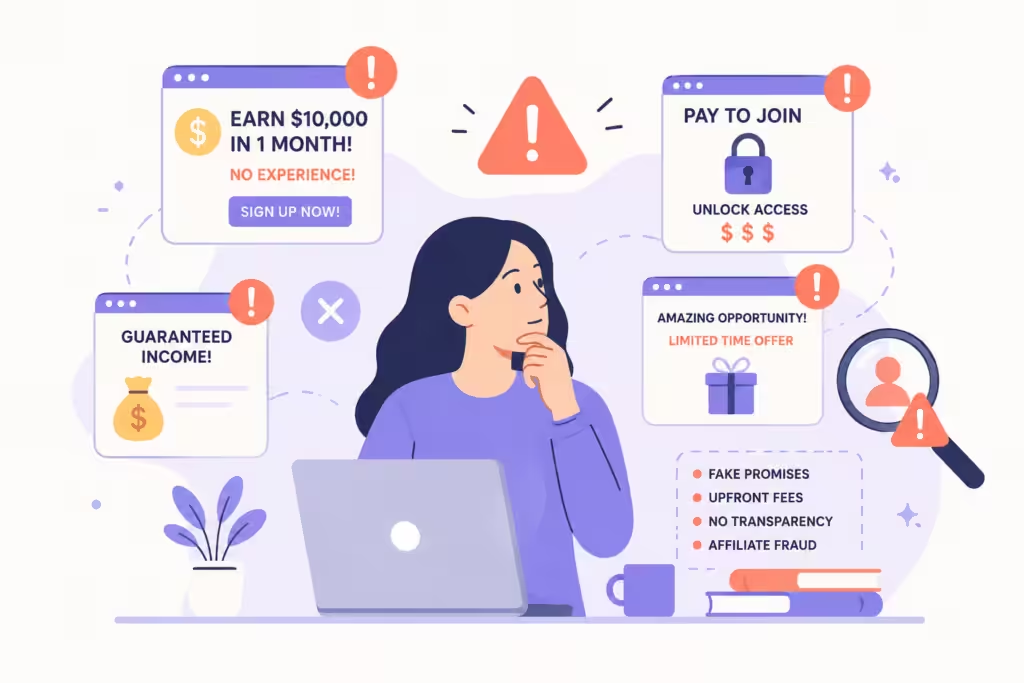
Acknowledging that affiliate marketing is legit does not mean every affiliate program or every “affiliate marketing opportunity” is legitimate. Affiliate scams are real. Common affiliate marketing scams follow predictable patterns, and knowing those patterns is the most practical thing this guide can offer anyone starting their affiliate marketing journey.
Pay-to-Join Programs
Legitimate affiliate programs offered by reputable affiliate programs and reputable brands are always free to join. If a program requires an upfront “registration fee,” “membership access fee,” or a mandatory product purchase before you can start promoting, that is a critical red flag.
This is the most common scam structure in the affiliate space, and it is worth being explicit about why: in a genuine affiliate program, the brand benefits when publishers drive sales. The brand has every incentive to make joining as frictionless as possible, because publishers who join and promote are valuable to them.
A program that charges you to join is making money from enrollment, not from sales generated through genuine promotion. That is not affiliate marketing. That is a pay-to-play scheme, and in many cases, it closely resembles an illegal pyramid scheme. This is one of the most common affiliate marketing scams and the easiest to avoid: if there are upfront fees, walk away.
Unrealistic Income Claims
“Earn $10,000 your first month, no experience needed!” Anyone who has built a real affiliate marketing business knows this is a fantasy. Genuine affiliate income requires strategy, valuable content, audience development, content creation, keyword research, and consistent effort over time.
Successful affiliate marketers emphasize consistent effort and audience trust above all other variables. Affiliate marketing scams of this type are particularly dangerous because they prey on people who are genuinely looking for legitimate ways to earn passive income online.
Success in affiliate marketing follows a power-law distribution: 41% of affiliates earn less than $1,000 monthly, while 15% earn between $80,001 and $1 million or more annually. Anyone presenting affiliate marketing as an easy, fast, or guaranteed income source is misrepresenting the channel, or selling something under its cover.
If you want real success stories from the affiliate marketing industry, they tend to come from people who treated their affiliate site as a serious online business, built audiences through valuable content and search engine optimization over years, and selected high quality products from reputable companies with strong commission structures.
Vague Commission Structures and Missing Payout Schedules
Always read the affiliate program’s terms before signing up. A legitimate program clearly explains how commissions are tracked, when payouts are issued, minimum payout thresholds, and acceptable promotional methods. Be cautious of vague language, missing payout schedules, or clauses that allow the company to withhold commissions without explanation.
Legitimate programs have transparent commission structures. You should know exactly what you earn per sale or lead, when payment is processed, what the minimum payout threshold is, and what promotional methods are permitted.
Programs that obscure these details are usually designed to avoid paying commissions earned, to commit fake sales attribution fraud, or to facilitate transaction frauds where affiliates earn commissions on returns or fraudulent orders. These are affiliate marketing scams at the program level, and they affect affiliate income that real publishers have genuinely earned.
MLM Programs Disguised as Affiliate Programs
Multi-level marketing (MLM) structures and affiliate marketing are fundamentally different, though they are sometimes deliberately confused.
In a legitimate affiliate program, affiliates earn commissions from promoting and driving sales of real, high quality products to potential customers. In an MLM structure disguised as affiliate marketing, your income primarily comes from recruiting new members who pay to join and then recruit more members.
This is one of the most sophisticated affiliate marketing scams because it uses affiliate marketing terminology while operating a fundamentally different and often illegal business model.
If a program spends more time explaining how much you can earn by referring other “affiliates” than explaining the actual product, treat it with significant skepticism.
Cookie Stuffing and Affiliate Fraud
On the brand side, the relevant concern is not whether affiliate marketing is legitimate, but whether the publishers you work with are using legitimate methods. Approximately 17% of affiliate traffic is fraudulent, meaning 83% is legitimate. The cost of affiliate fraud to brands is estimated at $3.4 billion annually.
Cookie stuffing, placing tracking cookies on users’ browsers without their knowledge to claim commissions on sales the publisher did not genuinely drive, is illegal, violates every major affiliate network’s terms of service, and is actively monitored by brand protection tools.
URL hijacking is a related form of affiliate marketing fraud where bad actors intercept or redirect a legitimate unique tracking link to substitute their own affiliate ID, stealing commissions from legitimate publishers.
It is not a feature of affiliate marketing. It is affiliate marketing fraud committed by bad actors within the space, in the same way that click fraud exists in paid advertising without making paid advertising illegitimate as a channel. Knowing these affiliate scams exist is what allows brands and publishers to build safeguards against them rather than writing off the entire channel.
For brands building affiliate programs, proper fraud detection and publisher vetting are the practical safeguards against this. See our post on how to find affiliates for your brand for a vetting methodology, and our guide on BrandVerity alternatives for affiliate monitoring for the tools that can help you detect and prevent fraudulent affiliate activity.
But Is Affiliate Marketing Legit? What Legitimacy Looks Like
For Brands
A legitimate brand-side affiliate program operated by reputable brands has the following characteristics. These are the signals that separate good affiliate programs from affiliate marketing scams at the program level:
Performance-based payment. You pay only when a confirmed sale, lead, or sign-up is generated through an affiliate link. No upfront spend on clicks or impressions that may or may not convert.
Transparent tracking and attribution. Every commission is tied to a tracked event, a click, a confirmed purchase, or an account creation through a unique tracking link, that you can verify in your affiliate platform’s reporting. Major brands including those on CJ Affiliate and Amazon Associates make this data fully transparent to advertisers. See our guide on what affiliate marketing reports to ask your agency for to understand what proper reporting looks like.
Clear program terms. Commission rates, cookie windows, prohibited promotional methods, payment schedules, and reversal policies are all documented in a formal affiliate agreement that publishers accept before joining. For a full breakdown of what to include, see our affiliate contract compliance guide.
Fraud prevention. Reputable affiliate programs and affiliate networks have fraud detection built in, actively monitor for policy violations, and terminate publishers found using deceptive methods.
Compliance infrastructure. Publishers are required to disclose their affiliate relationships per FTC guidelines and equivalent international regulations, and the program has mechanisms to verify and enforce compliance.
Some of the most recognizable global brands run affiliate programs as core acquisition channels, including Amazon, Shopify, Airbnb, NordVPN, Canva, and Semrush. The legitimacy of affiliate marketing as a brand-side channel is not in question. The variable is how well the program is structured and managed.
For a deeper look at building a program that drives real results, see our Kokido case study and Sposie case study.
For Publishers and Creators
A legitimate publisher-side affiliate operation has the following characteristics:
Free to join. No reputable affiliate program charges publishers to participate. If it costs money to start, it is not a legitimate affiliate program.
Real products with real demand. The affiliate products being promoted to potential customers exist, have genuine customers, and are sold through normal commercial channels. Successful affiliate marketers focus on high-quality products from reputable companies that they genuinely use and recommend, and build positive reviews and trust through valuable content rather than hard selling.
Trackable, verifiable earnings. Commissions are tracked through an established affiliate platform, such as Amazon Associates, ShareASale, Impact, CJ Affiliate, or UpPromote, and paid on a documented schedule to a verified payment method.
Disclosure compliance. Affiliates disclose their relationships with brands per FTC requirements in every piece of content, social media posts, and social media platforms where affiliate links appear. This applies to Google Adsense-adjacent content, pay per click promotions, and any other format where affiliates earn commissions.
Sustainable income timeline. 45.3% of affiliates struggle the most with getting traffic, according to Authority Hacker research, which tells you that real affiliate marketing involves real work. The income is real, but it is not instant, and it requires consistent effort, content creation, keyword research, audience development, and optimization over months and years.
Successful affiliate marketers who earn passive income and smart passive income from their affiliate site consistently describe the early months as the hardest, with results compounding significantly after the 6- to 12-month mark.
This is an online business, not a get-rich-quick scheme, and choosing affiliate programs carefully and selecting affiliate programs with strong commission structures and reputable brands behind them is what determines whether the effort pays off.
For a realistic picture of what the timeline looks like, see our guide on how long affiliate marketing takes to work.
Affiliate Marketing vs MLM: The Key Distinction
Because this distinction comes up often in discussions about affiliate marketing legitimacy, it is worth addressing directly.
| Legitimate Affiliate Marketing | MLM / Pyramid Structure | |
|---|---|---|
| How you earn | Commission on sales to genuine customers | Primarily from recruiting new members |
| Product requirement | Real product sold to real customers | Product often secondary to recruitment |
| Cost to join | Always free | Usually requires upfront payment or purchase |
| Income disclosure | Realistic expectations, verifiable earnings | Often relies on misleading income claims |
| Legal status | Legal in all major markets with disclosure compliance | MLMs occupy a legal gray zone; pyramid schemes are illegal |
| Income type | Passive income from content and audience | Active recruitment with no passive income potential |
| Scalability | Scales with audience size and content quality | Scales with recruitment, which has mathematical limits |
The simplest test: if the way you make money is by selling products to customers, it is affiliate marketing. If the way you make money is by recruiting other people who pay to join, it is an MLM regardless of what it calls itself.
Is Affiliate Marketing Right for Your Brand?
The question of whether affiliate marketing is legitimate is separate from whether it is the right channel for your business right now.
Affiliate marketing works best for brands with product-market fit, healthy margins that support commission rates competitive enough to attract quality publishers, and the operational capacity to manage publisher relationships over time. It works less well as a short-term spike channel, and it requires investment in setup, recruitment, tracking infrastructure, and ongoing management before it delivers meaningful results.
The brands that see the strongest returns from affiliate marketing, consistently generating 15% to 40% of total revenue from the channel, are those that treat it as a performance based marketing strategy to build rather than a tap to turn on.
They select major brands and reputable companies as benchmarks for commission competitiveness, promote products through affiliate managers who actively support their publisher network, and approach it as a legitimate online business channel requiring the same rigor as any other marketing effort.
For a full breakdown of what that looks like in practice, see our guide on how to set up an influencer affiliate program.
At Vivian Agency, we build and manage affiliate programs for brands across beauty, health, lifestyle, and e-commerce, from initial setup through publisher recruitment, onboarding, fraud monitoring, and performance optimization. If you want to understand whether affiliate marketing is the right fit for your specific business and what a realistic program would look like, book a free call and we will walk you through it honestly.
Frequently Asked Questions
Is affiliate marketing legal?
Yes. Affiliate marketing is legal in all major markets.
In the United States, it operates under the Federal Trade Commission’s Endorsement Guides, which require disclosure of affiliate relationships in all promotional content. In the European Union, GDPR governs tracking cookie consent. In the UK, the ASA CAP Code sets disclosure standards for affiliate advertising.
Tax obligations apply in most jurisdictions. Legitimate affiliate income is declared income, subject to income tax and in many cases self-employment tax.
Programs that ask affiliates to conceal their commission relationships or avoid tax documentation are the ones operating outside the law, not affiliate marketing as a channel.
For anyone beginning their affiliate marketing journey, understanding these regulations upfront is what separates legitimate affiliate marketing efforts from affiliate marketing scams that either ignore or deliberately exploit regulatory gaps.
How do I know if an affiliate program is legitimate or a scam?
The clearest indicators of a legitimate affiliate program: it is free to join, it has a clear and documented commission structure, it pays through a verifiable payment method on a documented schedule, it requires affiliate disclosures, and it is operated through a known affiliate network or directly by a recognizable brand.
The clearest red flags of a scam: upfront fees to join, unrealistic income promises with no specifics, a commission structure that depends more on recruiting other affiliates than on selling products to customers, missing or vague payout terms, and no verifiable company information or contact details.
For a comprehensive breakdown of what a compliant program looks like, see our affiliate marketing compliance checklist.
What are the most common affiliate marketing scams to watch out for?
The most common affiliate marketing scams follow five patterns. First, pay-to-join programs that charge upfront fees to access “exclusive” affiliate opportunities — legitimate affiliate programs are always free.
Second, fake affiliate programs that collect your personal and payment details but never process commissions, citing vague reasons to withhold payment indefinitely.
Third, pyramid scheme structures disguised as affiliate marketing, where your income depends primarily on recruiting other affiliates rather than on sales generated from promoting real products.
Fourth, affiliate marketing fraud at the publisher level, including cookie stuffing, URL hijacking, fake leads, bot traffic, and fake sales designed to generate commissions on activity that did not genuinely occur.
Fifth, get-rich-quick courses and smart passive income gurus who sell the idea of effortless affiliate income while the real business model is selling the course, not affiliate marketing itself.
Avoiding affiliate marketing scams comes down to three principles: never pay to join a program, verify that the company and products are real before promoting them, and treat any promise of substantial income without consistent effort as a red flag.
Can you actually make money with affiliate marketing?
Yes, though the realistic picture is more nuanced than most affiliate marketing content suggests. The average affiliate marketer generates $8,038 per month, translating to approximately $96,000 annually, but 41% of affiliates earn less than $1,000 monthly, while 15% earn between $80,001 and $1 million or more annually.
Income in affiliate marketing is highly dependent on niche selection, traffic source, content quality, program selection, and consistency over time.
Successful affiliate marketers in the upper income brackets typically run affiliate marketing as a full online business, with multiple affiliate sites, diversified affiliate networks, and significant investment in valuable content and search engine optimization.
They earn passive income from content published months or years ago, not from a single week’s work. For a realistic breakdown of income timelines, see our guide on how long affiliate marketing takes to work.
For further reading on building and scaling legitimate affiliate programs, see our guides on how to set up an influencer affiliate program, affiliate contract compliance, how to find affiliates for your brand, the full affiliate marketing compliance checklist, and what affiliate marketing reports to request from your agency.