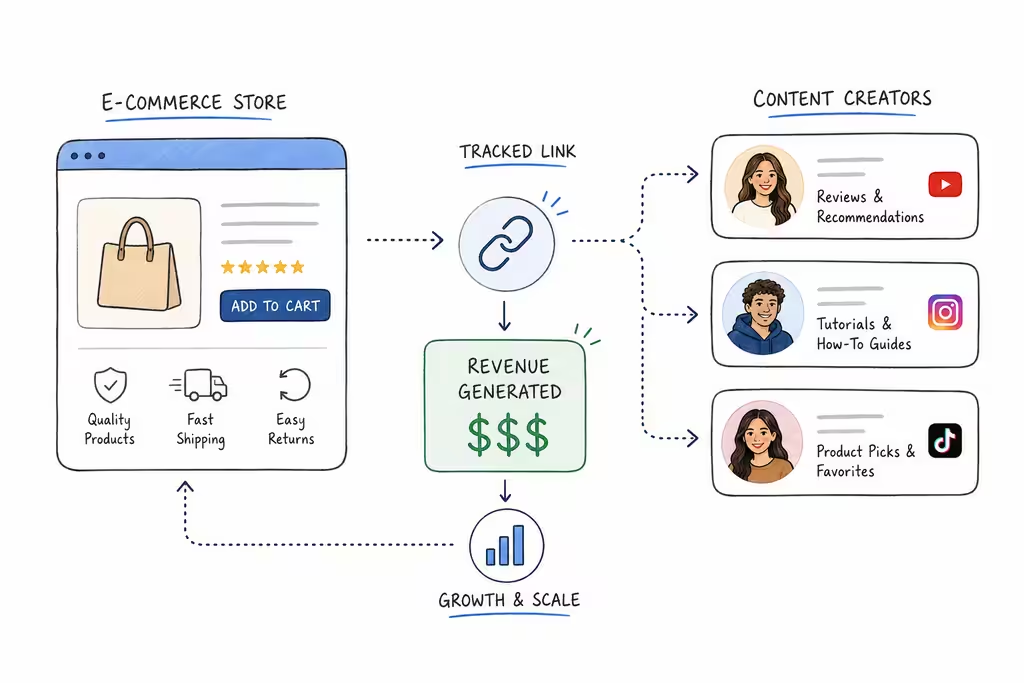

Affiliate marketing now accounts for approximately 16% of all online sales in the US, making it one of the most cost-effective marketing channels for e-commerce brands. But one of the most consistent patterns we see across brands working with affiliate agencies is this: they are paying for a program they cannot assess clearly.
They get a monthly summary. Maybe a spreadsheet with clicks and commissions. And they assume that is what reporting looks like. It is not.
A well-managed affiliate program generates rich, layered affiliate data at the publisher, marketing channel, product, and customer levels — data that should be driving your affiliate marketing strategies and business goals, not sitting in a platform dashboard your team never opens.
This guide covers every affiliate marketing report you should be receiving from your affiliate marketing agency, what each one tells you, and what the absence of any of them signals about how your program is actually being managed.
Whether you are working with a specialist affiliate agency or managing influencer partnerships and affiliate partners through a broader digital marketing strategy, these are the affiliate marketing reports that separate accountable partner management from guesswork.
Table of Contents
Overview
| Report | What It Covers | How Often |
|---|---|---|
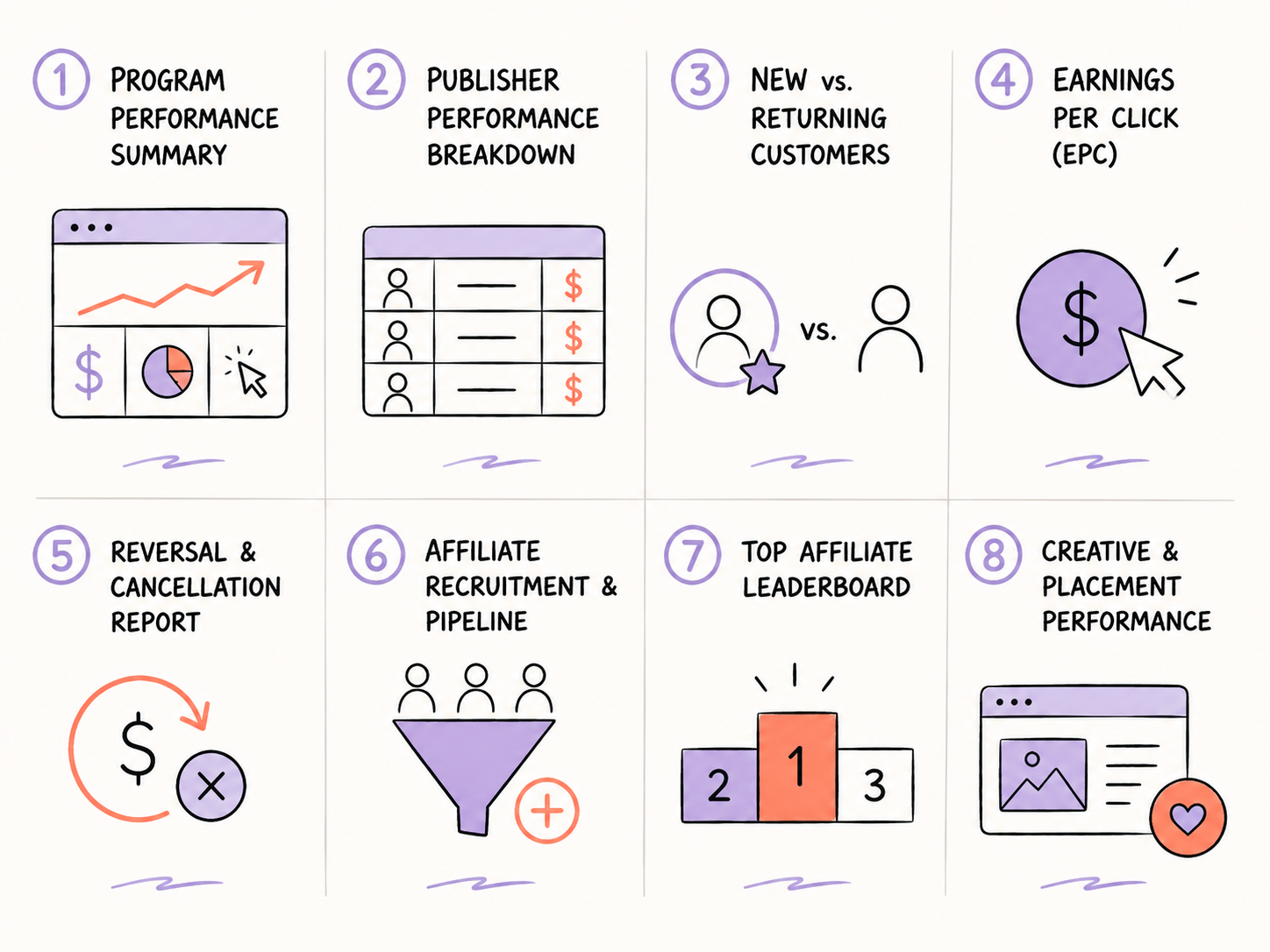
| Program performance summary | Revenue, clicks, conversions, ROAS, commissions paid | Monthly |
| Publisher performance breakdown | Revenue and conversion rate by individual partner | Monthly |
| New vs. returning customer report | What percentage of affiliate sales are genuinely new customers | Monthly |
| Earnings per click (EPC) report | How much revenue each affiliate partner drives per click | Monthly |
| Reversal and cancellation report | Commission reversals, fraud flags, and refunded sales | Monthly |
| Recruitment and pipeline report | New partners recruited, applied, approved, and activated | Monthly |
| Top affiliate leaderboard | Ranking of your top performers with trend data | Monthly |
| Content and creative performance | Which creatives, links, and placements drive the most conversions | Quarterly |
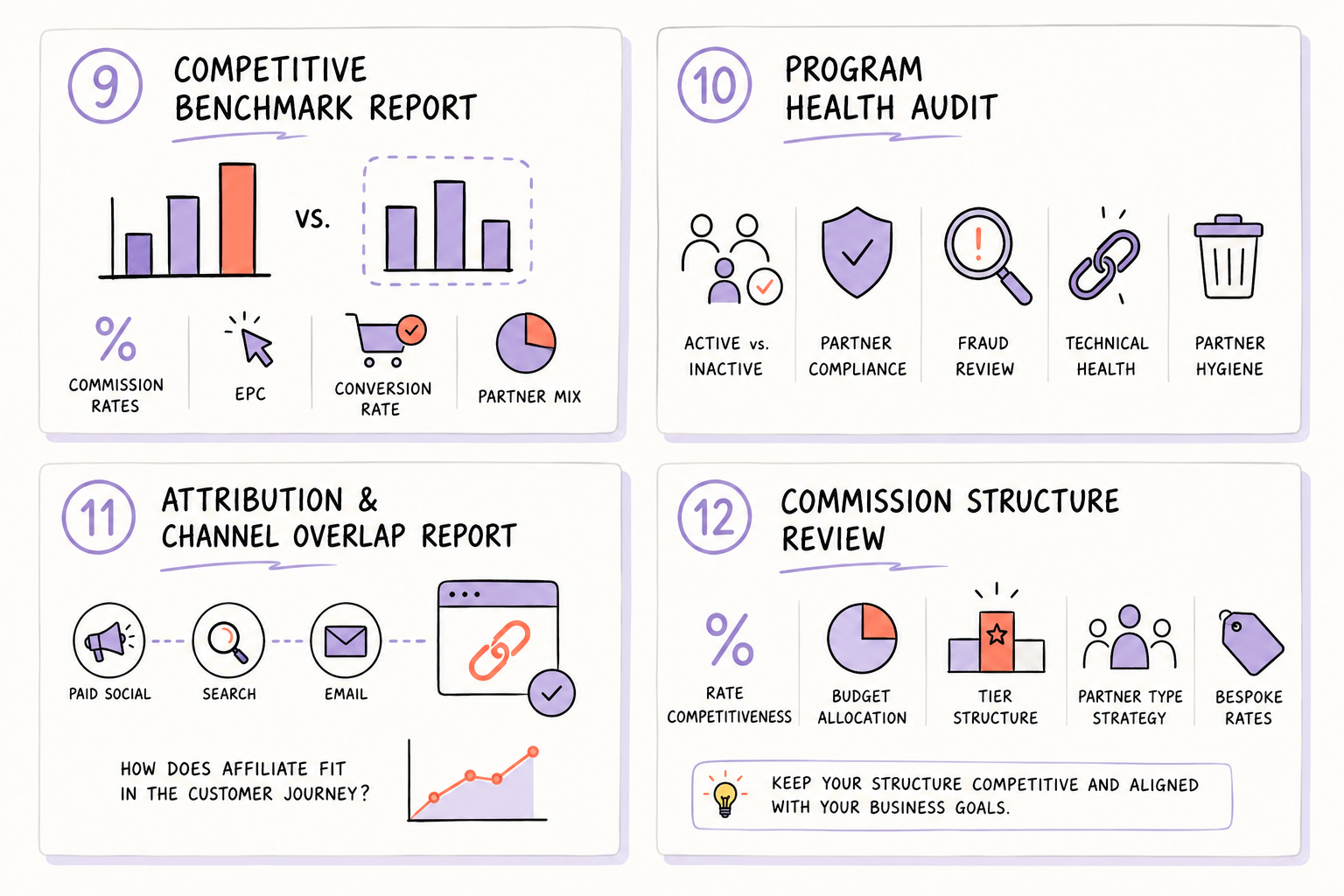
| Competitive benchmark report | How your program compares to category benchmarks | Quarterly |
| Program health audit | Active vs. inactive partners, fraud signals, compliance flags | Quarterly |
| Attribution and channel overlap report | How affiliate marketing interacts with other channels in the customer journey | Quarterly |
| Commission structure review | Whether your rates are competitive and driving the right behavior | Quarterly |
Why Most Brands Don’t Get the Reports They Should
Before getting into what to ask for, it is worth understanding why the reporting gap exists in the first place.
Affiliate agencies often operate across dozens of client affiliate programs simultaneously, across multiple marketing channels and partner types. Producing rich, customized reporting takes time. Some agencies simplify their reporting to what can be pulled with minimum effort from the affiliate platform’s default dashboard and call it a monthly report.
The second reason is more uncomfortable: some agencies prefer to keep reporting at high levels because it makes performance harder to interrogate. If your affiliate agency’s monthly affiliate marketing report shows “clicks up 12% and commissions paid $X,” you have no basis to question whether those clicks came from high-quality affiliate partners, whether the commissions were earned on genuine new customer purchases, or whether the program is actually growing or just generating inflated numbers.
The third reason is that many brands simply do not know what to ask for. Most performance marketing teams are fluent in paid search and paid social reporting. Affiliate marketing reporting has its own vocabulary, including EPC, reversal rate, publisher tier, and new-to-file rate, which takes familiarity to interrogate confidently.
This is especially true as the creator economy has expanded the definition of an affiliate partner to include influencer partnerships, content marketing collaborators, and digital products promoters alongside traditional publishers.
The 8 Reports You Should Receive Every Month
1. Program Performance Summary
This is the headline affiliate marketing report — the top-line view of how your affiliate program is performing against your business goals and marketing budget allocation. A solid program performance summary covers:
- Total revenue attributed to the affiliate channel
- Total commissions paid out
- Return on ad spend (ROAS) for the affiliate channel
- Total clicks and click-through rate
- Total conversions and overall conversion rate
- Month-over-month and year-over-year comparisons for each metric
- Program spend as a percentage of affiliate-driven revenue
Affiliate campaigns deliver an average return on ad spend of 12:1, according to Shopify, making ROAS one of the most important headline metrics to track. If your program summary does not include ROAS, you have no way to assess whether affiliate marketing is delivering better, worse, or comparable returns compared to your other marketing channels. This is the foundational question for any marketing budget decision about the channel.
What to watch for: a program performance summary that shows only gross commission spend, without revenue attribution, is incomplete. Affiliate marketing reports that cannot connect affiliate budget spend to incremental revenue are not giving you what you need to make strategic decisions.
2. Publisher Performance Breakdown
This is the most operationally important report in affiliate marketing and the one most commonly delivered in a watered-down form.
A publisher performance breakdown shows you at the individual partner level:
- Revenue generated per partner
- Clicks sent per partner
- Conversion rate per partner
- Commissions paid per partner
- Average order value of customers referred by each partner
- Partner type (content, coupon, cashback, loyalty, influencer)
Publishers care about earnings per click, approval consistency, and how reliably an offer converts across their audience. Your affiliate marketing agency should be tracking exactly these metrics because understanding what drives partner performance is what allows them to recruit the right affiliate partners, maintain strong relationships, and build long-term partnerships that drive sustainable growth.
What to watch for: concentration risk. If your top three affiliate partners account for more than 60% of your affiliate revenue, your program is fragile. This kind of partner concentration risk is one of the clearest signals of poor affiliate program management. A publisher performance breakdown should flag this, and your affiliate agency should be actively running partner recruitment to diversify.
3. New vs. Returning Customer Report (New-to-File Rate)
This is one of the most important and least commonly provided reports in affiliate marketing. It tells you what percentage of purchases made through affiliate links were from customers who had never bought from you before.
This matters because the affiliate channel’s primary job is customer acquisition. If a large proportion of your affiliate-attributed online sales is coming from existing customers who would have purchased anyway, you are paying commissions on sales you would have made without the affiliate program. That is not incremental revenue. That is margin erosion — and it is one of the most common ways affiliate marketing spend gets misallocated in a competitive market.
A healthy new-to-file rate varies by category, but for most consumer brands the affiliate channel should be driving more than 50% new customers. If your program is significantly below that, it is likely that coupon affiliates and cashback partners are capturing existing customers at checkout rather than introducing new ones.
What to watch for: if your affiliate marketing agency cannot provide new vs. returning customer data, it is a signal that attribution is not being tracked at sufficient depth — and that your affiliate marketing reports are not giving you the actionable insights needed to measure true incremental growth.
4. Earnings Per Click (EPC) Report
EPC measures how much revenue your affiliate program generates for every click sent by affiliate partners. It is one of the most important metrics in affiliate marketing reporting because it speaks directly to partner value. It is calculated by dividing total revenue by total clicks.
EPC matters for two reasons. First, it is the primary metric publishers use to evaluate whether your program is worth promoting. A low EPC signals to potential affiliate partners that your offer does not convert well for their audience, which limits your ability to recruit quality partners. An EPC above $1.00 generally signals a profitable, scalable program, while top-performing fashion programs regularly see EPCs of $1.50 to $3.00.
Second, EPC trends over time reveal the health of your conversion funnel and the overall performance of your affiliate marketing strategies. In 2026, declining EPC is often linked to AI-generated search results, reducing organic discovery traffic — one of the key affiliate marketing trends affecting content-heavy affiliate partners.
Your monthly report should show EPC by publisher, by partner type, and at the program level, plus trend data showing whether EPC is improving or declining month-over-month.
5. Reversal and Cancellation Report
A reversal is when a commission is canceled — either because the order was returned, the transaction was fraudulent, or it violated the program’s terms. Your reversal rate is the percentage of commissions that are reversed after being credited.
The reversal and cancellation report is where fraud, coupon affiliates’ abuse, and program policy violations show up in the affiliate data. It is a critical tool for maintaining program integrity and ethical practices in your affiliate network.
A healthy reversal rate for most programs sits below 10%. Above that, you likely have one of three problems: high return rates on the products being promoted, coupon stacking or cashback abuse by affiliate partners, or outright fraud.
What to watch for: a high reversal rate from a specific partner is a red flag that warrants immediate investigation. If your agency is not providing reversal data by partner, they may be obscuring a fraud or abuse problem that is costing you real money.
6. Affiliate Recruitment and Pipeline Report
This report shows what your affiliate agency is doing to drive growth, not just manage what is already there. Partner recruitment is one of the most important ongoing activities in affiliate program management, and one of the most commonly under-reported. A solid recruitment report covers:
- Number of new affiliate partners recruited in the period
- Number of affiliate applications received and approval rate
- Number of newly recruited partners who have activated (posted at least one sale)
- Partner types targeted in recruitment outreach
- Outreach activity: emails sent, responses received, partnerships initiated
Affiliate program growth comes from two things: improving the performance of existing partners and recruiting new ones. If you are only receiving performance data on your current partner set, you have no visibility into whether your agency is actively building the program or just managing a steady state.
What to watch for: if your affiliate agency has consistently recruited fewer than five new active affiliate partners per month, ask why. Either partner recruitment is not being prioritized, or the program’s commission structure is not competitive enough to attract top-performing partners in your affiliate network.
7. Top Affiliate Leaderboard
A simple but important report: a ranked list of your top-performing affiliate partners by revenue, with trend data showing whether each is growing, flat, or declining month-over-month.
The leaderboard has two practical uses. First, it identifies which partner relationships deserve more investment — exclusive rates, early access to new products, or dedicated creative support.
Second, it flags partners who are slipping. A top affiliate partner who was consistently in the top five and has dropped to fifteenth is usually signaling something: they have shifted their promotional focus, they have a better-converting offer from a competitor, or there is a relationship issue that has not surfaced yet.
Your affiliate marketing agency should be proactively managing long-term relationships with the top 20% of your partner list, because that 20% typically drives 80% of your affiliate marketing revenue. Maintaining trust and long-term value with these top-performing partners is one of the highest-ROI activities in affiliate program management.
8. Creative and Placement Performance Report
This report shows which creatives — banners, text links, product links, and coupon codes — are generating the most clicks and conversions, and where they are being placed.
Most brands provide affiliate partners with a library of creative assets and then have no visibility into what gets used and what does not. A creative performance report closes this gap. It tells you which assets are driving conversions, which have stopped performing, and where your top affiliate partners are actually featuring your brand across their marketing channels — whether that is email marketing, content marketing, social, or direct links.
This data feeds directly into your creative brief for the next period. If a specific product image consistently outperforms lifestyle photography, that is a signal to prioritize in your next asset batch. If a particular call to action is generating three times the CTR of alternatives, that belongs in everything.
The 4 Reports You Should Receive Every Quarter
1. Competitive Benchmark Report
This affiliate marketing report compares your program’s key metrics against category benchmarks — including commission rates, EPC, conversion rates, and partner type mix — to assess whether your affiliate program is competitive enough to attract and retain quality affiliate partners in a competitive market.
Core benchmark metrics should cover advertiser spend, revenue contribution, fully loaded ROI, conversion rate by partner type, and attribution terms. These reveal whether the channel is actually paying back or only looking healthy in last-click attribution reporting. A competitive benchmark report adds external context: not just how you are performing, but how you are performing relative to comparable programs in your category.
For reference, good affiliate conversion rates in 2026 range from 1% to 5%, depending on niche and traffic quality. E-commerce averages sit around 1 to 3%, while high-intent niches like software or finance can reach 4 to 8%.
Understanding where your program sits relative to the broader affiliate industry is essential for making evidence-based decisions about your affiliate budget and marketing spend allocation across channels.
2. Program Health Audit
A quarterly program health audit looks at the structural integrity of your affiliate program, independently from performance metrics. It is the affiliate marketing report that ensures your program structure is sound before you invest more affiliate budget into scaling it. It covers:
- Active vs. inactive partner ratio: what percentage of your approved affiliate partners have generated at least one sale in the past 90 days. Industry benchmarks suggest 10 to 20% of your total affiliates should be genuinely active, driving at least one sale per month
- Partner compliance: Are affiliate partners following your brand guidelines, disclosing properly per FTC requirements, and not bidding on your brand keywords?
- Fraud detection review: any affiliate partners showing anomalous click patterns, sudden traffic spikes, or unusual reversal rates: these are signals that require immediate investigation to protect program integrity and data transparency
- Technical health: are all tracking links functioning correctly? Are there broken creatives in your asset library?
- Partner hygiene: are there affiliate partners who should be deactivated due to inactivity, policy violations, or irrelevance to your current program strategy?
A program health audit is the equivalent of a compliance check. It is not about top-line performance. It is about whether the foundations of the program are sound. Many brands skip this and then discover, twelve months in, that a significant portion of their approved affiliate partners have never generated a single sale, or that a partner has been bidding on their brand name in paid search for months.
3. Attribution and Channel Overlap Report
Affiliate marketing rarely operates in isolation. A customer who ultimately purchases through an affiliate link has often been exposed to a paid social ad, a search result, and an email marketing campaign before clicking the affiliate link that gets credited with the sale.
The attribution and channel overlap report examines how affiliate marketing interacts with the rest of your marketing channels in the customer journey. It is the report that connects affiliate marketing to your broader digital marketing strategies and shows where the channel sits in your overall marketing budget allocation. It answers questions like:
- What percentage of affiliate-attributed sales have a prior touchpoint from another channel?
- Is affiliate primarily capturing customers at the bottom of the funnel through last-click attribution, or is it involved earlier in the customer journey as a performance channel for awareness and consideration?
- Are there channel conflicts — for example paid search ads running on branded terms that compete with affiliate traffic?
This report is essential for brands that want to understand affiliate’s true incremental contribution rather than its last-click credit. The best affiliate agencies prove incrementality by verifying that the incremental revenue and incremental growth attributed to affiliate would not have occurred through other marketing channels. This is what transforms affiliate marketing from a last-click attribution line item into a measurable, strategic performance channel within your digital marketing mix.
4. Commission Structure Review
Once per quarter, or whenever program performance materially shifts, your affiliate agency should review whether your commission structure is still calibrated correctly for your business goals. Commission optimization is one of the most direct levers in affiliate program management and one that most affiliate marketing agencies do not revisit often enough.
A commission structure review examines:
- Whether your base commission rate is competitive relative to category benchmarks. Commission rates typically range from 5% to 30% across programs, and being significantly below your category average makes partner recruitment consistently harder
- Whether your affiliate budget is being allocated efficiently across partner types, since coupon affiliates, content marketing partners, and influencer partnerships often require different commission structures to drive long term value
- Whether your tiered commission structure is driving the right behavior from top performing partners
- Whether specific partner types (coupon vs. content vs. influencer) should be on different commission structures
- Whether new product lines or seasonal categories warrant temporary commission adjustments
- Whether any affiliate partners should be on bespoke rates based on their performance and strategic value
Commission structures are often set at program launch and then left unchanged for years. As your program matures, as competitors adjust their rates, and as the partner type mix evolves, the original structure frequently becomes suboptimal. This review is what keeps the program competitive.
Red Flags in Affiliate Marketing Reports
Beyond what to ask for, here is what to watch for in the affiliate marketing reports you do receive. These red flags apply whether you are working with a specialist affiliate agency, running your own affiliate program management in-house, or evaluating a new affiliate network:
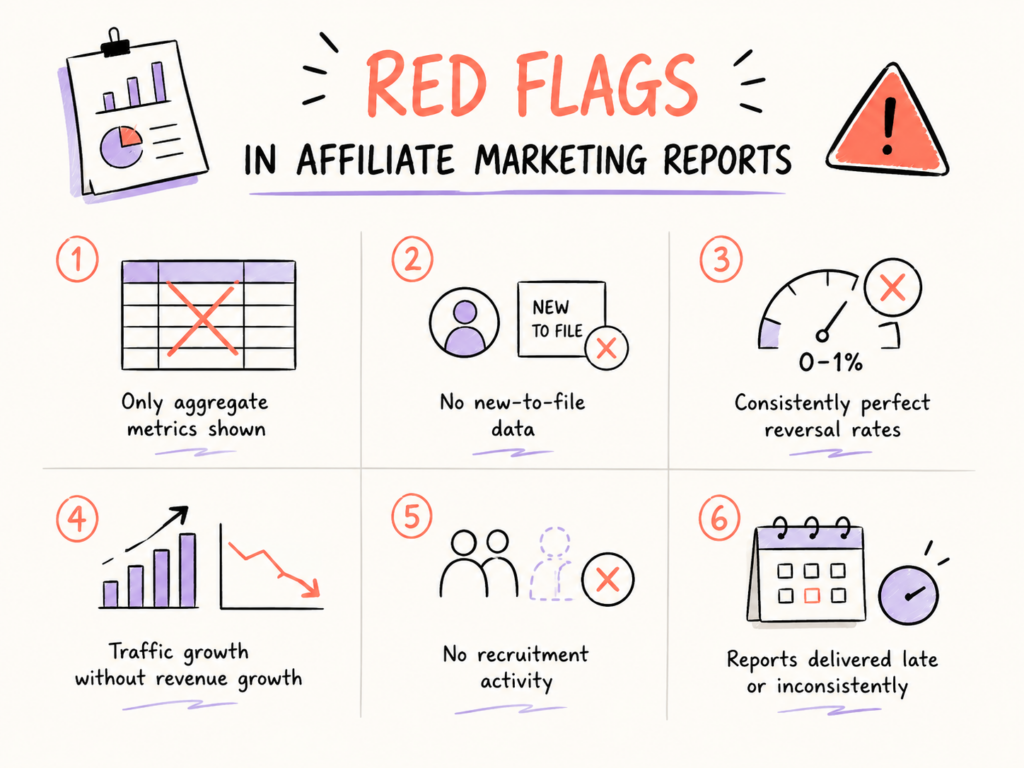
Reporting that only shows aggregate metrics. If your monthly affiliate marketing report does not break down performance by individual partner, you cannot identify fraud, concentration risk, or which relationships deserve investment.
No new-to-file data. If your affiliate agency cannot tell you what percentage of affiliate sales are genuinely new customers, they are either not tracking attribution at sufficient depth or the answer is unflattering. Affiliate marketing reports that cannot answer this question are not giving you the actionable insights needed to justify your affiliate marketing spend.
Consistently perfect reversal rates. A reversal rate of 0 to 1% sounds good but is often a sign that reversals are not being tracked or processed correctly. Every mature affiliate program has some level of returns and policy violations.
Traffic growth without revenue growth. If your affiliate marketing channel is sending more clicks but converting at a lower rate, something has changed. Either partner quality has declined, your site’s conversion rate has dropped, fraud has entered the program, or your offer has become less competitive in the affiliate industry.
No recruitment activity in the report. If your monthly affiliate marketing report shows no new partner recruitment, your agency is managing steady state rather than growing your program. That is a retention role, not a growth role.
Reporting delivered late or inconsistently. The cadence and reliability of reporting reflects the agency’s operational discipline. An agency that regularly delivers affiliate marketing reports late or in inconsistent formats is signaling something about how they are managing your program overall.
How Vivian Agency Approaches Reporting
At Vivian Agency, reporting is one of the primary ways we demonstrate program value and inform program decisions. Every client receives monthly performance summaries, partner breakdowns, reversal reports, and partner recruitment pipeline updates as a baseline. Quarterly program health audits, competitive benchmarking, and attribution analysis are built into our standard engagement.
We are also transparent about what the affiliate data shows when it is unflattering. If a recruitment month was weak, that goes in the report with context and a plan. If a specific partner is showing fraud detection signals, we flag it before acting on it so the client understands what is happening and why we are taking action.
The goal is for our clients to understand their affiliate programs and affiliate marketing strategies well enough to interrogate our work, because that accountability and data transparency is what drives sustainable growth and long-term value over time. Affiliate marketing reports are not just deliverables. They are the foundation of a strong agency-client relationship built on measurable results and actionable strategies.
If you want to see what our reporting looks like in practice, our case studies include real program outcomes. And if you want to discuss what you are currently getting from your agency and whether it is sufficient, book a free call and we will give you an honest look at where your reporting stands.
Frequently Asked Questions
How often should my affiliate marketing agency send reports?
Core affiliate marketing reports covering revenue, commissions, clicks, conversions, partner performance, and reversal rates should arrive monthly, within the first week of the following month. Deeper analysis including competitive benchmarking, program health audits, attribution analysis, and commission structure reviews should happen quarterly.
Ad hoc reporting should be available on request for specific questions. If you have to wait two weeks for a custom data pull, that is a sign your affiliate agency’s reporting infrastructure needs work.
What is the most important affiliate marketing metric to track?
New-to-file rate (the percentage of affiliate sales that are genuinely new customers) and ROAS (return on ad spend) are the two metrics that most accurately reflect whether your affiliate program is doing its job. Most programs over-index on gross revenue and commissions paid, which tells you the size of the program but not its quality or efficiency.
A program generating $500K in affiliate-attributed revenue with a 30% new-to-file rate is performing significantly worse than one generating $300K with a 70% new-to-file rate, despite the higher top line.
What should I do if my agency cannot provide the reports I am asking for?
Start by asking specifically what affiliate data they have access to and what is preventing them from delivering the report. Some gaps are technical: the tracking integration does not capture the right data, and those are fixable with a platform upgrade or integration change. Others are operational: the agency simply has not been generating the report because no one asked.
If after raising the specific affiliate marketing reports you need, your affiliate marketing agency still cannot or will not provide partner-level performance data, new-to-file rates, reversal breakdowns, and partner recruitment activity, that is a serious operational gap. It may also be worth consulting with other affiliate marketers or seeking market research on what standard affiliate agency reporting looks like in your category.
How do I know if my affiliate program’s performance is good or bad without benchmarks?
Key 2026 benchmarks to compare against: a healthy affiliate ROAS for consumer retail is 10 to 12:1. Conversion rates from affiliate traffic typically run 1 to 3% for e-commerce brands and 4 to 8% for SaaS and finance. A healthy reversal rate is below 10%. Active affiliate rate — the percentage of your approved affiliate partners who have generated at least one sale in the past 90 days — should be 10 to 20%.
An EPC above $1.00 generally signals a profitable, scalable program. These affiliate marketing benchmarks should be the starting point for any affiliate program management conversation with your agency, and your affiliate marketing reports should make it straightforward to compare your numbers against them.
Should my affiliate agency share the raw data or just a summary report?
Both. Summary affiliate marketing reports in a readable format are valuable for quick review and executive communication. But you should also have access to the underlying affiliate data — ideally through a shared dashboard or a regular raw data export — so you can run your own analysis, cross-reference against your internal sales data, and verify attribution claims independently.
Any affiliate agency that is reluctant to share the underlying affiliate data should raise a serious flag. Data transparency is a non-negotiable in affiliate program management, and your affiliate marketing reports should reflect complete, unfiltered access to the data your affiliate network and affiliate partners are generating.
For further reading on building and managing affiliate programs, see our guides on how to set up an influencer affiliate program, affiliate contract compliance, how to find affiliates for your brand, BrandVerity alternatives for affiliate monitoring, and why you need affiliate influencer marketing for your business.