
The affiliate marketing playbook that worked in 2024 is actively working against you in 2026.
The three structural forces reshaping the affiliate marketing trends in the 2026 industry are not trends you can observe from a distance.
The collapse of cookie-based tracking, the rise of AI-generated search answers, and the shift of affiliate marketing spending toward creator-led programs are already affecting how affiliate marketing campaigns are tracked, how affiliate marketers get discovered, and how commissions are earned and attributed.
The affiliate marketing industry is no longer rewarding scale and shortcuts. It is rewarding authenticity, precision, and data-driven decision-making.
US affiliate marketing spending is projected to reach $13.81 billion in 2026, up 11.3% year-over-year according to EMARKETER. Affiliate marketing continues to generate an estimated $241 billion in US e-commerce annual revenue.
What is changing is everything underneath those numbers: how tracking works, which affiliate marketers get credit, how AI search engines are redistributing discovery traffic, and what commission structures actually retain high-performing affiliates.
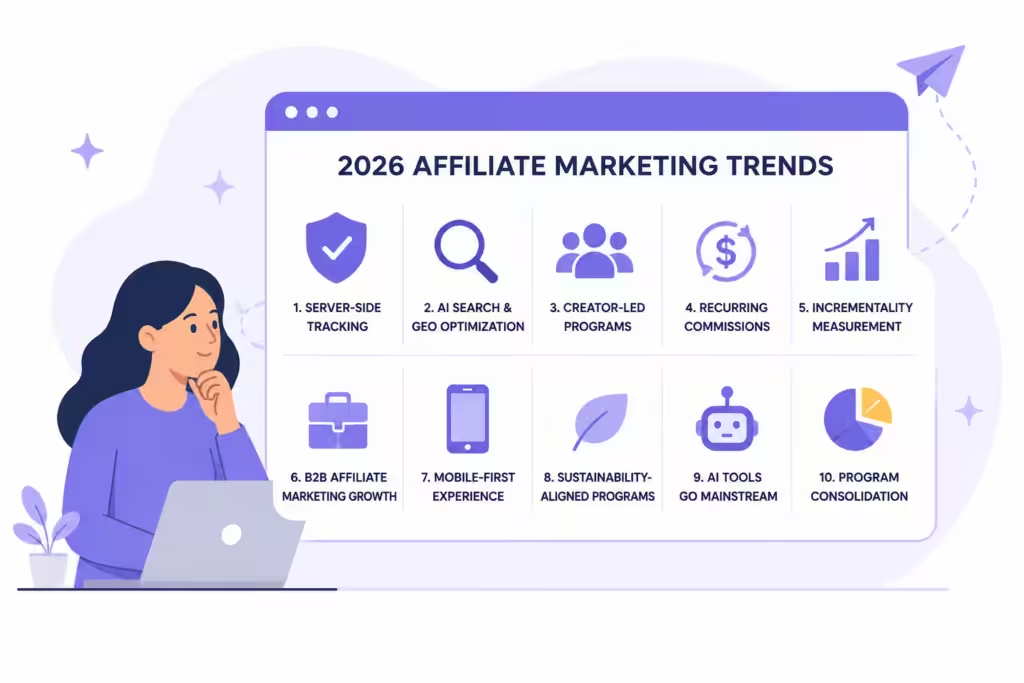
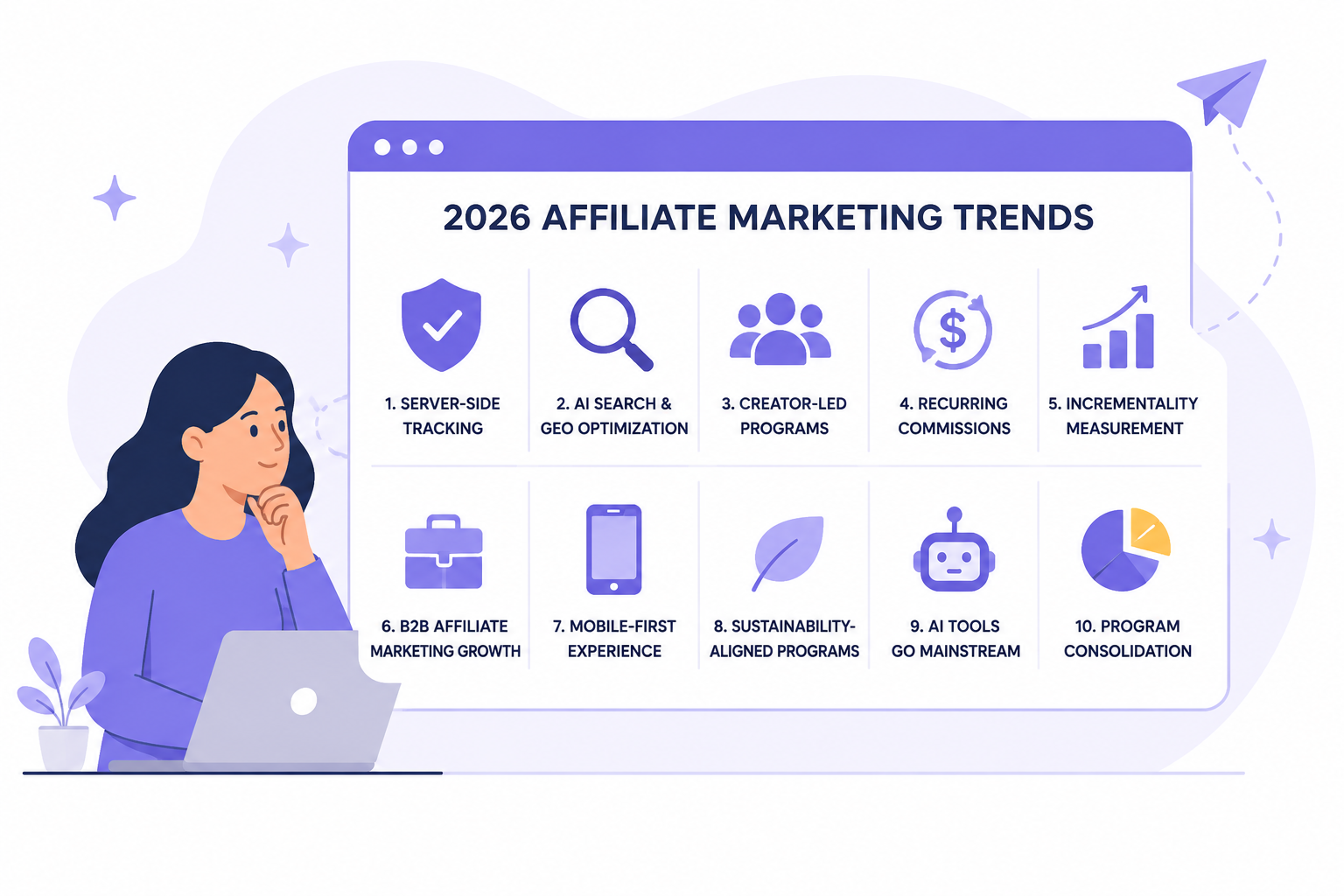
The latest affiliate marketing statistics confirm sustained and growing interest across various industries. This guide covers ten key trends in affiliate marketing in 2026 worth building strategy around — specifically the ones with enough data and real-world impact to warrant changing how you run your affiliate marketing program.
Table of Contents
Overview
| Trend | The Shift | What It Requires |
|---|---|---|
| Server-side tracking replaces cookies | S2S is now the dominant attribution method | Platform migration and first-party data infrastructure |
| GEO becomes a core affiliate marketing strategy | AI search answers are the new first touchpoint | Content-authority-based affiliate marketer recruitment |
| Creator-led programs outperform established networks | Creators now drive 19.5% of affiliate network revenue | Rebalancing recruitment toward content creators |
| Recurring commissions replace flat-fee structures | Subscription models drive demand for recurring pay | Commission structure redesign |
| Incrementality measurement becomes standard | Last-click attribution replaced by proven lift | Multi-touch attribution infrastructure |
| B2B affiliate marketing programs are scaling rapidly | SaaS and professional services now run major programs | Specialist recruitment for B2B audiences |
| Mobile-first infrastructure is now mandatory | 62% of affiliate traffic originates from mobile devices | Mobile optimization and tracking |
| Sustainability-aligned programs growing 35% YoY | Consumers and affiliate marketers increasingly vet brand values | Brand positioning and partner selection criteria |
| Artificial intelligence tools are now operational | 78% of affiliate marketers now use AI-driven content tools | Policy, oversight, and quality control frameworks |
| Program consolidation replacing network diversification | Major brands are pruning affiliate marketer rosters for quality | Active management and performance pruning |
10 Key Affiliate Marketing Trends to Pay Attention to in 2026
Here are the ten most significant trends that are reshaping the affiliate marketing landscape today:
Trend 1: Server-Side Tracking Has Replaced Cookie-Based Tracking as the Dominant Attribution Method
This is the structural change with the most immediate operational impact on affiliate marketing programs in 2026. It is not optional.
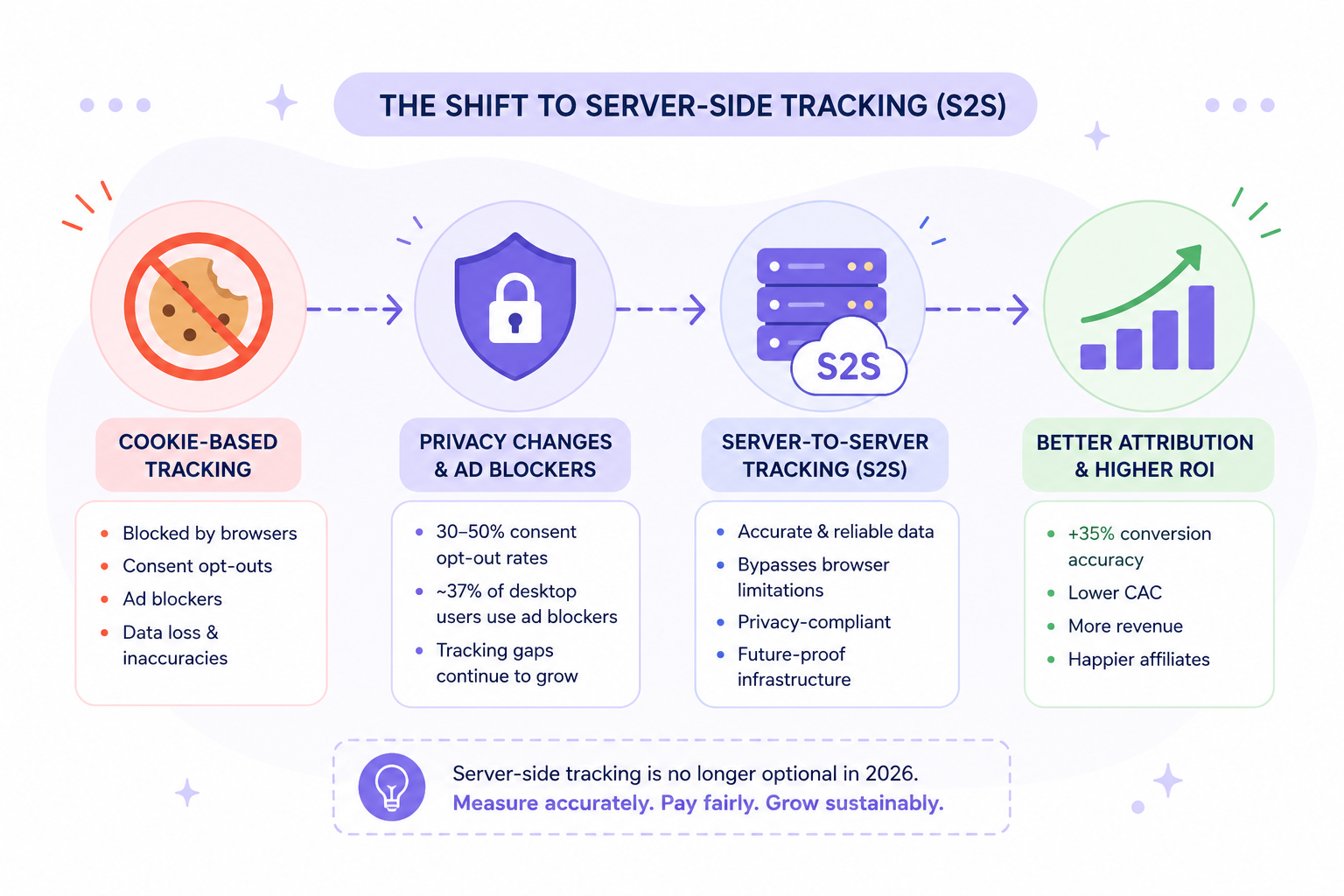
Server-to-Server (S2S) is now the dominant tracking method in the affiliate marketing industry, providing the highest level of accuracy by bypassing browser-side issues and browser-based cookie restrictions.
A 35% increase in conversion accuracy is achievable with S2S implementation, leading to lower customer acquisition costs and more revenue generated for affiliate marketers and brands alike.
The urgency is real for three reasons:
- Browser-based cookies have become unreliable, with consent opt-out rates between 30% and 50% in strict-privacy regions
- Around 37% of desktop users now run ad blockers, creating a roughly 30% blind spot in affiliate marketing statistics and revenue reporting
- 62% of affiliate traffic now comes from mobile devices, where cookie-based tracking is least reliable
If your affiliate marketing program is still running on browser-side cookie-based tracking, you are operating with a minimum 30% measurement gap.
The real-world consequence: you are underpaying affiliate marketers who are genuinely driving conversions because those conversions are not being captured, and overpaying affiliate marketers whose reported performance is inflated by the tracking gaps of their competitors.
Over 70% of affiliate marketing platforms are actively transitioning to server-side tracking solutions to meet privacy regulations like GDPR and CCPA.
The affiliate platform options that have made the transition cleanest include Impact, PartnerStack, Awin, and ShareASale. CJ Affiliate is also expanding its first-party data strategies to address the same gap.
Building trust with your affiliate marketers requires transparent reporting on the conversions they drive. Affiliate marketers earn less than they should when your tracking misses their conversions, which damages the affiliate marketing relationship and increases churn among your best performers.
What this means for your program: If you have not evaluated your tracking infrastructure against the S2S standard, that is the most urgent audit on your affiliate marketing agenda in 2026. Every other optimization decision is downstream of accurate first-party data attribution.
For a comprehensive breakdown of how tracking accuracy affects what you should be reporting on, see our guide on what affiliate marketing reports to ask your agency for.
Trend 2: AI Search Is Reshaping How Affiliate Marketers Drive Traffic — and Most Programs Are Not Ready
This is the trend that caught the most affiliate marketing programs off-guard in 2025, and it is accelerating in 2026.
The most consequential moment in a 2026 buying decision often happens before the user ever clicks anything. That moment happens inside an AI answer that does not pass UTM parameters to affiliate marketing platforms.
When internet users ask ChatGPT, Perplexity, or Google’s AI Overview which product to buy or which software to try, the answer they receive is almost always based on content from affiliate marketers.
The comparison articles, long-form reviews, and “best X for Y” roundups that your affiliate marketers create on their affiliate websites are the raw material from which AI search engines assemble their answers.
For brands, affiliate content is now a key component of generative engine optimization (GEO), ensuring a brand appears favorably in AI-generated responses.
The implications are structurally different from traditional search engine optimization. Affiliate marketing statistics from 2025 show a clear divergence: affiliate marketers with high editorial authority and genuine product experience are gaining share, while thin affiliate websites built purely on keyword targeting are losing it.
Affiliation in 2026 has become a game of authority. If you are not cited by reference media or present in agentic flows, you effectively no longer exist for 40% of the market.
The affiliate marketers best positioned to drive high-intent traffic through AI search are:
- Long-form review sites with genuine editorial depth
- Comparison content backed by real product testing
- Review sites with verifiable experience credentials
- Affiliate websites with demonstrated niche authority
These affiliate marketers most likely to drive AI search visibility are often not the ones at the top of your last-click leaderboard. Recruiting on conversion history alone systematically filters out the partners who matter most for GEO.
A hybrid payment structure works best: a base content stipend for authoritative affiliate campaigns, plus a CPA commission for performance. Paying for the influence affiliate marketers create in the customer journey, not just the conversions they close.
What this means for your program: Your affiliate marketing recruitment criteria need to evolve beyond click volume and last-click conversion rate. Affiliate marketers who write authoritative, in-depth comparison content on their affiliate websites may be driving the AI search visibility that eventually generates sales your attribution system credits to someone else.
For a vetting methodology that captures this, see our guide on how to find affiliates for your brand.
Trend 3: Content Creators Are Taking a Growing Share of Affiliate Marketing Budgets
The affiliate marketer landscape is shifting in a direction that most brand-side affiliate managers have not fully operationalized yet.
Content creators’ share of revenue on major affiliate networks rose from 15.9% to 19.5% year-over-year.
That is not a marginal uptick. It represents a meaningful rebalancing of where affiliate marketing spending is going.
The reason is not sentimental preference for creators. It is performance data.
Content affiliate marketers consistently outperform traditional affiliate marketer types on two metrics that matter most:
- New-to-brand customer acquisition rate
- Average order value of customers referred through their affiliate sales
When a creator’s audience makes a purchase, they are typically discovering the brand for the first time, through genuine endorsement, with strong purchase intent.
When a coupon or cashback affiliate marketer drives the same sale, it is usually an existing customer capturing a discount at checkout.
The shift toward creator-led affiliate marketing programs also intersects directly with the GEO trend above.
The content that search engines and AI systems cite most frequently, including long-form reviews, tutorial content, and genuine product comparisons, is exactly what creator-affiliate marketers produce.
A micro-influencer with 15,000 subscribers who has created a thorough, experience-based product review contributes more to your brand’s search engine and AI visibility than twenty coupon affiliate websites pointing to the same product page.
Building trust with a niche audience takes time, but affiliate marketers who do it generate affiliate sales that compound. The customer value of creator-referred customers is consistently higher than that of coupon-referred customers across most affiliate marketing industry categories.
What this means for your program: Audit your current affiliate marketer mix by new-to-brand customer rate, not just total commissions paid.
If more than 60% of your affiliate marketing spending is going to coupon, cashback, or deal sites, you have an affiliate marketer mix problem that is suppressing both the quality and the AI discoverability of your affiliate marketing campaigns.
See our post on why you need affiliate influencer marketing for your business for a breakdown of how the creator-affiliate marketing model works in practice.
Trend 4: Recurring Commission Structures Are Replacing One-Off Flat Fees
The subscription economy has changed what affiliate marketing commissions need to look like.
Subscription models are projected to grow at an 11% rate, based on Global Market Insights data. This makes recurring commissions one of the defining shifts in affiliate marketing in 2026.
The traditional affiliate marketing commission model, a flat percentage of the first sale paid once, made sense when most affiliate products were discrete purchases.
It makes considerably less sense for:
- Subscription software and SaaS affiliate products
- Membership platforms
- Any product where customer value is built through ongoing payments rather than a single transaction
Recurring commission structures pay affiliate marketers a percentage of every renewal payment for as long as the referred customer remains a subscriber.
For affiliate marketers, this transforms the math of promoting products.
A customer who subscribes to a $49/month SaaS tool through their affiliate link at a 20% recurring commission generates $9.80 per month, potentially indefinitely. That compounding revenue generated fundamentally changes how seriously high-performing affiliates will promote your product versus a competitor’s one-time-payout program.
Switching to recurring commission programmes transforms affiliate marketing from a volume game into an asset-building online business. Even one year of effort can generate passive income for years.
For brands, the benefit is alignment.
An affiliate marketer who earns recurring commissions has a direct financial interest in referring customers who actually stay. This naturally filters toward higher customer value referrals and more honest promotion across all traffic sources.
What this means for your program: If your affiliate products have a subscription or recurring revenue component and you are still running a one-time-payout commission structure, you are undercompetitive for the affiliate marketers who will drive your best customers.
Redesigning your commission structure to include a recurring element is one of the highest-ROI changes you can make to affiliate marketer retention. For a full breakdown of how to structure commissions competitively, see our guide on how to set up an influencer affiliate program.
Trend 5: Incrementality Measurement Is Replacing Last-Click Attribution as the Affiliate Marketing Standard

For years, last-click attribution was the default across affiliate marketing platforms because it was easy to implement and easy to report on.
In 2026, it is increasingly recognized as a measurement model that systematically misallocates credit.
It overpays affiliate marketers who intercept purchase intent that was created by others. It underpays the affiliate marketers who actually built it.
The affiliate marketing programs that thrive into 2027 will be those that treat the affiliate channel as a measurement and partnership discipline first, and a commission-rate negotiation second.
Incrementality measurement asks a different question than last-click attribution.
Instead of “which affiliate marketer was last in the customer journey before the purchase?”, it asks “would this purchase have happened without this affiliate marketer’s involvement?”
The gap between these two answers is enormous for coupon-heavy affiliate marketing programs.
A coupon affiliate marketer that captures 40% of last-click attribution credit may be incrementally responsible for almost none of it, simply intercepting customers who were already going to buy after being influenced by other affiliate marketers earlier in the sales funnel.
The practical implementation involves:
- Hold-out testing, withholding affiliate marketing exposure from a matched control group to measure the difference in purchase rate
- Multi-touch attribution models that weight touchpoints throughout the customer journey
- First-party data integration that gives a complete view of the path to purchase
Affiliate marketing programs that implement incrementality measurement consistently find that a smaller number of higher-quality affiliate marketer relationships drive more genuine annual revenue than a large network of last-click interceptors running across multiple channels.
What this means for your program: The affiliate marketer pruning conversation is uncomfortable but necessary.
If you have not conducted an incrementality analysis of your top affiliate marketers, you are likely funding significant last-click attribution theft.
The question is not which affiliate marketer was last in the customer journey. It is which affiliate marketer genuinely changed the customer’s purchasing decision. For a guide to the metrics that actually answer this question, see our post on what affiliate marketing reports to ask your agency for.
Trend 6: B2B Affiliate Marketing Programs Are Scaling Rapidly
B2B affiliate marketing is no longer a niche experiment.
It is one of the fastest-growing segments of the affiliate marketing industry in 2026, and major brands that have not built B2B affiliate marketing programs are missing a significant customer acquisition channel.
B2B SaaS affiliate networks, especially in AI and automation, are opening new revenue streams for technical affiliate marketers.
The B2B affiliate marketing model differs fundamentally from the B2C model in two ways.
First, commission rates are higher. Typically 20% to 50% recurring for SaaS affiliate products, compared to 5% to 15% for most consumer categories, because the customer value and sales cycle justify it.
Second, the affiliate marketers who perform best in B2B are completely different. The effective ones are:
- Industry newsletters and niche communities
- Technical YouTubers and LinkedIn thought leaders
- Podcast hosts with professional audiences
- Software comparison review sites
- Subject-matter experts with direct purchase authority
In B2B SaaS specifically, affiliate marketing programs at companies like Notion, Airtable, and HubSpot now drive meaningful percentages of net new customer acquisition.
Affiliate-referred customers in B2B also typically have higher customer value and retention rates than those acquired through paid ads or display, making B2B affiliate marketing one of the most cost-effective traffic sources available.
According to 28% of affiliate marketers worldwide, new, innovative marketing partners entering the channel are affiliate marketing’s unique strength. In B2B, those new affiliate marketers are predominantly technical creators and subject-matter experts whose niche communities have direct purchase authority and genuine product needs.
What this means for your program: If you run a B2B product and you do not have an affiliate marketing program, you are behind.
If you have a B2B affiliate marketing program but it is structured like a B2C program, with low commissions, coupon focus, and management through established networks built for consumer brands, you are not accessing the affiliate marketers who can actually drive affiliate sales for B2B.
Trend 7: Mobile-First Affiliate Marketing Infrastructure Is Now a Baseline Requirement
62% of affiliate marketing traffic now originates from mobile devices, where in-app checkout and short-form video dominate discovery.
This has significant operational implications for affiliate marketing programs that have not been optimized for mobile.
Consider this scenario: an affiliate marketer drives a click from their TikTok content to your product page. The customer arrives on a mobile browser.
If your landing page loads slowly, if the affiliate tracking fires incorrectly on mobile devices, if the checkout flow is not optimized for small screens, you have wasted both the affiliate marketer’s promotional effort and your affiliate marketing spending on an attribution event that resulted in no affiliate sale.
Mobile optimization extends across every layer of your affiliate marketing program:
- Server-side tracking performs significantly better on mobile devices than cookie-based tracking
- Short-form video on TikTok and Instagram drives social commerce at 5.2% average engagement rates
- TikTok Shop’s built-in affiliate commission system creates a direct line from creator content to purchase without leaving the app
- Amazon Associates, still heavily used by affiliate marketers to drive traffic and affiliate sales, is increasingly cookie-dependent and therefore underperforming on mobile devices
What this means for your program: Audit your mobile affiliate marketing experience end-to-end.
Check page load speed on mobile devices, test your tracking fire sequence in-app and on mobile browsers, and verify that your creative asset library includes vertical video formats for short-form video platforms.
For the creator content side of mobile affiliate marketing, see our post on TikTok influencer marketing.
Trend 8: Sustainability-Aligned Affiliate Marketing Programs Are Growing 35% Year-Over-Year
This is a trend most affiliate marketing statistics roundups skip because it is harder to quantify than tracking technology or commission structures. But the data is consistent.
Sustainability and ESG-focused affiliate marketing programs grow 35% annually, reflecting rising demand for ethical purchasing.
A growing segment of the affiliate marketer universe, particularly in fashion, beauty, food, and travel categories, is actively selective about the brands they choose to promote.
An affiliate marketer who has spent two years building trust with a niche audience around sustainable fashion will not run affiliate campaigns for a brand whose supply chain practices conflict with those values, regardless of how competitive the commission rate is.
This creates both a challenge and an opportunity.
Major brands whose environmental and ethical practices are genuinely strong have a meaningful competitive advantage in recruiting the highest-value affiliate marketers in their category.
Brands that have made superficial sustainability claims are increasingly exposed as those claims are scrutinized by affiliate marketers and their audiences.
For affiliate marketing programs, the ESG advantage is measurable:
- More organic affiliate marketer applications
- Higher conversion rate among affiliate marketers who apply
- Longer affiliate marketer retention because the relationship is value-aligned rather than purely transactional
Building trust with creator-affiliate marketers through genuine brand values is one of the most durable forms of competitive advantage in affiliate marketing today.
What this means for your program: If your brand has genuine sustainability or ESG commitments, these should be prominently featured in your affiliate marketing program materials, specifically in the sections affiliate marketers read before deciding whether to apply.
If your brand does not yet have clear positions on these issues, the affiliate marketer ecosystem in your category is increasingly asking.
Trend 9: Artificial Intelligence Has Moved From Experiment to Operational Infrastructure
78% of affiliate marketers now use AI-driven content creation tools. But the real shift is what they are using artificial intelligence for.
Modern AI powered tools can predict which affiliate products will trend months before competitors spot the opportunity, identify optimal commission rates for different affiliate marketer segments, and automate routine tasks that previously consumed affiliate managers’ time.
The AI driven applications generating the most genuine value in affiliate marketing programs in 2026:
Affiliate marketer discovery and matching. Advanced tools powered by artificial intelligence scan content databases, digital platforms, and affiliate network performance data to identify affiliate marketers whose audience demographics, content themes, and engagement patterns predict strong performance. Email marketing data and first-party data strategies feed directly into this matching process.
Ad fraud detection. AI-powered behavioral analysis reduces false-positive fraud flags by 43% versus rule-based threshold systems and cuts average ad fraud detection latency from 18.4 days to 2.3 days. For affiliate managers running large affiliate marketing programs, this is a material improvement in protecting affiliate marketing spending.
Content performance prediction. AI-driven analysis trained on affiliate marketing campaign data can predict which creative approaches and content formats will drive the highest click-through and conversion rates for specific affiliate products in specific niche communities.
Commission optimization. AI-powered tools adjust the commission rate offered to individual affiliate marketers based on their predicted incremental customer value, paying more to affiliate marketers whose audiences are genuinely new-to-brand and less to those who primarily capture existing demand from multiple channels.
The important caveat: artificial intelligence amplifies the output of good affiliate marketing programs. It does not compensate for poor commission structures, low-quality affiliate marketer relationships, or inadequate first-party data and tracking infrastructure.
What this means for your program: The question is no longer whether to use artificial intelligence in your affiliate marketing program. It is which applications to prioritize first.
Ad fraud detection and affiliate marketer discovery offer the fastest time-to-ROI. Commission optimization requires more data maturity but delivers significant returns at scale for established affiliate marketing programs.
Trend 10: Program Consolidation Is Replacing Diversification Across Multiple Channels
For most of the past decade, the conventional affiliate marketing wisdom was to run affiliate campaigns across as many established networks as possible to maximize affiliate marketer reach.
In 2026, the affiliate marketing industry data is pointing in the opposite direction.
Incrementality-driven affiliate marketer pruning is one of the defining affiliate marketing trends of 2026. The programs that thrive into 2027 will be those that treat the affiliate marketing channel as a measurement and partnership discipline first.
The consolidation trend is driven by two converging forces.
First, incrementality measurement is revealing that a significant portion of affiliate marketer relationships in many affiliate marketing programs are not driving net new customers. They are capturing existing demand that would have converted anyway.
Pruning these relationships reduces affiliate marketing spending without reducing annual revenue.
Second, the operational complexity of managing affiliate marketer relationships across multiple affiliate marketing platforms and channels has become a competitive disadvantage.
Major brands running consolidated affiliate marketing programs on single platforms like Impact or PartnerStack report:
- Significantly better affiliate marketer relationships
- Faster affiliate campaign turnaround
- Cleaner first-party data attribution
- More transparent reporting
This is consistently better than the results brands see when managing fragmented multi-network affiliate marketing programs.
The affiliate marketers who thrive in this environment have genuine authority in their niche, deep audience trust built through consistent building trust activities, and the content capabilities to create long-form, experience-based material that both AI search engines and potential customers rely on.
The affiliate marketing programs that retain these affiliate marketers are the ones with competitive commission structures, transparent reporting, consistent communication, and clear brand positioning that aligns with the user intent of their target audience.
What this means for your program: Run an incrementality analysis of your current affiliate marketer roster.
Identify the 20% of affiliate marketers driving 80% of genuine annual revenue. Build deeper, better-resourced relationships with those partners. Prune the remainder.
The affiliate marketing programs generating the strongest ROI in 2026 are not the largest ones. They are the best-managed ones.
What These Affiliate Marketing Trends Add Up To
The affiliate marketing industry in 2026 is not harder than it was five years ago. It is more precise.
The shortcuts that worked when cookie-based tracking was reliable, when AI search engines did not exist, and when any affiliate marketer volume was considered good affiliate marketer volume no longer generate the returns they once did.
What works in 2026:
- First-party data and server-side tracking infrastructure that captures the full picture of affiliate marketing conversion
- Affiliate marketer recruitment weighted toward authority content creators and away from last-click interceptors
- Commission structures that reflect subscription models and incentivize referral of high customer value customers
- GEO-aligned affiliate marketing content strategies that treat affiliate marketers as the primary vehicle for AI search engine visibility
- Incrementality measurement that replaces last-click credit allocation with genuine lift analysis
- AI-powered tools applied to ad fraud detection, affiliate marketer discovery, and commission optimization
What no longer works:
- Cookie-based tracking that misses 30%+ of mobile device conversions
- Commission structures that pay flat one-time fees regardless of customer value or retention
- Affiliate marketer rosters dominated by coupon and cashback sites with low new-to-brand rates
- Last-click attribution models that systematically misallocate credit across the customer journey
- Multi-network fragmentation across digital platforms that prevents coherent affiliate marketer relationship management
At Vivian Agency, we build affiliate marketing programs with all of this in mind from the start: server-side tracking, creator-weighted affiliate marketer recruitment, incrementality-conscious commission design, and the transparent reporting infrastructure that tells you what is actually working.
If you want to understand what a 2026-ready affiliate marketing program looks like for your specific brand and category, book a free call and we will walk through it.
Frequently Asked Questions
What is the biggest affiliate marketing trend in 2026?
The shift from cookie-based to server-side tracking is the most operationally urgent affiliate marketing trend, because it affects the accuracy of every other decision in your affiliate marketing program.
The most strategically significant trend is the role of affiliate marketer content in generative engine optimization (GEO), specifically the fact that the affiliate marketers you recruit and the affiliate websites and review sites they create now determine whether your brand appears in AI-generated search engine answers.
These two trends are connected: you cannot accurately measure the contribution of your GEO-driving affiliate marketers without server-side first-party data attribution.
How is artificial intelligence changing affiliate marketing in 2026?
Artificial intelligence is changing affiliate marketing in two distinct ways.
On the infrastructure side, AI-powered tools are now operational for affiliate marketer discovery, ad fraud detection at scale, commission optimization, and affiliate campaign performance prediction across multiple channels.
On the consumer-facing side, AI-generated search engine answers are replacing traditional search results for product discovery queries across various industries, which means the affiliate marketing content that affiliate marketers create is now the raw material from which AI search engines build their recommendations.
Major brands that are visible in those AI answers, through the authoritative, experience-based content that their affiliate marketers produce on affiliate websites and review sites, have a significant customer journey advantage over those that are not.
Are browser-based cookies still usable for affiliate marketing tracking in 2026?
Technically yes, but practically no. Consent opt-out rates of 30% to 50% in GDPR-regulated markets, combined with ad blockers running on 37% of desktop browsers and the structural shift in mobile device browsing away from cookie-readable environments, mean that cookie-based affiliate marketing tracking is missing a significant portion of actual affiliate sales.
Affiliate marketing programs that have migrated to server-to-server tracking on their affiliate platform are reporting 35% more conversion accuracy.
For affiliate managers, the practical implication is that any commission decision, affiliate marketer evaluation, or affiliate marketing program optimization based on cookie-dependent data is working from an incomplete picture.
What types of affiliate marketers are performing best in 2026?
Long-form review sites and comparison affiliate websites with genuine editorial depth, creator-affiliate marketers with engaged niche communities in relevant categories, and technical content affiliate marketers in B2B verticals are outperforming traditional affiliate marketer types on the metrics that matter most: new-to-brand customer rate, average order value, customer value over time, and AI search engine citation frequency.
Coupon and cashback affiliate marketers continue to drive high last-click attribution numbers in affiliate marketing statistics, but incrementality analysis consistently shows their contribution to genuine new customer acquisition is lower than their commission share suggests.
How should affiliate marketing spending change in 2026?
The direction most well-managed affiliate marketing programs are moving is toward fewer, better-resourced affiliate marketer relationships rather than more affiliate marketers at lower investment per partner across established networks.
This means higher commission rates for top creator-affiliate marketers and authority affiliate websites, content stipends for GEO-contributing affiliate marketers who build search engine and AI visibility, investment in server-side first-party data tracking infrastructure, and reallocation of affiliate marketing spending from last-click-optimized coupon and cashback affiliate marketers toward incrementally-proven creator and content partners.
The total affiliate marketing budget does not need to increase. The allocation within it needs to reflect what is actually driving new customer acquisition, which requires proper incrementality measurement and transparent reporting to see clearly.
For further reading on building affiliate marketing programs aligned with these trends, see our guides on how to set up an influencer affiliate program, how to find affiliates for your brand, affiliate contract compliance, what affiliate marketing reports to ask your agency for, and BrandVerity alternatives for affiliate monitoring.