
There is a moment at the end of every influencer campaign that everyone in this industry recognises. The creator sends over a results deck. It contains a screenshot of a story frame with a large view count on it, a couple of engagement figures, and a sentence about how well the audience responded.
The brand looks at it. The agency looks at it. Everyone nods. And nobody in the room can tell you whether it sold a single unit.
That is not a small gap. It is the entire question. Brands are not buying views, they are buying customers, and the standard reporting format for this industry is structurally incapable of telling them whether they got any.
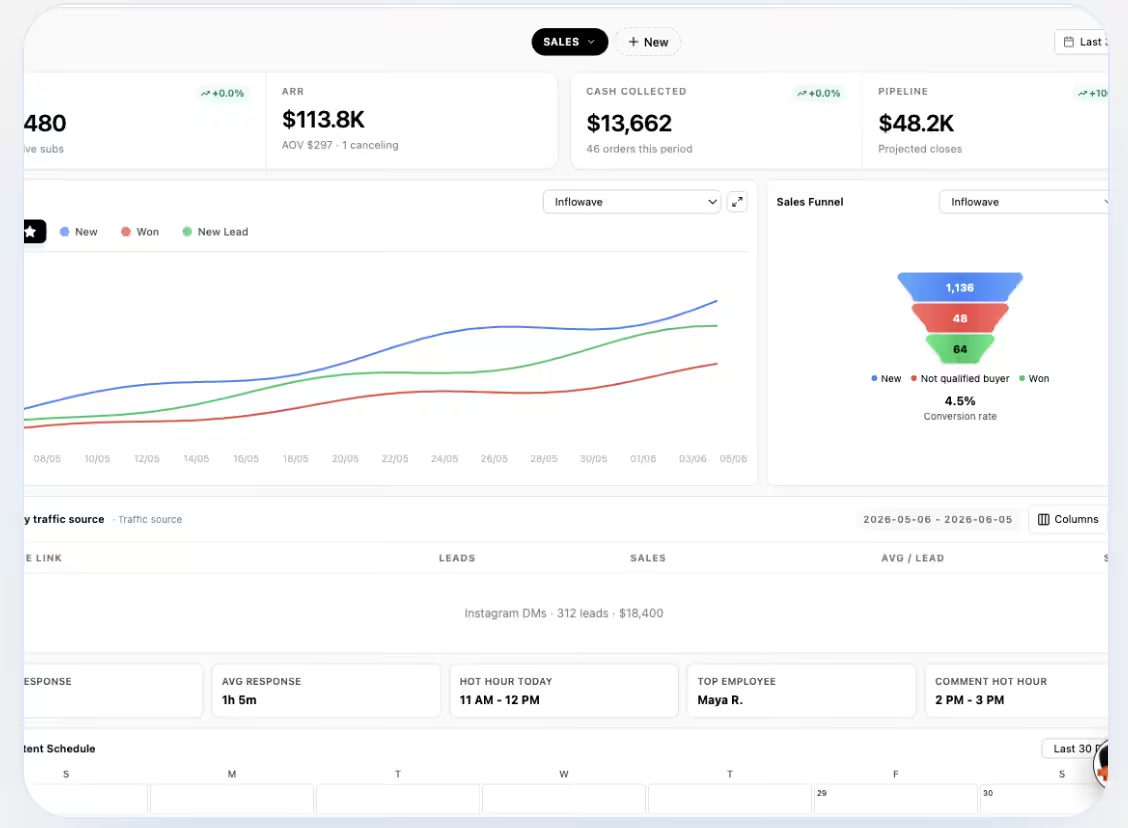
Creator and campaign measurement software like Inflowave shows what happens when agencies stop accepting the deck and start reading the accounts directly. That is currently 4,376 connected social accounts, 389,821 post-level performance records, 13,670 stories captured with their analytics, and 43,859 recorded visitor sessions on the destination sites those campaigns point at. Where a number below comes from our platform, we say so. Everything else is opinion and marked as such.
This piece is about how to measure a partnership so that “did it work” has an answer, and how to tell when the numbers you are being shown are better than the numbers that actually happened.
Table of Contents
The Structural Problem with a Results Deck
A results deck is self-reported, self-cropped, and self-timed. That combination is the problem, and it does not require anyone to be dishonest.
Self-reported means the only source is the person being paid. Self-cropped means they choose which frame and which metric to show you. Self-timed means they choose the window, and a screenshot of the best 24 hours of a seven-day campaign is not technically false.

None of that is fraud. Most creators are not trying to deceive anyone. But a format where the seller controls the measurement will, on average, produce numbers that flatter the seller, and the ones who are genuinely excellent get priced identically to the ones who are not. That is bad for the brand and it is worse for the good creators.
The fix is not suspicion. It is access.
Measure Before, During, and After
Most agencies measure a partnership exactly once, at the end. That is the worst possible moment to start, because you have nothing to compare against.
Before: take the baseline. For two to four weeks before anything goes live, capture what normal looks like on both sides. On the creator side that means their actual recent account performance, reach, profile views, follower movement, and how their unsponsored content typically does, pulled from the connected account rather than from a pitch deck. On the brand side it means site traffic, conversion rate, and sales volume.
This is the step everyone skips, and skipping it is precisely what makes an inflated results deck work. A big number with nothing to compare it against is unfalsifiable. The same number sitting next to a baseline is either impressive or it is not, and the deck does not get a vote.
During: watch it per asset, while it is live. Story performance decays in hours. A weekly check-in is a post-mortem. What matters while a campaign is running is which asset landed and which did not, whether the second post beat the first, and whether the link is actually being clicked, in time to change the brief rather than write it up afterwards.
After: compare to the baseline, not to the promise. The only honest question is what moved relative to the two weeks before. A campaign that produced 40,000 views and no measurable movement in traffic, leads or sales did not work, however good the deck looks.
What Is Actually Worth Measuring
Here is the useful division, and it is the most important idea in this article.
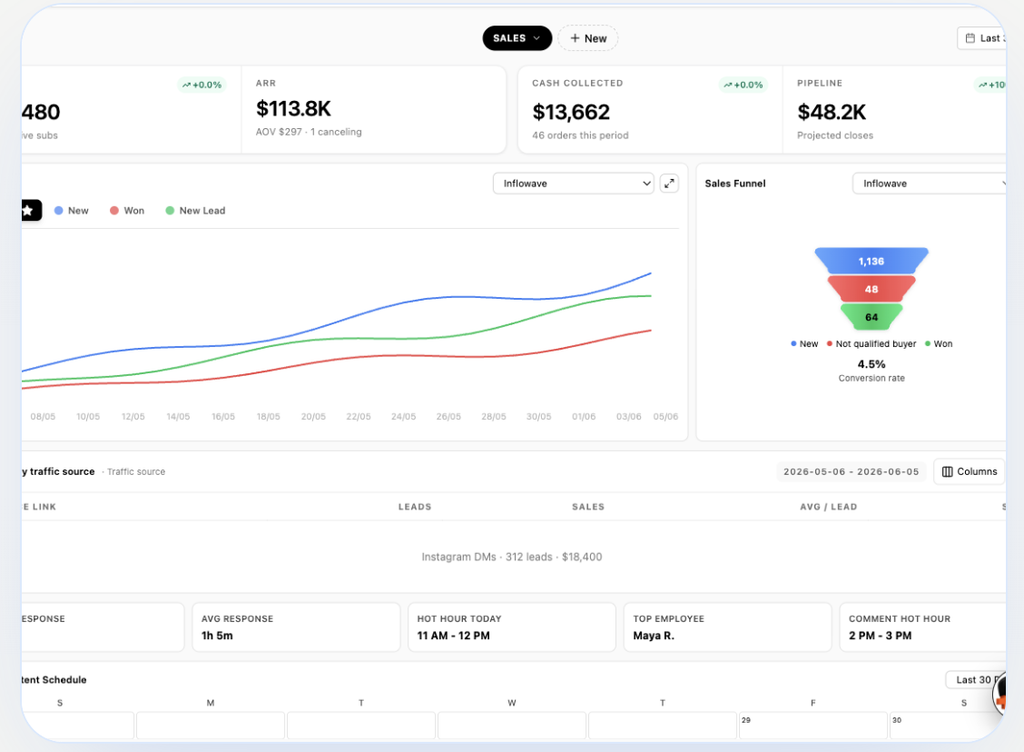
The creator controls everything upstream of the click. You control everything downstream of it.
Upstream metrics – view, impressions, and reach – are reported through the creator’s account and are the easiest things in the chain to present favourably. Downstream metrics – what happened after somebody tapped – run on infrastructure you own. They cannot be cropped, retimed or screenshotted, because they were never the creator’s to report.
So weight your judgement accordingly.
Upstream, from the connected account. For stories, what genuinely tells you something is not the view count. It is taps back versus taps forward, because taps forward means people are skipping and taps back is the closest thing the format has to real interest. It is exits, because a spike in people leaving the app on the sponsored frame specifically is the audience telling you something the view count will not. And it is profile visits, follows, and replies, because those are actions rather than impressions.
Across the stories on our platform we capture all of these directly from the account: views, reach, taps forward, taps back, exits, replies, profile visits ,and follows.
For posts and reels, the honest signals are saves, shares, comments, average watch time, and completion rate. Saves and shares in particular are the two the algorithm cannot inflate on a creator’s behalf and that a disengaged audience never produces. We hold 389,821 post-level records, with average watch time on 370,680 of them.
Note what is not on that list. Follower count is not a measurement, it is a price justification. Engagement rate is directionally useful and trivially gameable. Neither belongs at the centre of a buying decision.
Downstream, on your own infrastructure. This is where the real answer lives.
Tracked links. Every campaign destination should be a link you control and measure. Click volume then becomes a fact recorded by your system rather than a claim made by theirs. This single change does more to make influencer spend accountable than every engagement metric combined, and it costs nothing.
What the traffic did when it arrived. A click that bounces in four seconds without scrolling and a click that reads the whole page are identical in a click count, and only one of them is worth paying for. We record visitor session behaviour on destination sites, 43,859 sessions so far, which turns “we sent 800 clicks” into “we sent 800 clicks and 60 of them behaved like buyers”.
Leads and sales, with the source attached. The final link in the chain, and the one that makes every other number meaningful. When a purchase or an enquiry arrives carrying the campaign and creator that produced it, revenue per creator stops being a matter of memory.
The Specific Tells
Put the two halves together and the mismatches become obvious. None of these require accusing anyone of anything.
Large view count, negligible clicks. The most common pattern, and usually the most expensive. Audiences that genuinely respond to a recommendation click on it. If a creator reports 50,000 views and your tracked link recorded 120 clicks, the discrepancy is the finding, and it is measured on your side, not argued about on theirs.
Clicks that arrive and immediately leave. Traffic that does not scroll, does not read, does not convert. This points either to an audience that is not a fit for the product or to a framing in the content that set the wrong expectation. Either way it is a brief problem you can fix, and you will only ever see it if you are watching the destination.
Views with no profile visits and no follows. Attention that went nowhere. A creator whose audience acts produces movement on their own profile as well as yours.
Strong upstream numbers, no baseline movement. Everything looks good in isolation and nothing changed. This is the pattern that a results deck is best at hiding and that a baseline makes impossible to hide.
Timing that does not line up. A view spike on a day the content was not live, or a reported window that does not match the campaign dates. Rare, but it is the one that ends a relationship.
The right posture here is not distrust. It is a shared dashboard. In our experience the creators worth keeping actively prefer this arrangement, because it protects them: a creator who genuinely delivered can prove it, and stops being priced the same as one who did not. The ones who object to being measured are telling you something useful too.
Who Is Making You Money, From Where
Ask most agencies which creator generated the most revenue last quarter and you will get an answer built from memory, a screenshot of engagement rates, and a strong opinion. That is not a criticism of the people. It is what happens when nobody wrote down where the money came from at the moment it arrived.
Engagement analytics cannot fix this. Reach, impressions, and saves describe what a post did. None of them describe what it earned, and the two correlate far less than the industry assumes. A creator with 40,000 followers and a genuinely warm audience routinely outperforms one with 400,000, and you will never see that in a reach report.
Closing the loop requires four things attached to the same record, automatically, as each happens:
- The source. Which creator, which campaign, which post, which link. Captured when the visitor or lead arrives, not reconstructed later.
- The performance. What the content actually did, read from the account rather than the deck.
- The outcome. Bought or did not, with a date attached.
- The money. Deal or order value, split between one-off and recurring, because a creator who reliably produces small repeat customers can be worth far more than one who produced a single large spike.
With those four in place, three questions become answerable in seconds rather than never. Revenue per creator across their entire history with you rather than campaign by campaign, which stops flattering whoever happened to be in a well-funded launch. Revenue by channel and campaign. And cost per acquisition per creator.
That last one is the one almost nobody calculates. Take the hours your team spent on a creator at your loaded rate, add the fee, and put it against what the relationship actually earned. Some of your favourite creators, the ones who are lovely to work with and always deliver on time, are quietly your least profitable, because they consume five hours of account management for a fee that never grows.
When to Stop Working with a Creator
Cut on a pattern, not on a campaign. One weak campaign is a bad brief at least as often as it is a bad creator, and cutting on a single result will cost you good people.
The evidence for a cut is a consistent gap, across two or more campaigns, between the size of the audience and the movement produced: tracked link clicks well below what the view count implies, traffic that arrives and does not engage, no measurable change against the brand’s baseline, and negligible profile activity on the creator’s own side.
Two campaigns, with baselines on both. Then it is a decision rather than a mood.
And cut to a bench, not to a bin. A creator who was wrong for a fintech brief in May can be exactly right for a beauty launch in November. The point is to stop them occupying a slot in an active roster and consuming a person’s attention every week, not to end the relationship.
The uncomfortable output of running this properly for the first time is usually that a meaningful share of the active roster is costing money rather than making it. That is an opinion from what we see rather than a platform statistic, and you should test it against your own numbers. But every agency that has run the exercise has cut somebody they liked.
Where Automation Belongs
Automate the mechanics. Do not automate the judgement.
Worth automating: continuous capture of account and post performance, so baselines exist without anyone collecting them. Source capture at the moment a visitor or lead arrives, which is what makes the revenue question answerable later. Alerts when a live campaign asset underperforms its baseline while there is still time to act. Recurring client reporting, which is otherwise the least valuable day of every month.
Not worth automating: the brief, the creative direction, rate negotiation, or anything that reads as your agency’s opinion of a creator’s work.
The frame that holds: automate everything that happens because of a relationship, and none of the relationship itself.
A Setup Order that Works
Week 1. Connect the accounts and instrument the destination. Both sides, plus tracking on the site the campaigns point at. Nothing else works without this, and every week you delay is a week of baseline you can never go back and collect.
Week 2. Turn on source capture. Before any dashboard exists, make sure every visitor and lead arrives with its origin attached. This is the highest-value hour on the list, because it is the only step that cannot be done retroactively.
Week 3. Collect two to four weeks of baseline before the next campaign launches. Resist launching into an unmeasured environment just because a brief is ready.
Week 4 onward. Add revenue reporting. Now it is worth building, because outcomes and sources have somewhere to live and something to answer.
If you handle onboarding for brand clients as well as creators, the same discipline applies to the client side, and the agency client onboarding checklist covers that half of the operation. Agencies running this across several client accounts at once usually end up wanting a CRM for marketing agencies rather than an influencer-specific tool, because the hard part is running six of these operations in parallel for six clients whose data must never mix.
The Two Tests
The verification test. Take the last results deck a creator sent you. Can you check every number in it against the account itself, without asking them for anything?
The revenue test. Name the creator who generated the most revenue for you last quarter and prove it from a record rather than from memory. Then name the one who cost the most and earned the least.
If you can answer the first, you are buying media. If you cannot, you are buying screenshots.
If you can answer the second, you have a business you can steer. If you cannot, you are running on taste, and taste is expensive at scale.
The industry has spent a decade getting very good at measuring attention and almost no better at measuring whether that attention bought anything to inform their actual influencer marketing ROI. The gap between those two is where the budget goes.
Frequently Asked Questions
How do you measure the ROI of an influencer partnership?
Attach four things to the same record as each one happens: the source, meaning which creator and which post; the performance, read from the connected account rather than from a deck; the outcome, bought or did not; and the money, split between one-off and recurring.
Without all four, the question is unanswerable after the fact because the link between the work and the revenue was never written down. Reach and impressions describe what a post did. Only the last two describe what it earned.
How can you tell if a creator is inflating their numbers?
You mostly cannot tell from what they send you, which is the point. A results deck is self-reported, self-cropped, and self-timed, and a screenshot of the best 24 hours of a seven-day campaign is not technically false.
The defence is access rather than suspicion. Connect the accounts, use tracked links you control, and instrument the destination. The clearest signal is a large view count sitting on top of very few clicks, because the view count comes from their side and the clicks are measured on yours.
What should you measure before a campaign goes live?
Two to four weeks of baseline on both sides. On the creator side, their actual recent account performance and how their unsponsored content typically does. On the brand side, site traffic, conversion rate and sales volume.
This is the step almost everyone skips and it is the one that makes everything afterwards meaningful. A big number with nothing to compare it against cannot be challenged, which is exactly why unanchored numbers are the ones you get sent.
Are views and engagement rate useless?
Not useless, just weak evidence for a buying decision. Follower count is a price justification rather than a measurement, and engagement rate is directionally useful and easy to game.
The upstream signals worth reading are the ones that show behaviour rather than delivery: saves and shares on posts, and on stories the taps back, the exits, and the profile visits and follows. Those describe an audience doing something. Views describe an audience being served something.
Should you pay creators per post or per result?
Per post is normal and usually fair, because a creator controls the content and not your offer, your pricing, or your landing page.
The thing to change is not the payment model but the renewal decision. Pay the agreed fee, measure properly, and let the measurement decide whether there is a second campaign and at what rate. That keeps the relationship straightforward while still making the money follow the performance.
How many campaigns before you drop a creator?
Two, with baselines on both. One weak campaign is a bad brief at least as often as it is a bad creator, and cutting on a single result will cost you people who were fine.
What justifies a cut is a repeated gap between the size of the audience and the movement produced: clicks well below what the view count implies, traffic that arrives and does not engage, and no measurable change against the brand’s baseline.
Move them to a bench rather than a bin, because the same creator can be right for a different brief later.
Do you need account access to measure a partnership properly?
For the upstream half, yes, and that is the part worth negotiating for up front rather than after a disappointing campaign. For the downstream half, no, because tracked links, destination analytics and your own sales data all sit on infrastructure you already control.
If a creator will not agree to account visibility, you can still measure everything after the click, and in practice that is where the more honest answer lives anyway.
Conclusion
The influencer industry has spent a decade getting very good at measuring attention and almost no better at measuring whether that attention bought anything. Reach went up, dashboards multiplied, and the question a brand actually asks stayed unanswerable.
It stays unanswerable because of a habit rather than a technology gap. Campaigns are measured once, at the end, using numbers supplied by the person being paid, against no baseline. Change those three things and most of the ambiguity disappears without any new tooling at all.
So: take a baseline before the next campaign rather than after it. Send traffic through links you control. Record the outcome and the money on the same record as the source. None of that requires trusting anybody less. It requires being able to check, which is a different thing, and the creators who are genuinely good will welcome it, because it is the only way they stop being priced like the ones who are not.
For further reading on developing effective influencer partnerships that actually move the needle, see our guides on how to set up a successful influencer affiliate program, how to find micro influencers for your brand, what marketing reports to ask your agency for, and how to measure your influencer marketing ROI.