Creator content can pile up fast. You have five creators, three hooks, a few edits, and a growing folder of ad variants. But more content does not always mean better creative learning.
The real value comes from knowing what worked, why it worked, and what you should test next.
This is where a clear creative testing process helps. Instead of launching a batch of ad creatives and hoping one wins, you can test one idea at a time and learn from each round. This matters even more across Meta and TikTok Ads, where the same ad creative can perform very differently.
A strong creative strategy gives your content creators a clear direction, keeps your tests easier to read, and helps you build better creative variants over time.
In this guide, you’ll learn how to structure creator tests, choose the right variables, read performance metrics, and turn each round of testing into stronger content for Meta and TikTok.
Table of Contents
Why Creator Content Needs a Testing Strategy
Creator ads come with more variables than standard branded creative. The creator, hook, message, delivery style, format, edit, proof, and CTA can all affect performance.
This matters because creative can carry a large share of campaign performance. TikTok’s 2025 research with System1 found that creative accounts for 50% of a campaign’s success.
When several variables change at once, it becomes hard to tell what actually drove the lift. A structured testing strategy helps you isolate those signals and carry the useful ones into future creative briefs.
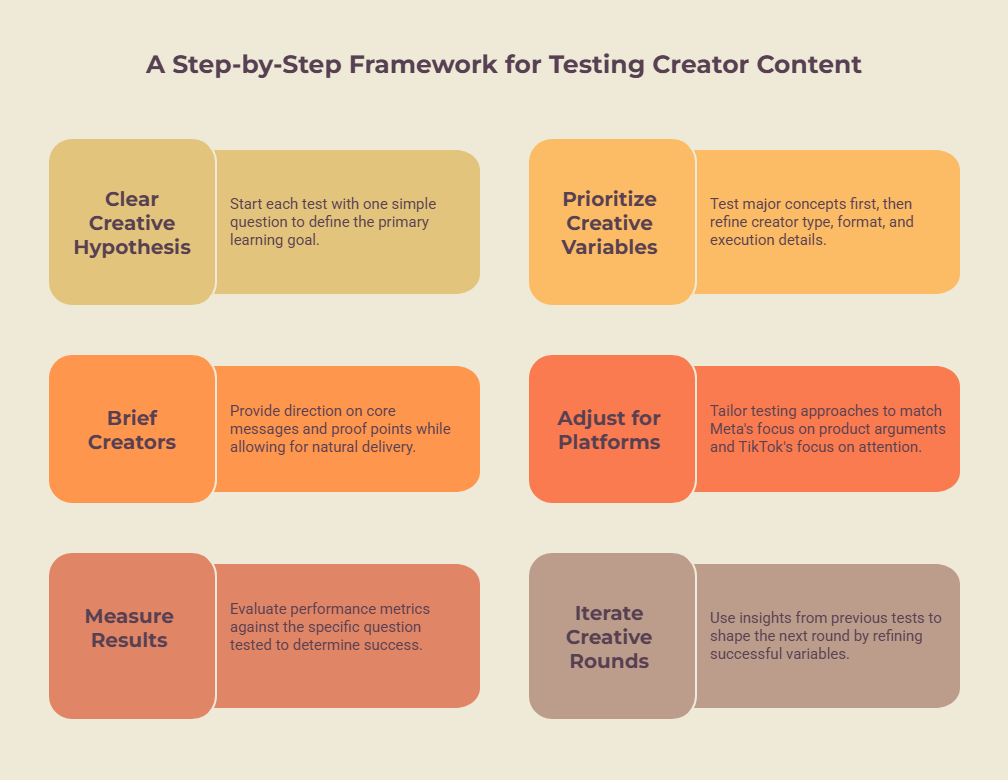
A Step-by-Step Framework for Testing Creator Content on Meta & TikTok
Creator testing works best when each round has a clear purpose. The steps below help you move from broad ideas to more focused creative decisions.
1. Start With a Clear Creative Hypothesis
Every test should start with one simple question: What are you trying to learn from this round?
Your hypothesis might focus on a:
- Customer problem
- Product benefit
- Common objection
- Buying motivation
- Specific use case
For example, you may want to test this idea: People respond more strongly to saving time than saving money.
This is the core hypothesis. The creator video is the execution.
One creator might show the time-saving benefit through a product demo. Another might explain it through a customer story or direct-to-camera video. The format changes, but the idea stays the same.
Give each testing round one primary learning goal.
2. Prioritize the Right Creative Variables
Start with major concepts and messaging angles. These tell you which ideas are worth developing further.
Once one concept performs better than the other ideas in that round, you can test creator type, format, and delivery style. From there, refine the stronger versions through hooks, pacing, captions, CTAs, and edits.
| Testing stage | What to test |
| Concept level | Customer problem, benefit, use case, objection, core message |
| Creator level | Creator type, format, delivery style |
| Execution level | Hook, pacing, captions, CTA, edit style |
This order matters because small creative changes cannot fix a weak core idea. If the concept itself falls flat, a new caption or opening line is unlikely to give you a useful answer.
Pro tip: Move into smaller creative tweaks once you have a core idea worth refining.
3. Brief Creators for Better Testing
A good test starts before the content is filmed. Your creative brief should give creators enough direction to keep the comparison fair, while still leaving room for natural delivery.
If you are comparing creators, keep the core message, offer, and required proof points consistent. That way, you are testing the creator and delivery style instead of several variables at once.
At the same time, avoid scripting every line. Creator content should still sound like the person delivering it. This matters to viewers. TikTok’s 2026 research with Accenture found that 76% of consumers want to see more authentic brand content, while 9 in 10 said authenticity can influence what they buy.
So, a strong brief can ask for:
- Several hook options
- Two or three CTA endings
- Product demos or supporting shots
- Clean B-roll
- Alternate voiceover files
- Key proof points that must be included
This gives your ad production workflow more flexibility. The same footage can be turned into modular content and new creative variants without asking the creator to reshoot the full video.
Pro tip: If your team needs a steady flow of testable creator assets, working with an expert UGC ads agency can help with creator sourcing, creative briefs, production, and iteration.
4. Adjust the Testing Approach for Meta and TikTok
A strong idea can work across social media platforms, but the way you test it should match how people use each feed. Meta and TikTok Ads respond to different creative signals, so the same testing approach will not always give you useful answers.
Testing on Meta
On Meta, put more weight on the product argument. Messaging, proof, conversion angles, and creator archetypes are useful variables to test.
For example, you could present the same product through:
- A customer story
- A problem and solution demo
- An expert-style creator
- A relatable lifestyle creator
- A direct product benefit
The aim is to find which combination makes the strongest case for the product. Once an idea starts showing potential, you can build new ad variants around the message, creator type, or proof that appears to be working.
Meta recommends using A/B testing to compare Reels creative and advises advertisers to test native or Reels-optimized assets. Its current guidance also recommends 9:16 vertical video with audio, with key messages kept inside the Reels safe zone.
You can manage these tests in Meta Ads Manager and adapt the same concept for different placements when needed.
Testing on TikTok
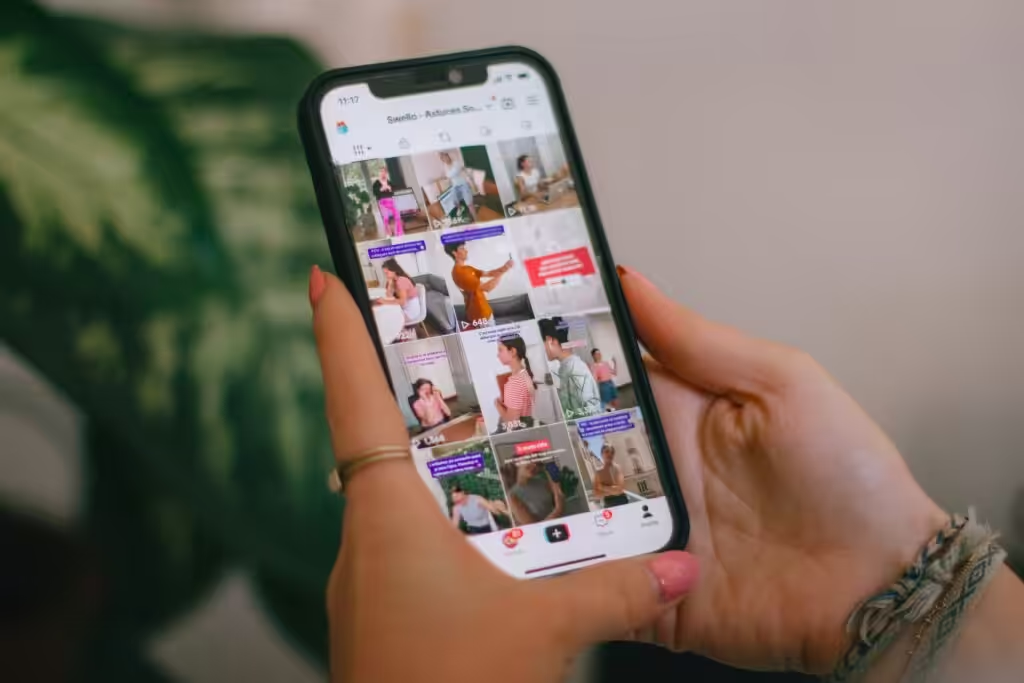
TikTok puts more pressure on the opening and delivery of the video. Your creator needs to earn attention quickly and keep the story moving.
TikTok’s own guidance recommends grabbing attention in the first few seconds, then building the video around a clear hook, body, and close. It also points to quick pacing, movement, captions, sound, and creator-led storytelling that feels natural in the feed.
Creator delivery deserves close attention too. TikTok’s 2025 campaign analysis found that creator-led ads delivered 70% higher CTR and 159% higher engagement than non-creator ads at the same CPM.
Your TikTok creative testing can therefore pay close attention to:
- The first few seconds
- Creator delivery
- Pacing
- Story structure
- Visual movement
- Sound and dialogue
- How naturally the video fits into the feed
TikTok Spark Ads give you another way to work with creator content. They let you promote your own organic posts or authorized posts from content creators while keeping views, comments, shares, likes, and follows connected to the original post.
This makes Spark Ads useful when you want the paid version to retain the context and engagement of the original creator post.
Note: Before you put creator posts behind paid spend, make sure your agreements cover influencer whitelisting and usage rights for the platforms and campaign periods involved.
Carry the Learning Across Platforms
Platform-specific testing does not mean starting from zero each time. If you learn that a certain pain point, objection, benefit, or use case connects with your audience on Meta, take that insight into TikTok and adapt the execution.
For example:
| Validated learning | Meta execution | TikTok execution |
| Customers care about saving time | Creator testimonial with clear proof and CTA | Fast routine demo with the time-saving benefit in the opening |
| Buyers need more trust | Customer story supported with product proof | Casual creator story with visual proof built into the video |
| A use case drives conversions | Benefit-led Instagram Reels ad | Native-style demonstration built around the same use case |
The customer insight can travel. The ad creative should still match the platform.
That is the real value of platform-specific testing. You keep what you have learned about the audience while adapting the hook, pacing, format, and creator delivery to the way people consume content on each platform.
5. Measure Results Against the Question You Tested
A creative test is only useful if you read the results against the question you started with. Different performance metrics tell you different things, so avoid treating one number as the final verdict.
A simple way to read performance is through three questions:
| Question | Metrics to watch | What they can tell you |
| Did it earn attention? | Hook performance, watch time, hold rate, completion rate | Did the opening and delivery keep people watching? |
| Did it create interest? | CTR, landing page visits, meaningful engagement | Did the message make people want to learn more? |
| Did it convert? | Conversion rate, CPA, ROAS, revenue, lead quality | Did that interest turn into business value? |
When creator content is part of a wider influencer program, these same metrics also help you understand influencer marketing ROI, from acquisition cost and conversion value to revenue.
The useful insight usually comes from reading these signals together.
For example, strong watch time with weak conversion can mean the hook works, but the product argument, proof, or offer needs work. A high CTR with weak landing page activity may point to a gap between the ad promise and the user experience after the click.
The reverse can also happen. A video may have average retention but still produce strong conversions. In that case, the creative may be reaching a smaller group of people with strong purchase intent.
Give each test enough delivery before you make a call. Small samples can make one creative look much stronger or weaker than it really is.
Keep the main test conditions reasonably consistent too. Large changes in audience segments, budget, offer, or landing page can make it harder to tell how much of the performance change came from the ad creative itself.
6. Turn Test Results Into the Next Creative Round
Once a test gives you a clear signal, use it to shape the next round.
Start by asking which variable most likely drove the improvement. Was it the concept, creator, hook, proof, or format?
Keep the strongest element in place and change the next most important variable. This gives you a cleaner read than rebuilding the whole ad from scratch.
For example:
| Winning concept → New creator → New hook → Stronger proof → Platform adaptation |
This kind of sequential testing helps you build on what already works instead of resetting every round.
You can also carry strong insights into new content creators or new social media platforms. A customer pain point that performs well on Meta may still be useful on TikTok, even if the execution needs a different hook, pacing, or format.
At the same time, keep testing fresh concepts. If you only produce variations of one winner, your creative strategy can become too narrow.
A simple testing loop looks like this:
| Hypothesis → Create → Test → Diagnose → Iterate |
Each round should leave you with one useful answer and a clearer direction for the next creative brief.
Common Mistakes That Make Creator Tests Hard to Read
Even a well-structured test can lose value if the learnings are not recorded properly.
A few mistakes can make future rounds harder to plan:
- Poor naming and version control: Labels like “final_v2” make it hard to trace what changed. Use clear names that identify the creator, concept, hook, and version.
- No creative test log: Without a record, useful insights disappear fast. Track the hypothesis, asset, launch date, audience, outcome, and main takeaway for each test.
- Losing context behind a winner: A winning ad means less if you cannot explain what made it different. Save the original creative brief and note the exact changes between versions.
- Keeping learnings inside one team: Paid media insights can get lost before they reach creators or editors. Share key findings with the people writing briefs, sourcing creators, editing footage, and managing campaigns.
Good documentation gives every future test a stronger starting point.
Build a Creator Testing System That Compounds Learning
Good creator testing should leave you with more than one winning ad. Each round should improve the next creative brief and add to what you know about messages, creators, hooks, proof, and formats.
Over time, those learnings give your team a stronger base for creative decisions across Meta and TikTok. The insight may carry across both platforms, while the execution changes to fit each feed.
If you are building a larger creator program, working with an influencer marketing agency can also help connect creator sourcing, campaign management, content production, and performance learning.
What matters is keeping that learning cycle going, so every new round starts with more context than the last.
Frequently Asked Questions
How many creator ads should you test at one time?
There is no fixed number that works for every account. As a practical benchmark, TikTok recommends 3 to 5 unique creatives per ad group. Your own test size should still match your budget and conversion volume. Too many ad variants can spread delivery too thin. Each one may then receive too little data for a useful comparison.
How long should you run a creator ad test before making a decision?
Avoid judging a test after a fixed number of days alone. Look at how much delivery and conversion data each creative has received. Higher volume accounts may learn faster, while smaller accounts need more time. Make decisions once each variant has had a fair chance to reach the intended audience.
How do you know when a winning creator ad is starting to fatigue?
Watch for a steady decline in performance after the ad has been running successfully. Falling CTR, weaker video retention, rising CPA, or lower conversion rates can all be warning signs. Check several metrics together before replacing the creative, since normal day-to-day movement does not always mean fatigue.
What is the difference between A/B testing and sequential creative testing?
A/B testing compares two or more variants under similar conditions to see which performs better. Sequential testing happens across multiple rounds. You take a useful learning from one test, keep the strongest element, and test the next variable. This makes sequential testing useful for developing a creative idea over time.