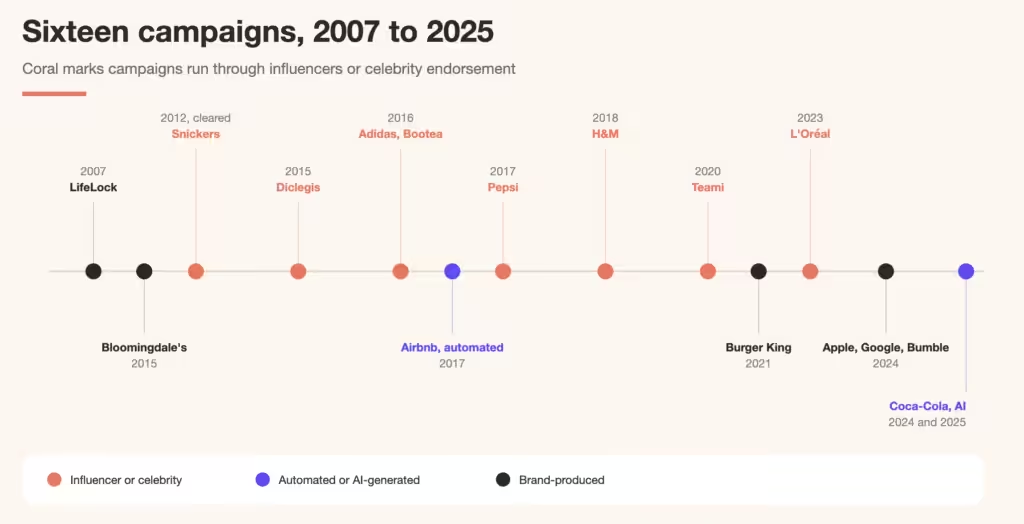

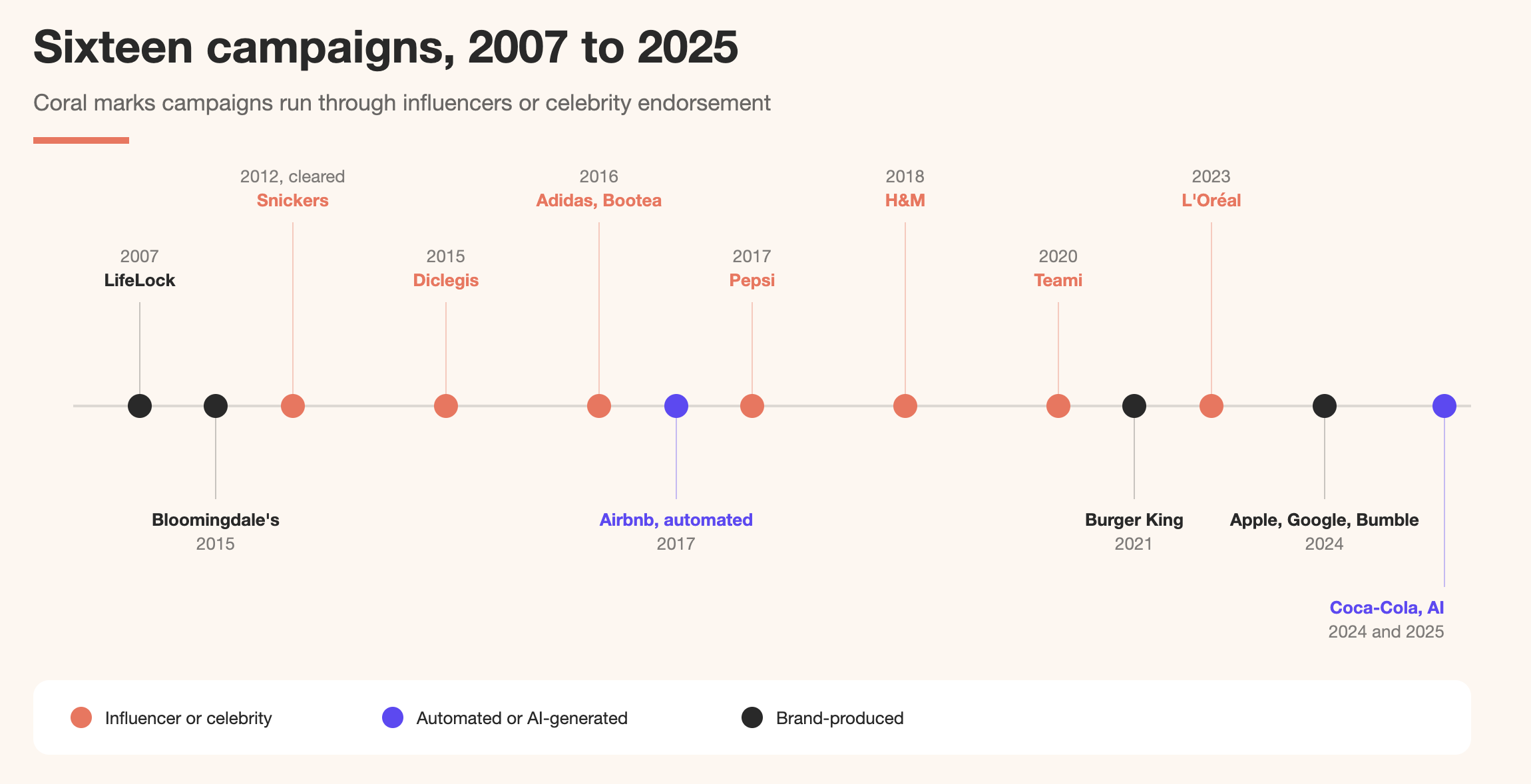
Most bad advertisements clear every internal approval before they reach the public. A team briefed the work, a marketing team approved it, legal signed it, and it still landed badly enough to be pulled within a day.
These examples are documented: pulled ads, regulator letters, apologies, court-ordered judgments. Each names what the brand intended, the mechanism that broke, and what happened next.
Campaigns built with influencers dominate the list because that’s where the review step is thinnest. A brand can spend nine months on a television spot and forty minutes on a brief for influencers reaching the same audience.
Table of Contents
What Makes an Ad Fail
An ad fails when what the audience sees is different from the intended message, and the gap becomes the story. Backlash alone doesn’t prove failure. Plenty of controversial advertising raises awareness and lifts purchase intent.
The test marketers should apply is whether the campaign got discussed on its own terms. When people argue about whether a product is good, the ad worked. When they argue about whether the brand understands the culture it sells into, the ad failed.
Meaning is the variable nobody controls. The same creative carries one message in March and another in June, because the news moved and the ad didn’t. Brand values are asserted by the advertiser and assigned by the audience, and bad advertising is usually the gap between the values a company claims and the values its creative demonstrates.
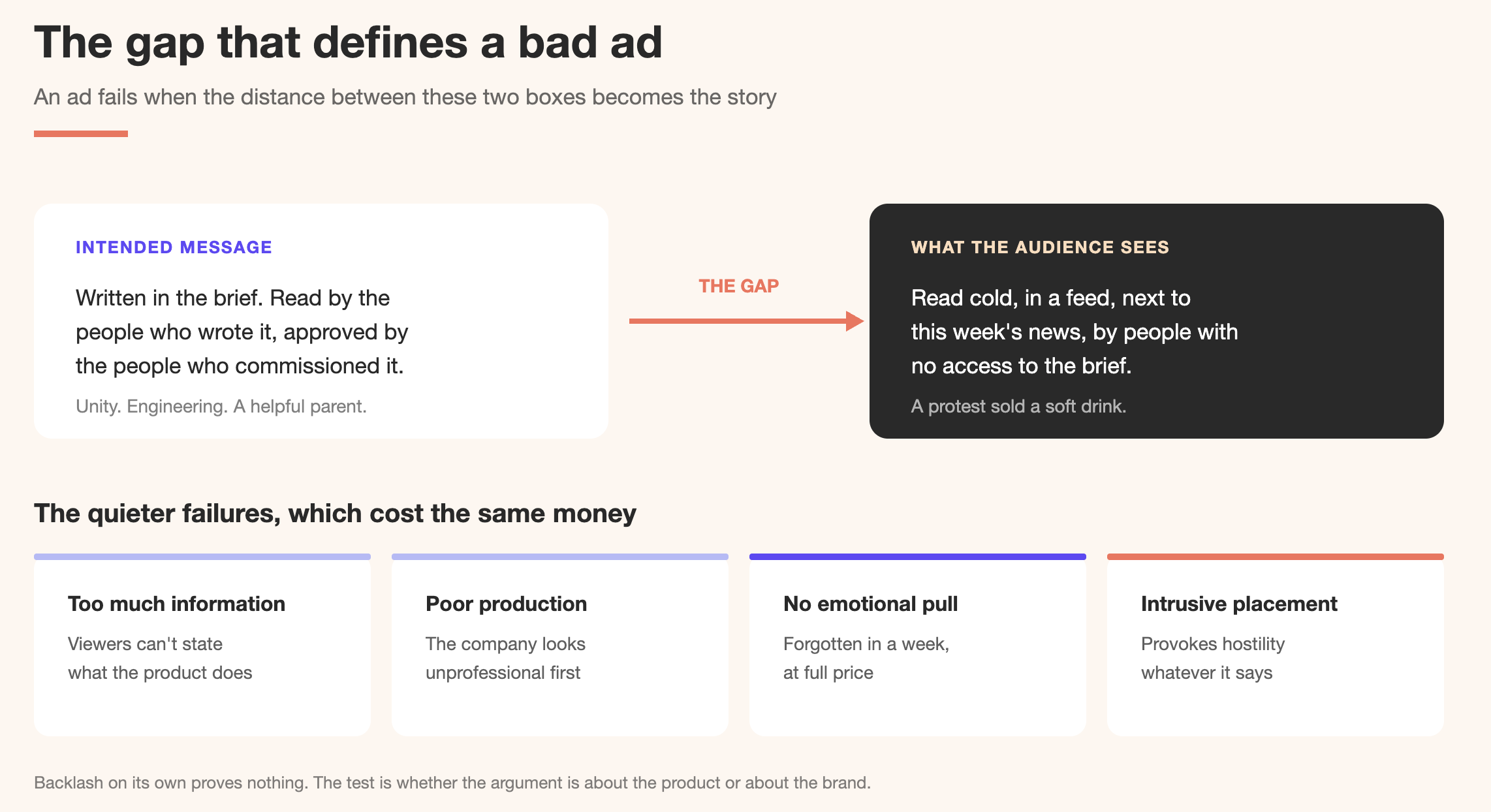
Failure has quieter versions. Ads carrying excessive information leave viewers unable to state what the product does. Poor production quality makes a company look unprofessional before anyone evaluates the offer. Ads that connect with nobody emotionally get forgotten inside a week, which costs the same money as being hated and buys less. Intrusive placement provokes hostility regardless of what the creative says.
Regulators sit at the far end. Campaigns that break an advertising code get withdrawn and subsequently banned, and in the US the Federal Trade Commission can bill the advertiser. Most bad ads never get that far. They get deleted quietly, brand equity erodes, the agency loses the account.
Why Campaigns with Influencers Fail Differently
Influencers carry a second brand into every post, which doubles the ways a campaign can fail. Working with influencers is not riskier than broadcast; it fails in different places. The brand can get the message wrong, the influencers can get the execution wrong, or the pairing makes no sense to an audience that follows one and has never heard of the other.
Marketers also review this work differently. A television script gets read by a dozen people. Captions written for influencers often get read by nobody once the brief leaves the building, and most of the mistakes in these examples trace to that gap rather than to bad creative judgment.
Scale compounds it. A brand running fifty influencers is publishing fifty pieces of copy it didn’t write, on accounts it doesn’t control, at times it didn’t choose.
Influencer Campaigns that Failed
L’Oréal Telescopic Lift and the Mascara Demo
Mikayla Nogueira posted a 44-second TikTok review of L’Oréal’s Telescopic Lift mascara on 25 January 2023. Viewers watching frame by frame accused her of wearing Ardell Wispies false lashes under the mascara she was paid to promote.
Nogueira denied it, and no regulator tested the claim. She replied in the comment thread that L’Oréal “would never allow that in a partnered post” and said she had applied three or four coats.
The accusation was never proven either way, which is the point. A beauty demo is a product test performed in public, and once an audience decides it can’t verify the test, the disclosure label stops helping. Time, Rolling Stone and Glossy covered the dispute, and none of it carried the product message.
Pepsi and Kendall Jenner, April 2017
Pepsi released “Live For Now Moments Anthem” on 4 April 2017. Kendall Jenner leaves a photo shoot, joins a march, and hands a can of Pepsi to a police officer, who drinks it while the crowd cheers.
The march had no stated cause. Critics read the final frame as an echo of the photograph of Ieshia Evans facing riot police in Baton Rouge in 2016, meaning the ad borrowed the visual language of protests against police shootings of Black Americans and resolved that social conflict with a soft drink.
Pepsi pulled it on 5 April, one day after release: “Pepsi was trying to project a global message of unity, peace and understanding. Clearly we missed the mark, and we apologize. We did not intend to make light of any serious issue.” It added: “We also apologize for putting Kendall Jenner in this position.”
That last line is the tell. The brand apologised to its own talent for a decision the brand made. A white supermodel resolving a protest came from the brief, and the brief had never been read by anyone with reason to object. Brands engage with live social issues and survive it constantly. Pepsi trivialised one, which is a different act.
Kim Kardashian, Diclegis, and the FDA Warning Letter
In 2015 Kim Kardashian posted an Instagram endorsement of Diclegis, a prescription morning sickness drug made by Duchesnay. The post described the benefit and omitted the risks.
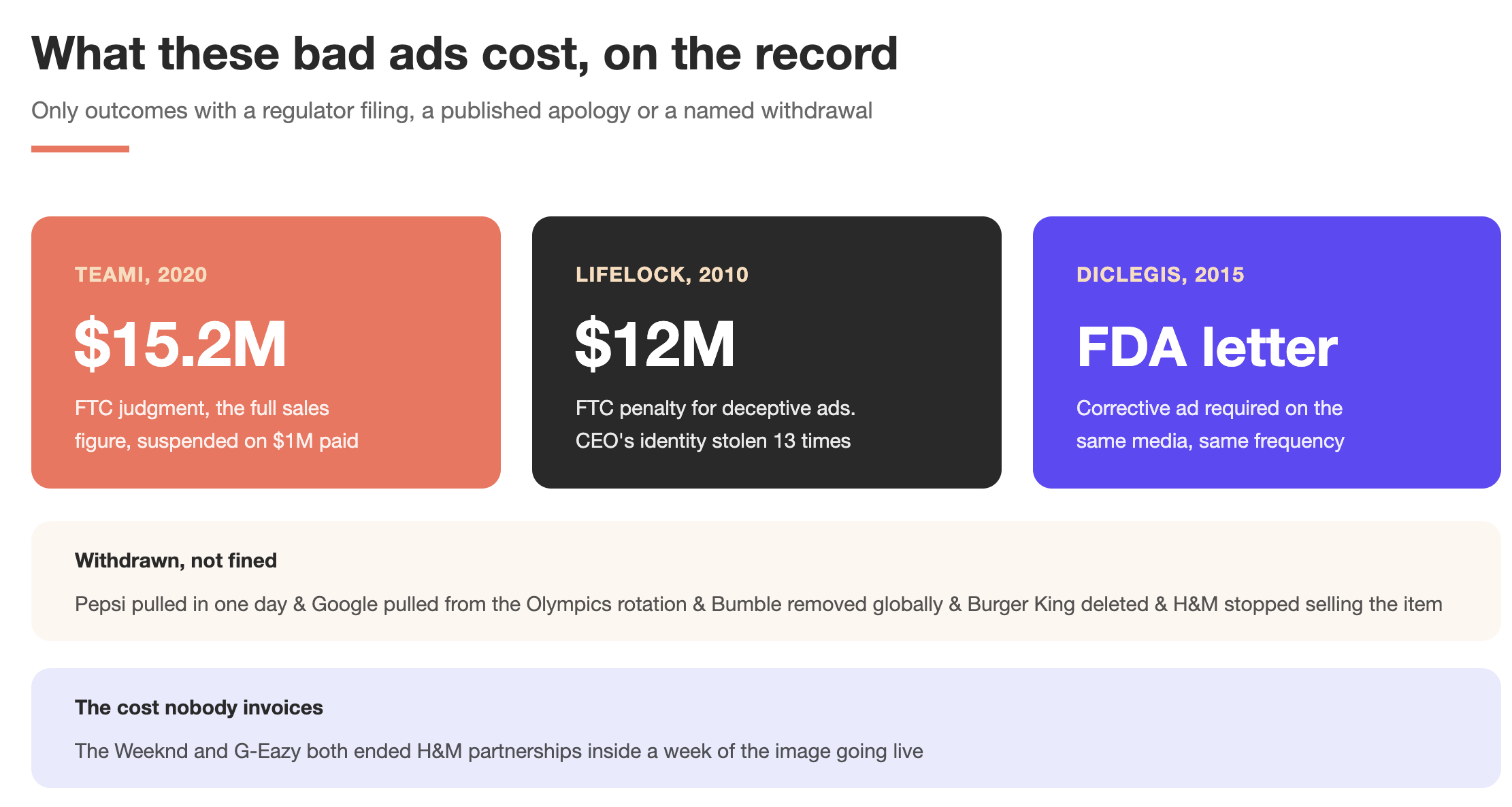
The FDA issued a warning letter to Duchesnay on 7 August 2015. Because Kardashian was a paid spokesperson, the post was regulated as prescription drug advertising, and the agency found it false and misleading for presenting efficacy claims while leaving out warnings and limitations of use. The post came down immediately, and the FDA required corrective messaging through the same media at the same frequency.
Nothing in the post broke a platform rule for influencers. It broke drug advertising law, and the bill went to the pharmaceutical company rather than the celebrity. Misleading claims damage consumer trust before a regulator arrives; the letter makes the damage expensive.
Adidas and Naomi Campbell, June 2016
Naomi Campbell was paid to promote Adidas Originals to her Instagram following in June 2016. The caption she published included the brand’s instructions to her:
Naomi, So nice to see you in good spirits!!! Could you put something like: Thanks to my friend @gary.aspden and all at adidas – loving these adidas 350 SPZL from the adidas Spezial range.
She had pasted the whole thing straight from her email. The caption was revised later, but the screenshots had circulated.
Bootea and Scott Disick, May 2016
The same failure happened a month earlier with a timestamp attached. Scott Disick was paid to promote a Bootea shake, and his caption opened: “Here you go, at 4pm est, write the below. Caption: Keeping up with the summer workout routine with my morning @booteauk protein shake!”
Two things leak out: the brand wrote the endorsement, and the brand chose the hour. Neither is unusual and neither breaks a rule. What made both posts damaging is that the audience sees the machinery, and the machinery contradicts the format. Most people don’t mind a paid post. They mind a paid post pretending to be a thought.
Tower Jewellers and the Rigged Giveaway
Irish influencer Terrie McEvoy ran giveaway competitions for Dublin retailer Tower Jewellers. Following claims raised online, and as reported by Lovin Dublin and Pedestrian.tv, she confirmed on Snapchat that two competitions had been won by her best friend and her brother’s partner.
A giveaway is the cheapest engagement mechanic influencers run and the easiest to break. The entry cost is real: a follow, a tag, an email. Once the outcome is known in advance, every previous campaign on that account gets re-read.
Teami and the $15.2 Million Judgment
In March 2020 the FTC settled charges against Teami, LLC over deceptive health claims and undisclosed influencer payments, citing Instagram posts by Cardi B, Jordin Sparks, Adrienne Bailon, Brittany Renner and other influencers.
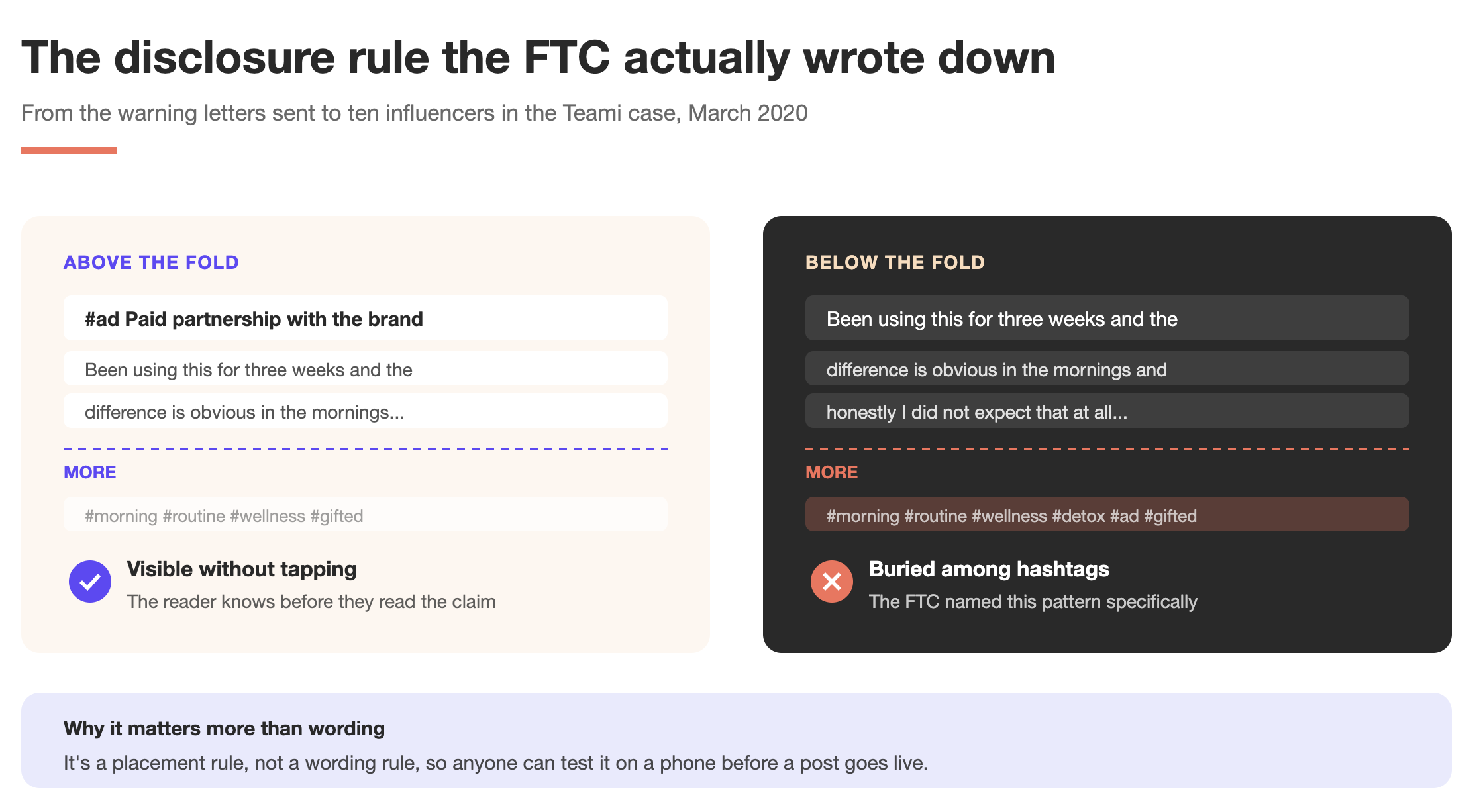
The judgment was $15.2 million, the total sales of the products at issue, suspended on payment of $1 million. The FTC also sent warning letters to ten influencers, stating that a material connection must be disclosed above the “MORE” button rather than buried among hashtags.
That’s the most operational instruction any regulator has given brands working with influencers: a placement rule, testable on a phone before a post goes live. It belongs on the same sheet as the rest of your affiliate marketing compliance checklist.
H&M and the Partnerships that Ended in a Week
In January 2018 H&M’s UK site showed a Black child model in a hoodie reading “coolest monkey in the jungle.” Tops from the same range carrying other animals were modelled by white children.
H&M pulled the image, issued a second apology and stopped selling the hoodie, saying “we have got this wrong and we agree that, even if unintentional, passive or casual racism needs to be eradicated wherever it exists.” It later appointed Annie Wu as global leader for diversity and inclusiveness.
The endorsement cost landed within days. The Weeknd, who had fronted H&M campaigns since 2017, said he would no longer work with the company, and G-Eazy ended his partnership the same week. Ads built on outdated stereotypes alienate customers, and when a brand has influencers attached, they leave first and publicly.
The Snickers Campaign Regulators Cleared
Every roundup of bad advertising and influencer marketing fails includes the Snickers Twitter campaign, and every one gets it wrong.
In January 2012 Katie Price, Ian Botham and boxer Amir Khan each posted tweets that read as out of character, covering eurozone debt and quantitative easing, before a final tweet showed the celebrity holding a Snickers bar with the line “You’re not you when you’re hungry” and the hashtag #spon.
The ASA investigated complaints that the teasers weren’t identifiable as marketing and ruled the ads were not in breach. The reveal tweet plus the #spon label made commercial intent clear, and the teasers were relevant to the slogan they set up.
A campaign that generates complaints and survives them has been tested in public. Controversial advertising buys visibility; whether it also costs trust depends on whether the controversy is about the idea or the people used to sell it.
Brand Campaigns that Failed the Same Way
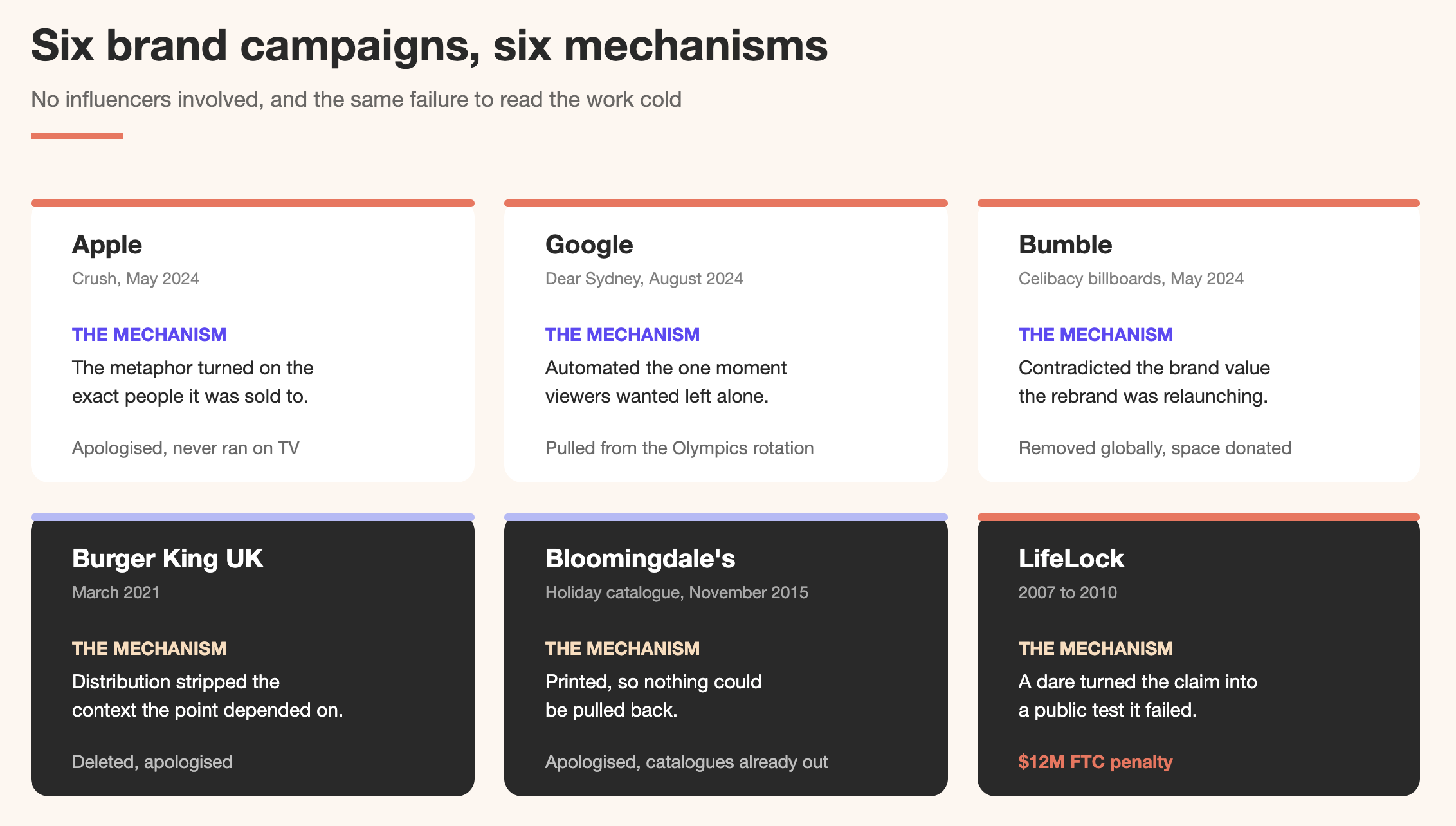
Apple’s Crush Ad, May 2024
Apple’s iPad Pro spot showed a hydraulic press crushing a piano, a trumpet, a record player, paint cans, cameras, books and an arcade cabinet into a tablet. Tim Cook posted it on X.
The backlash came hardest from professional creatives, the segment the iPad Pro is sold to. Tor Myhren, Apple’s vice president of marketing communications, said: “We missed the mark with this video, and we’re sorry.” Apple did not run the ad on television.
The creative worked in the room. Compression as a metaphor for a thin device is a clean creative idea. It breaks when you ask what the audience sees, which is a machine destroying the tools they own.
Google’s Dear Sydney Ad, August 2024
Google ran a Gemini spot during the 2024 Paris Olympics in which a father uses the AI to help his daughter write a fan letter to the hurdler Sydney McLaughlin-Levrone. Google pulled it on 2 August. A spokesperson said: “While the ad tested well before airing, given the feedback, we have decided to phase the ad out of our Olympics rotation.”
Read that first clause again. The ad tested well. Audience research measured what it was designed to measure and missed that the emotional premise, a child’s letter to her hero, was the one task viewers didn’t want automated. Technology in the wrong moment becomes the story and buries the message.
Bumble’s Celibacy Billboards, May 2024
Bumble launched a rebrand with taglines including “You know full well a vow of celibacy is not the answer.” and “Thou shalt not give up on dating and become a nun.”
The slogan was written as a joke. The criticism came from women who read it as telling them their own choice was invalid, and who found the joke offensive rather than knowing. For a brand built on women’s agency, the ads contradicted the brand values they were meant to relaunch.
Bumble removed them globally and posted a statement on 13 May 2024: “We made a mistake. Our ads referencing celibacy were an attempt to lean into a community frustrated by modern dating, and instead of bringing joy and humor, we unintentionally did the opposite.” It then donated to the National Domestic Violence Hotline and offered the billboard space to advocacy organisations.
Burger King UK and the Missing Context, March 2021
On 8 March 2021, International Women’s Day, Burger King UK tweeted “Women belong in the kitchen.” The follow-up tweets explained the point: only 20% of professional chefs in UK kitchens are women, and the brand was launching culinary scholarships.
The first tweet travelled alone. It collected tens of thousands of replies and over a quarter of a million retweets, far outrunning the thread, amplified by accounts that liked it exactly as written.
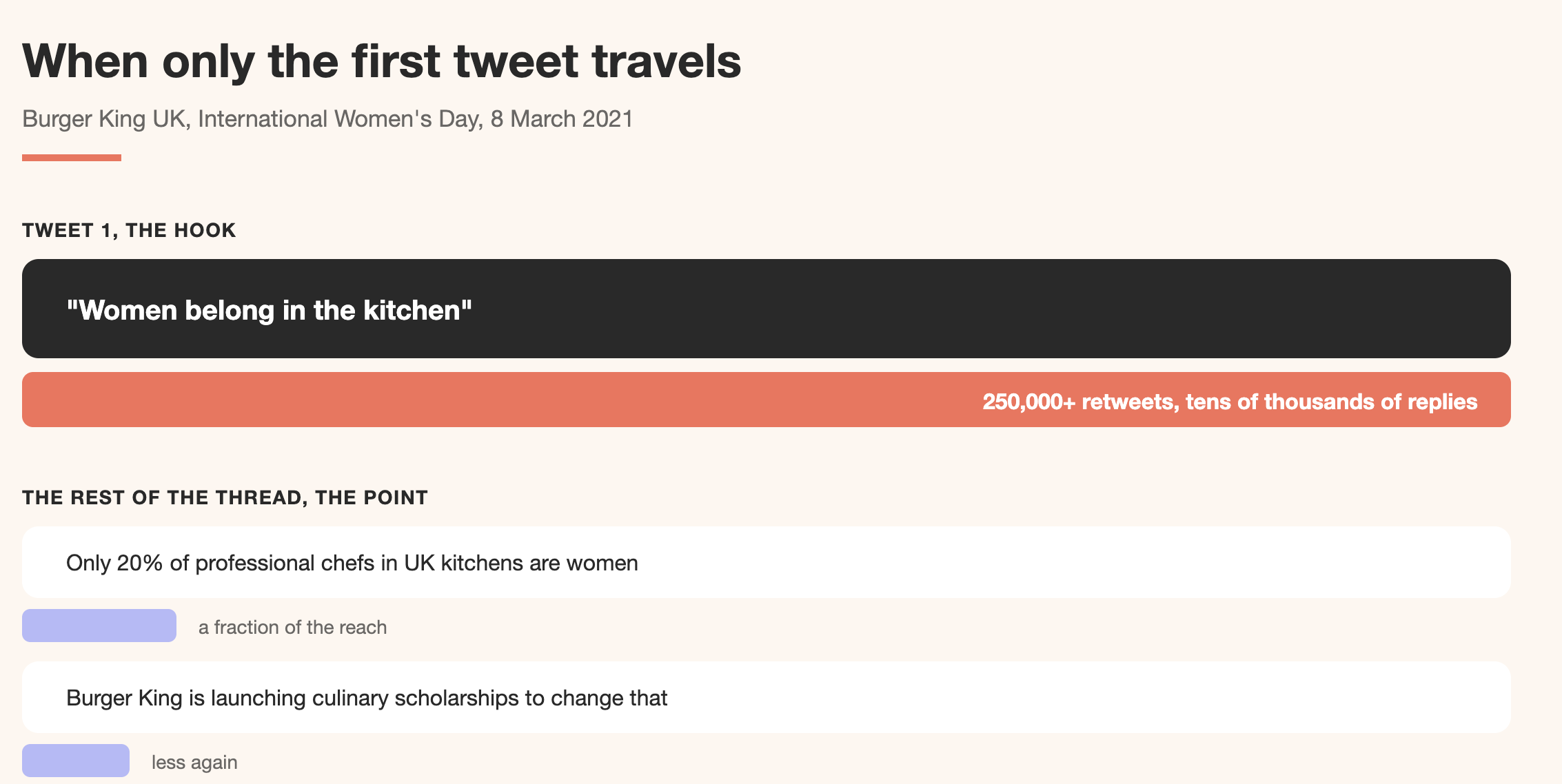
Burger King deleted it and apologised: “We got our initial tweet wrong and we’re sorry.” A message that only works when the audience reads all of it isn’t a message. It’s a gamble on distribution behaving.
Bloomingdale’s Holiday Catalogue, November 2015
Bloomingdale’s ran a Rebecca Minkoff page in its 2015 holiday catalogue with the line “Spike your best friend’s eggnog when they’re not looking,” over an image of a man watching a laughing woman turned away from him.
The retailer apologised: “the copy we used in our recent catalog was inappropriate and in poor taste. Bloomingdale’s sincerely apologizes for this error in judgment.”
Print is the aggravating detail. Nothing could pull the ad from catalogues already in millions of homes, which is why review matters more as the medium gets less reversible.
LifeLock and the Published Social Security Number
From 2007 LifeLock advertised identity theft protection by printing CEO Todd Davis’s actual Social Security number on billboards, daring anyone to misuse it.
They did. Davis’s identity was stolen at least 13 times. A man in Texas took out a $500 loan in his name; a man in Georgia opened an AT&T account that ran up $2,390 in debt. In 2010 the FTC fined the company $12 million over deceptive advertising, finding LifeLock’s protection claims overstated what the service did. It didn’t cover identity theft involving existing credit cards or bank accounts, which is most of it.
A dare creates a strong hook and a terrible claim structure. It converts a marketing promise into a falsifiable public test, invites dozens of strangers to run that test for free, and puts the CEO’s own identity up as proof.
Automated and AI-generated Campaigns
Airbnb’s Hurricane Harvey Email, August 2017
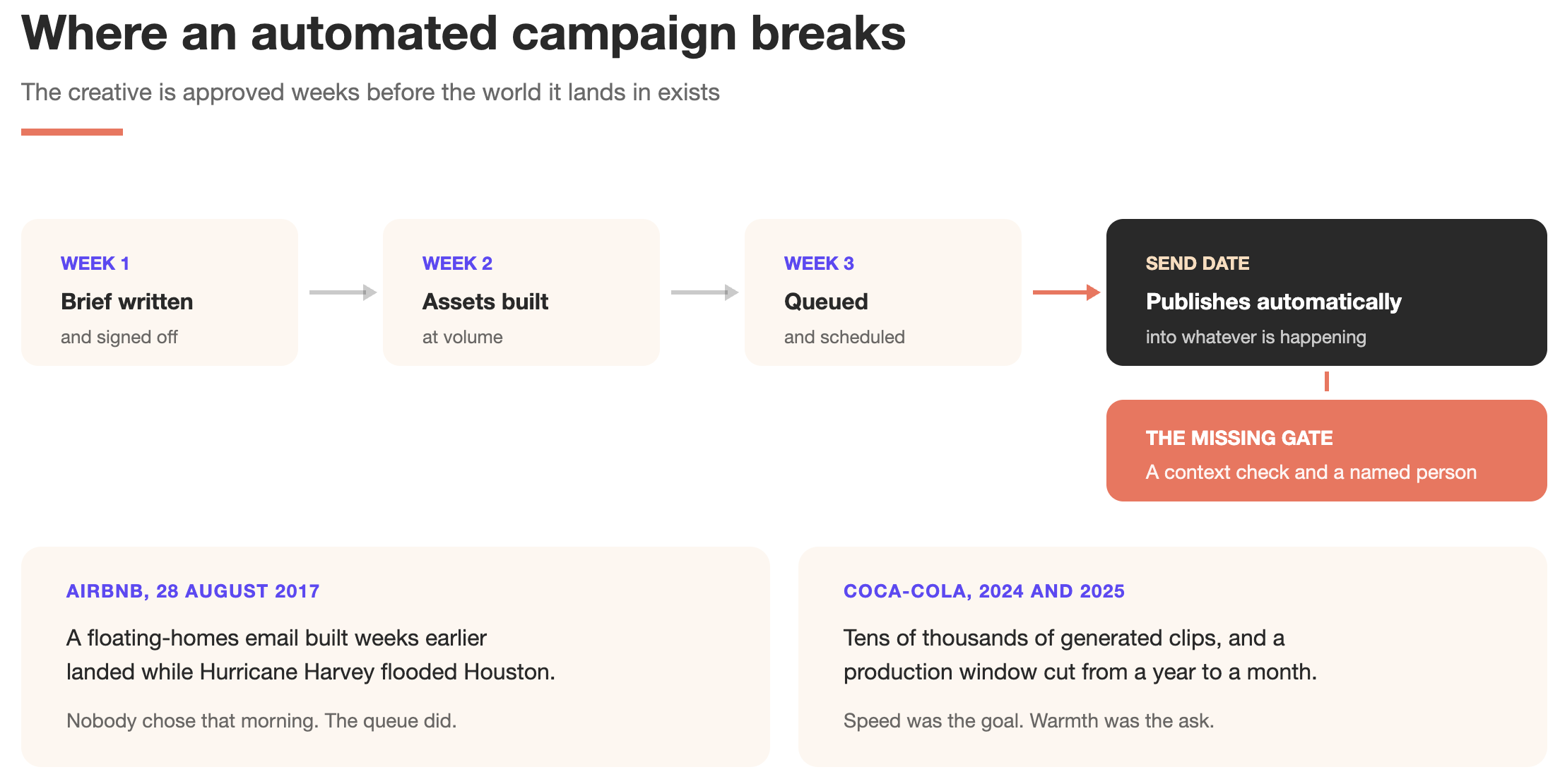
On 28 August 2017, while Hurricane Harvey flooded Houston, Airbnb sent a marketing email built around floating homes, with copy including “Stay above the water: live the life aquatic with these floating homes.”
Nobody at Airbnb chose that morning. The campaign was built weeks earlier and scheduled, which is how most email marketing runs. Spokesman Christopher Nulty told Quartz: “The timing of this email marketing campaign was insensitive and we apologize for that.”
The company was simultaneously waiving fees for Houston evacuees. Both things were true at once, and the automated send is the one people remember. Every automated campaign needs a pause process a human can trigger during a crisis, and a context check on current events before anything leaves the queue.
Coca-Cola’s AI Holiday Ads, 2024 and 2025
Coca-Cola rebuilt its “Holidays Are Coming” caravan spot with generative AI in 2024. Viewers called it soulless and pointed at uncanny faces and awkward motion. It ran another AI version in 2025, produced with studios Silverside and Secret Level, and the reaction repeated.
The production numbers explain the appeal. Coca-Cola put roughly 100 people on the project, five of them writing prompts that generated tens of thousands of clips, and its marketing leadership said a spot that used to start a year ahead now takes around a month. Pratik Thakar, its head of generative AI, said: “The genie is out of the bottle, and you’re not going to put it back in.”
Generative tools produced the spot. The decision to hand the brand’s most nostalgic asset to a process optimised for speed produced the backlash, because warmth was the thing the audience came for.
Automation Scales Mistakes Much Faster
Generative AI produces ad variations faster than any team can review them, which changes the risks. A bad concept used to reach one execution. Now it reaches four hundred, across every placement, before anyone reads the third.
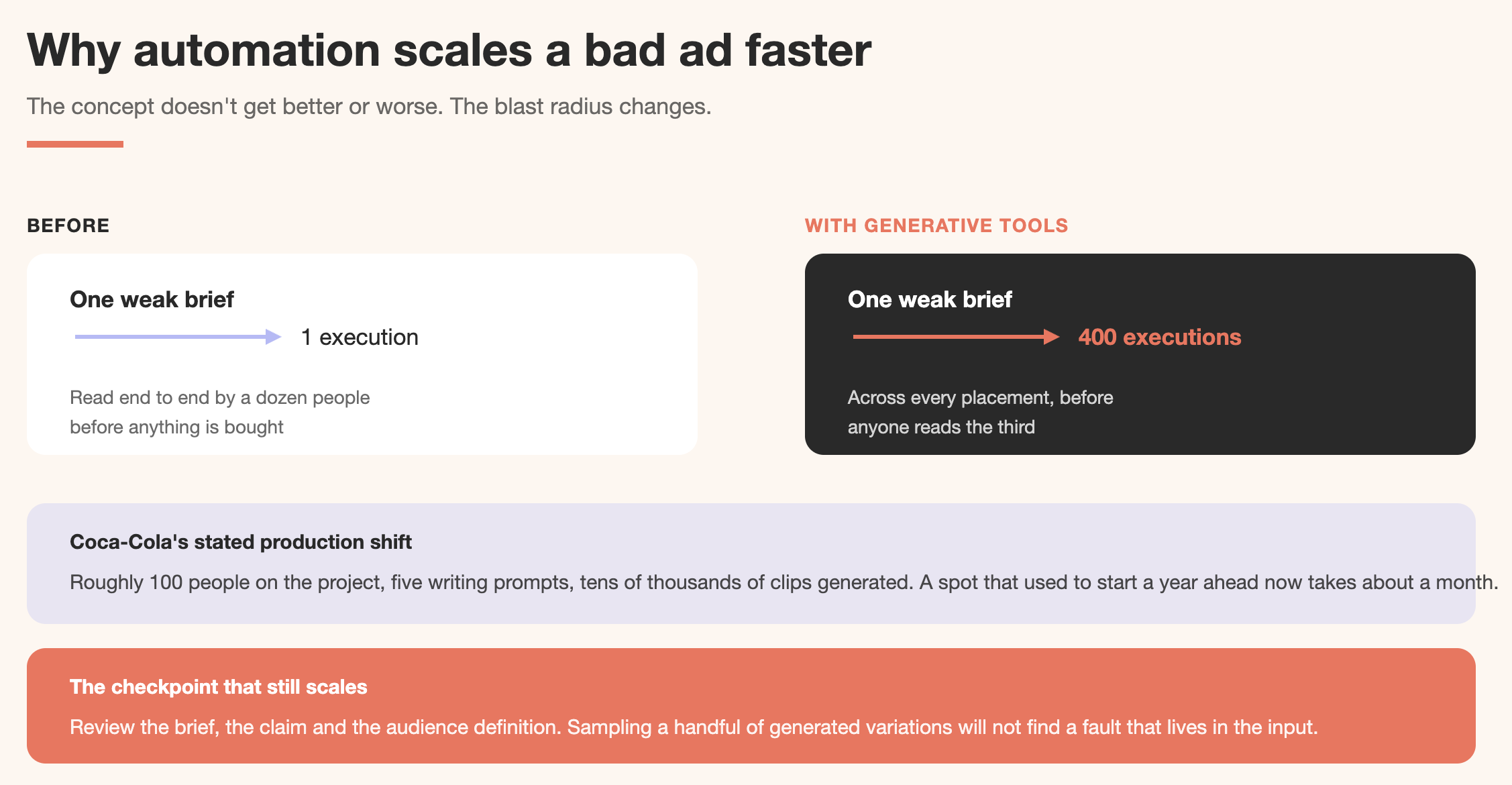
Weak inputs produce weak ads at that speed. A vague brief run through a model returns vague creative in volume, and volume reads as confidence. Automation scales whatever it was given, mistakes included.
Review the inputs rather than sampling the outputs. If the brief, the claim and the audience definition are wrong, checking a handful of generated variations will not find it.
What Bad Advertising Has in Common
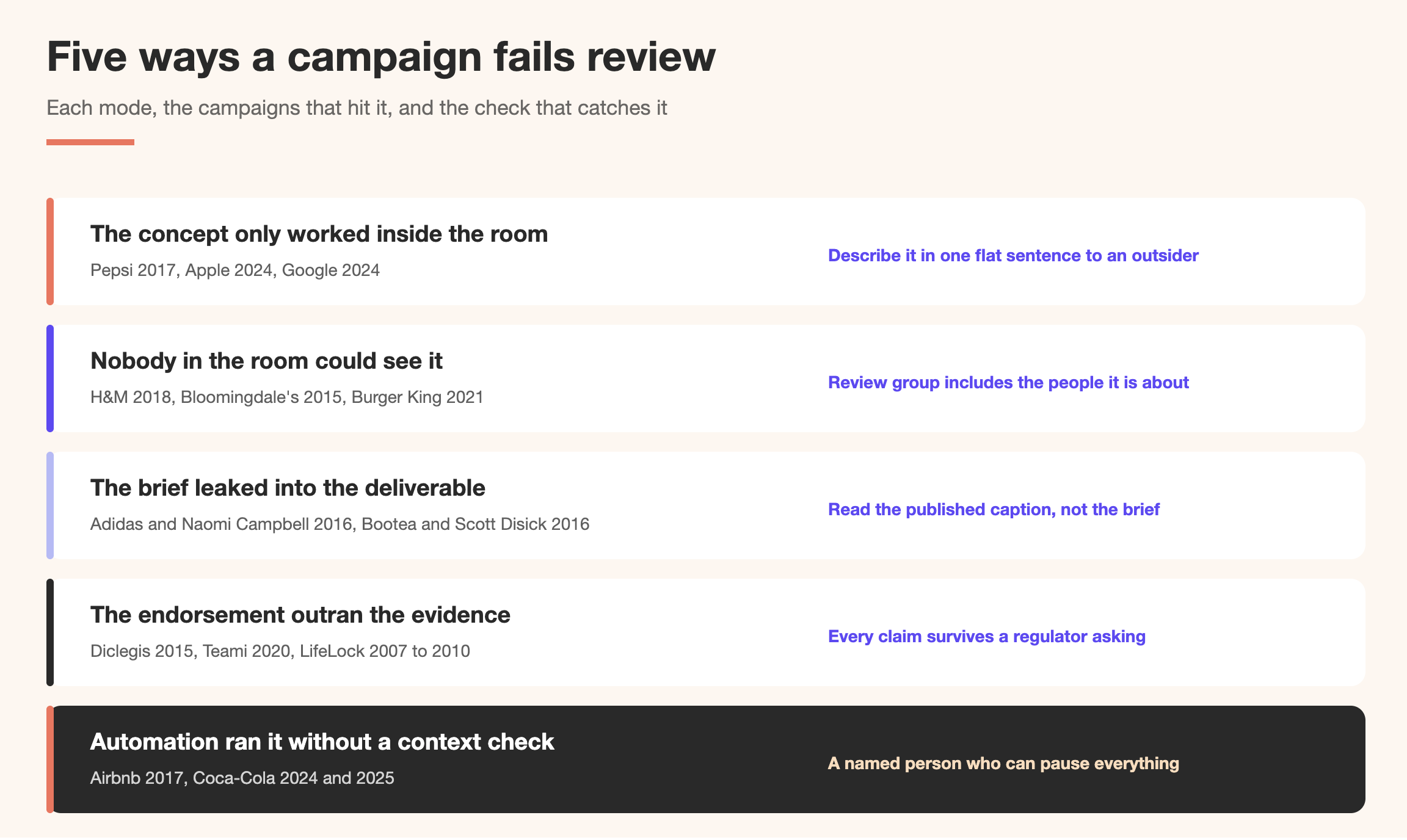
The Concept Only Worked Inside the Room
Pepsi, Apple and Google each created an idea that holds together as a pitch. Protest as unity, compression as engineering, AI as a helpful parent. Every one of these examples survives a slide and fails a screen.
The check costs nothing: describe the ad in one flat sentence, no music and no adjectives, to somebody who wasn’t in the meeting. A white supermodel ends a protest by giving a police officer a soft drink. A press destroys musical instruments. Say it out loud and the tone deaf version is obvious.
Nobody in the Room Could See It
Burger King, Bloomingdale’s and H&M each published work a wider set of reviewers would have stopped in seconds. Diverse review teams catch this earlier than process does, because the objection is obvious to someone the campaign is about and invisible to everyone else. Cultural context is not a compliance box; it’s the difference between a message the audience completes correctly and one it completes against you.
The Brief Leaked into the Deliverable
Campbell and Disick published the brand’s instructions because nothing sat between the brief and the post.
The Risks Nobody Priced
Working with influencers adds three risks broadcast doesn’t have: they publish from their own account, on their own schedule, and their back catalogue stays searchable next to yours. Brands running influencers at scale price those risks rather than absorbing them. They read every caption before it publishes, check for bought followers before signing, and cost a creator’s history into the deal instead of finding it in a screenshot.
The Endorsement Outran the Evidence
Kardashian’s post, Teami’s health claims and LifeLock’s billboards all made a claim the product couldn’t carry. These are the most expensive mistakes here, because they create a paper trail. A social issue handled badly costs a brand a week of criticism and some spending on crisis comms. A claim a regulator can test costs money and produces an order limiting what the company may say next.
Current events change what a message means without anyone touching the creative. Seen in that light, poorly timed is a category of failure on its own, and the one most likely to hit work approved months earlier and never re-read.
Run this pre-launch checklist, and sleep much better afterwards
Run these before the spending starts. Marketers should treat the list as a risk register, not a formality, and it applies to broadcast creative and to influencers alike.
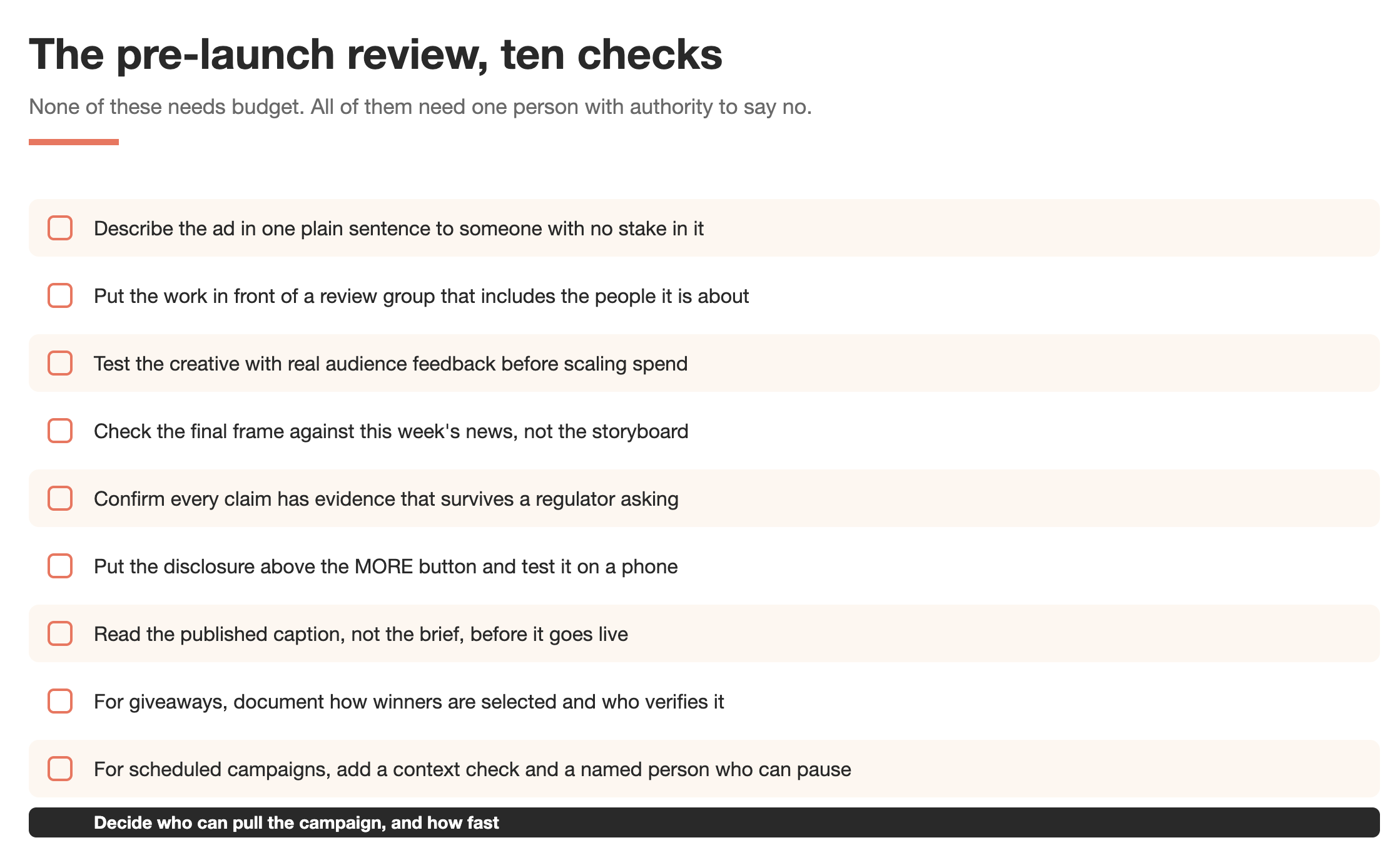
- Describe the ad in one plain sentence to someone outside the marketing teams with no stake in it
- Put the work in front of a review group that includes the people the campaign is about
- Test the creative with real audience feedback before scaling spend behind it
- Check what the audience sees in the final frame, not the storyboard, against the week’s news
- Confirm every claim has evidence that would survive a regulator asking
- Put the disclosure above the “MORE” button and test it on a phone
- Read the published caption, not the brief, before it goes live
- For giveaways, document how winners get selected and who verifies it
- For scheduled and automated campaigns, add a context check on the send date and a named person who can pause everything
- Decide who can pull the campaign, and how fast
Checking what rivals are already running is a separate job from checking your own work, and it belongs to ad intelligence software rather than to the review meeting.
None of these examples came from incompetent teams. They came from capable teams with no adversarial reader in the room, a cheaper problem to fix. Nothing on that list needs budget. It needs one person with the standing to say no, the time to look, and responsibility for the answer.
A checklist only works when somebody owns it. Where that adversarial reader doesn’t exist in-house, an influencer marketing agency can hold the brief, the caption review and the disclosure check as a standing process rather than a favour someone does the day before launch.
What to Do When an Ad Has Already Failed
Stop the campaign first, whether it runs on broadcast or through influencers. Pepsi did this in a day and limited the damage. The ad is remembered, but the brand didn’t compound it by defending the work.
You can’t stop what nobody has noticed. Social listening platforms such as Brand24 push mentions in real time on their upper tiers, which is the difference between catching a spike on the day and reading about it in a trade title.
Name the mistakes in the brand’s own words, dropping the marketing register. Bumble said “We made a mistake” and then said what the mistake was. Apple said “We missed the mark with this video, and we’re sorry.” Neither explains, and neither asks for credit.
Then match the response to the harm. Bumble gave the billboard space away and donated to organisations working with the people the ads landed on. H&M appointed a global diversity lead. Most brands skip that, and it decides whether the apology reads as accountability or another campaign nobody believes.
Bad advertisements are rarely a creative failure. They’re an approval failure, and approval is the cheapest thing in the process to create properly.
Common Questions About Bad Advertising
What counts as a bad ad?
An ad is bad when it damages the business it was created to promote. Bad advertising is measured in commercial harm, not comment volume. A campaign can annoy a large audience and still raise awareness, shift purchase intent and pay for itself, which makes sense once you separate offence from harm.
Why do large companies release offensive ads?
Because nobody in the approval chain was given the job of reading the work as a hostile stranger would. Marketers approve creative they’ve already seen forty times, the worst position from which to judge the meaning a first viewer takes from it. Dozens of small approvals create the illusion that somebody checked the work against the brand’s values.
Does backlash mean a campaign failed?
No. Snickers generated complaints and cleared the regulator. The question is whether the debate is about the product or about the brand’s grasp of the world it sells into.
Can a controversial ad still work?
Yes, when the controversy is about the idea rather than the people in it. Ads that create arguments over a claim tend to survive, because the argument stays inside the product’s own world. Ads that use a social issue as set dressing tend not to, because the audience reads the borrowed meaning as cynical. That distinction explains most of the examples above.
How should brands review AI-generated ads?
Review the brief and the claim, not a sample of outputs. Generative tools produce more variations than any team can read, so the only checkpoint that scales is the input. Then apply the same context check you would to a scheduled email: what is happening in the world on the day this runs.
What do these mistakes cost?
The measurable numbers in these examples run from $12 million in FTC penalties for LifeLock to a $15.2 million judgment against Teami, suspended to $1 million. The unmeasured cost is larger: every message that brand sends next gets read with the failure in mind, which is why influencer marketing ROI is worth measuring across a programme rather than one campaign.
Sources
- FTC warning letter to Duchesnay over the Kim Kardashian Diclegis post, 7 August 2015
- Pepsi pulls the Kendall Jenner ad, NBC News, 5 April 2017
- Naomi Campbell’s Adidas caption, Racked, 17 June 2016
- Scott Disick’s Bootea caption, HuffPost, May 2016
- Terrie McEvoy and Tower Jewellers, Lovin Dublin
- FTC action against Teami, LLC, March 2020
- FTC blog on the Teami case and disclosure placement, 6 March 2020
- H&M apologises for the “coolest monkey” hoodie, Washington Post, 8 January 2018
- The Weeknd and G-Eazy end their H&M partnerships, CNN, 10 January 2018
- ASA ruling on the Snickers sponsored tweets, The Register, 7 March 2012
- Mikayla Nogueira and the Telescopic Lift dispute, Time, January 2023
- Apple apologises for the Crush ad, Variety, 9 May 2024
- Google pulls the Dear Sydney ad, Variety, 2 August 2024
- Bumble removes the celibacy ads, CBS News, 13 May 2024
- Burger King UK deletes the International Women’s Day tweet, Global News, 8 March 2021
- Bloomingdale’s apologises for the holiday catalogue copy, NBC News, November 2015
- Airbnb’s Hurricane Harvey email, Quartz, 29 August 2017
- Coca-Cola’s AI Christmas ad backlash, NBC News, 2024
- Coca-Cola runs a second AI holiday ad, Hollywood Reporter, 2025
- LifeLock CEO’s identity stolen 13 times, CBS News
- LifeLock settles with the FTC over deceptive ads, NBC News, 2010