83% of satisfied customers say they would refer a brand, but only 29% actually do.
That gap is not a customer problem. It is a referral program design problem.
Most referral programs fail quietly. Not because current customers dislike the brand, but because the referral program makes referring friends too complicated, the referral rewards are not compelling enough to act on, or nobody asked clearly enough. Happy customers are willing to refer friends. The referral program is just not working hard enough to encourage them.
Referred customers convert 4x better, retain 37% longer, and generate 16% higher customer lifetime value than customers acquired through traditional marketing channels. For any brand spending heavily on paid marketing campaigns, those numbers represent a significant opportunity sitting untouched in their existing customer base.
This guide covers the referral program best practices that consistently make the difference between a referral marketing program that compounds over time and one that launches well and stalls within three months. Whether you are launching a new referral program or reviewing a company’s referral program that is underperforming, these best practices apply across every business model and customer referral program type.
Table of Contents
Overview
| Best Practice | What It Addresses | Impact |
|---|---|---|
| Make the referral ask clear and direct | The referral-to-action gap | Closes the gap between willingness and action |
| Use dual-sided referral rewards | Low participation rates | Dual-sided rewards increase participation by 29% |
| Keep the whole referral process simple | Drop-off at sign-up | Every extra step reduces referral conversions |
| Time your referral ask correctly | Poor conversion on referral prompts | Post-purchase is the highest customer journey moment |
| Personalize referral rewards to your customer | Generic referral incentives underperform | Personalized referral rewards drive higher customer lifetime value |
| Use multiple channels for sharing | Single-channel limitations | 65% of referrals come from mobile messaging |
| Automate referral reward delivery | Manual reward friction | Instant referral rewards generate more referrals |
| Promote the referral program actively | Set-and-forget syndrome | Most referral programs fail from underpromotion |
| Measure referral conversions incrementally | Last-click attribution distortion | Reveals true referral marketing program ROI |
| Review and iterate the referral program quarterly | Referral incentive drift | Referral programs that iterate consistently outperform static ones |
10 Key Referral Program Best Practices for Success

1. Make the Referral Ask Clear and Direct
The single most common reason a referral program underperforms is that current customers do not realize it exists.
Over 4 in 5 consumers learn about new brands during conversations, yet most brands bury their customer referral program in a footer link and consider their promotion efforts complete.
A referral marketing program is not a passive referral program page on your website. It is an active ask to encourage customers to refer friends.
The most successful referral programs make the referral ask explicitly and repeatedly: in automated post-purchase emails, on the referral program page, in packaging inserts, in loyalty program dashboards, and in marketing campaigns triggered by positive customer behavior like repeat first purchases or high NPS scores.
The language matters too. “Share with a friend” is weaker than “Give your friend $20 and get $20 yourself.” Specific, tangible referral reward framing converts significantly better because it answers the question every customer is silently asking: what is in it for both the referrer and for the friend they are referring?
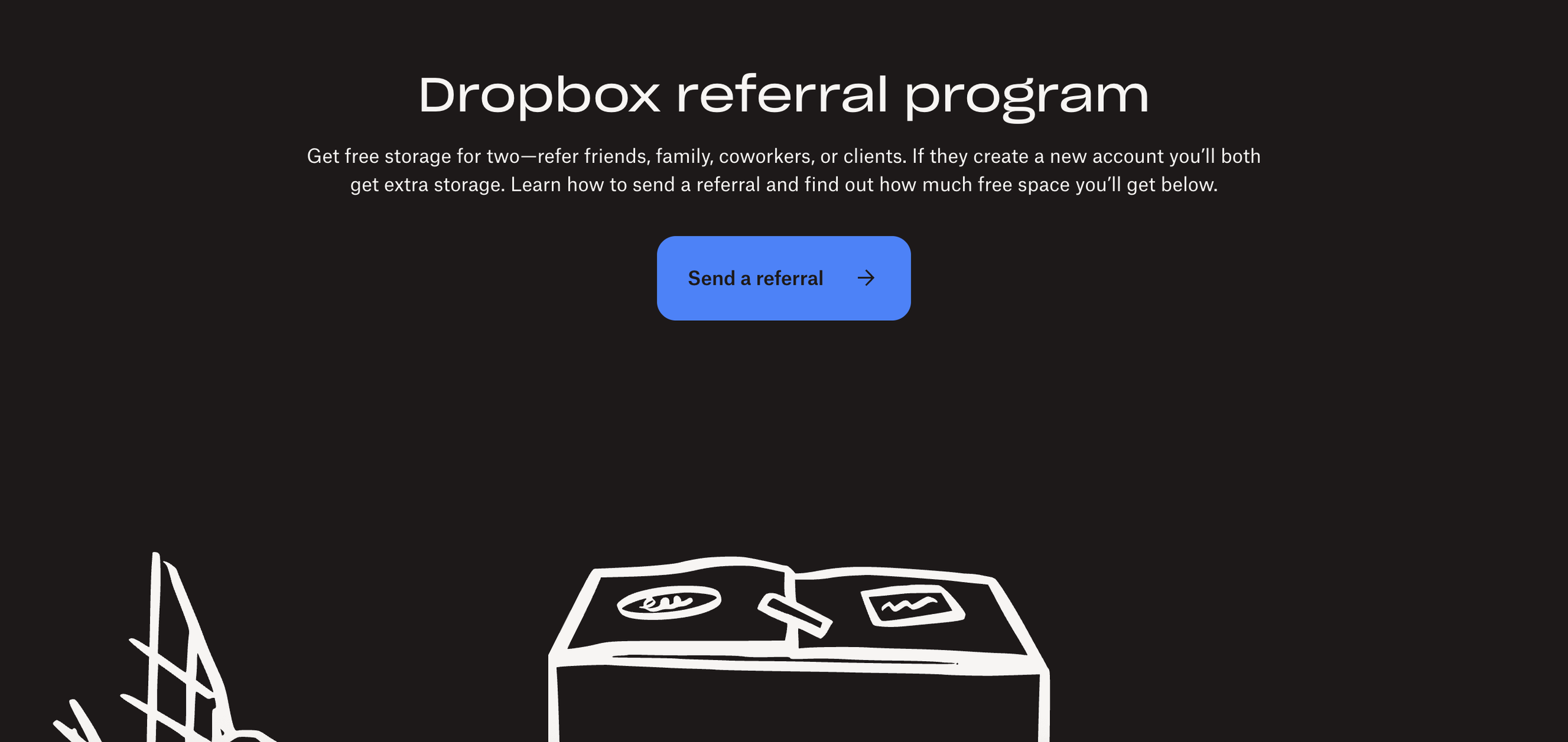
A great referral program example here is Dropbox, whose refer-a-friend program made the referral ask explicit at every step of the customer journey, contributing to 3,900% growth. Their personal referral link model gave existing customers something concrete to share.
2. Use Dual-Sided Referral Rewards
Over 78% of consumer referral programs are double-sided, and 54% of referral programs offer the same referral reward to both the referrer and the referred person.
There is a reason for this.
One-sided referral programs, where only the existing customer earns referral rewards, create an awkward dynamic. The current customer has to ask a friend to do something that benefits themselves with no clear upside for the friend they are referring. This makes the referral ask feel transactional and self-serving, which is the opposite of how natural word-of-mouth marketing works.
Dual-sided referral rewards increase referral program participation by 29%. When both the advocate and the referred customer receive something of value, the referral marketing process transforms from a self-interested transaction into a generous act. The existing customer feels good about referring friends, and the new customer arrives with a positive first impression of the brand.
The referral rewards do not need to be identical or even equivalent. What matters is that the referred customer receives something meaningful enough to reduce the friction of trying something new for the first time.
Common dual-sided refer-a-friend program structures that work:
- Give $X, get $X in store credit
- Give a free first month, get a free month on your next renewal
- Give 15% off your first purchase, get 15% off your next order
- Give early access to a product launch, get a loyalty tier upgrade
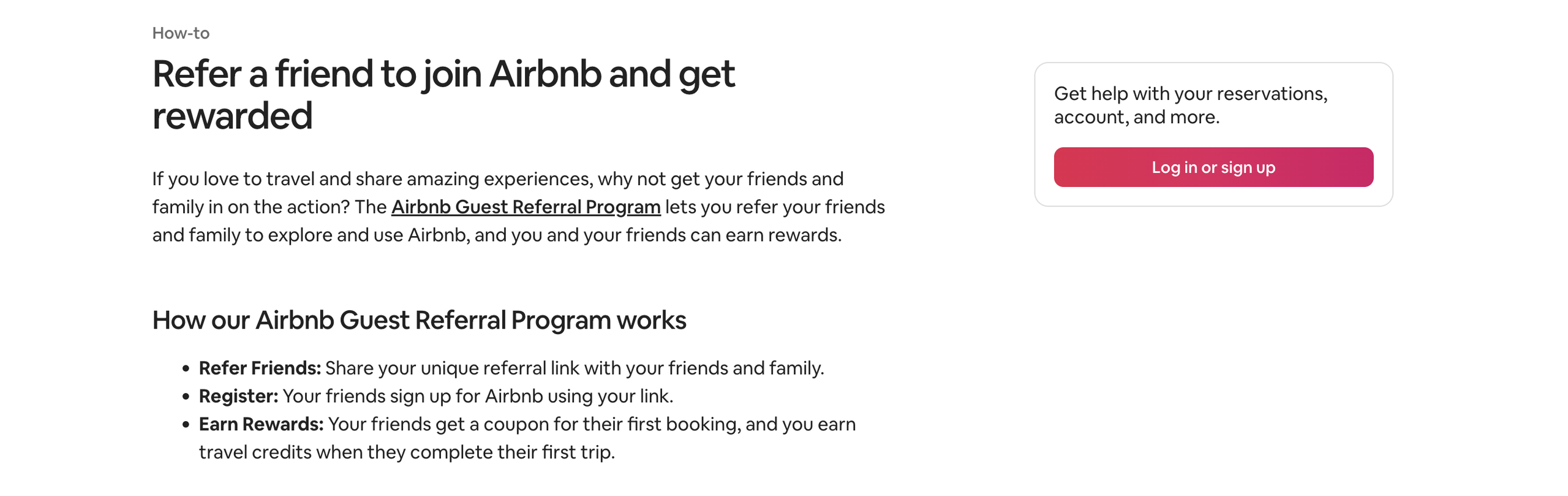
A strong referral program example of dual-sided referral rewards is Airbnb‘s refer-a-friend program, which offered both the advocate and the referred customer travel credits, making it a genuine win-win for both sides of the referral.
3. Keep the Whole Referral Process Simple
Every step you add to the referral process reduces referral conversions.
The ideal refer-a-friend program flow looks like this: the current customer sees the referral offer, copies their personal referral link or referral code, and sends it to a friend. Three steps maximum.
If your referral program requires customers to create a separate user account, navigate to a different referral program page, verify their identity, or fill out a form before they can share, you are creating friction that kills referral program participation before it starts.
65% of referrals come from mobile messaging apps, which means your referral process must work flawlessly on mobile. A referral program that is elegant on desktop and clunky on mobile is losing more than half of its potential referral sales before the referral link is ever sent.
The referral link or referral code should be:
- Pre-populated and ready to copy with one tap from inside the user account
- Shareable directly to WhatsApp, iMessage, email, and social platforms from inside the refer-a-friend program
- Trackable back to the individual referrer without any extra steps from the customer
A good referral program example of simplicity is PayPal’s refer-a-friend program, which gives existing customers a personal referral link directly in their user account, requires no additional sign-up, and delivers referral rewards automatically on qualifying referrals.
The referral program should also include a clear status page in the user account where existing customers can see how many successful referrals they have made, what referral rewards they have earned, and what referral bonuses are pending.
4. Time Your Referral Ask at the Right Moment
When you make the referral ask matters as much as how you make it throughout the customer journey.
The moments of highest referral intent are:
Immediately after the first purchase. The current customer has just made a decision they feel good about. Their enthusiasm for the brand is at its peak. The post-purchase confirmation referral program page and the first automated post purchase emails are the highest-intent moments in the customer journey to present a refer-a-friend program offer.
After a positive customer service experience. A happy customer whose problem was just resolved by a helpful support team is significantly more likely to refer friends than one who has had no recent interaction. Triggering a referral ask in the follow-up to a resolved support ticket is a consistently underused referral marketing tactic that most referral programs miss entirely.
After the first meaningful product experience. For SaaS and subscription referral programs, the right moment in the customer journey is after the customer has hit a value milestone: their first completed task, their first month of results, their first time achieving the outcome they signed up for.
After a high NPS score. If you run NPS surveys and a customer responds with a 9 or 10, that is a warm referral marketing lead. A follow-up message with a referral button and a clear referral program offer converts at significantly higher rates than a cold referral ask sent to your full customer base.
What does not work in any referral marketing program: sending a referral ask in the first email a customer ever receives, before they have experienced the product, or in bulk marketing campaigns to your entire customer base regardless of purchase recency or customer satisfaction signals.
5. Personalize Referral Rewards to Your Customer
The most effective referral incentive structures now focus on value alignment: referral rewards that reflect brand values, experience over discounts, and tiered rewards that acknowledge top advocates.
The one-size-fits-all referral reward is increasingly underperforming across most referral programs.
A referral code offering a discount works for price-sensitive customers in competitive categories. It is the wrong referral incentive for a luxury brand, a B2B referral marketing program, or a brand whose loyal customers are primarily motivated by status and experience rather than savings.
58% of marketers say personalized referral rewards drive higher customer lifetime value than generic referral incentives.
Personalization does not require AI at scale. It starts with a simple segmentation decision: do your most valuable current customers respond better to cash rewards, referral bonuses in store credit, tiered rewards, or experience rewards? Build your refer-a-friend program incentive structure around the answer based on customer preferences.
For e-commerce and DTC referral programs: Offer different referral reward tracks. A referral code for a discount for customers who prefer savings, and a tiered rewards track or exclusive product access for customers who respond better to status and brand recognition.
For SaaS referral programs: Offer additional seats, extended subscription time, or premium feature unlocks rather than cash rewards. A referral program example here is Google Workspace, which offers storage upgrades and extended trials as referral rewards rather than cash, matching the referral incentive to what SaaS users actually value.
For lifestyle brand referral programs: Offer experiences, early access to limited releases, or brand ambassador status. These referral rewards generate more referral sales in the long run than generic referral bonuses because they appeal directly to what loyal customers in lifestyle niches care most about.
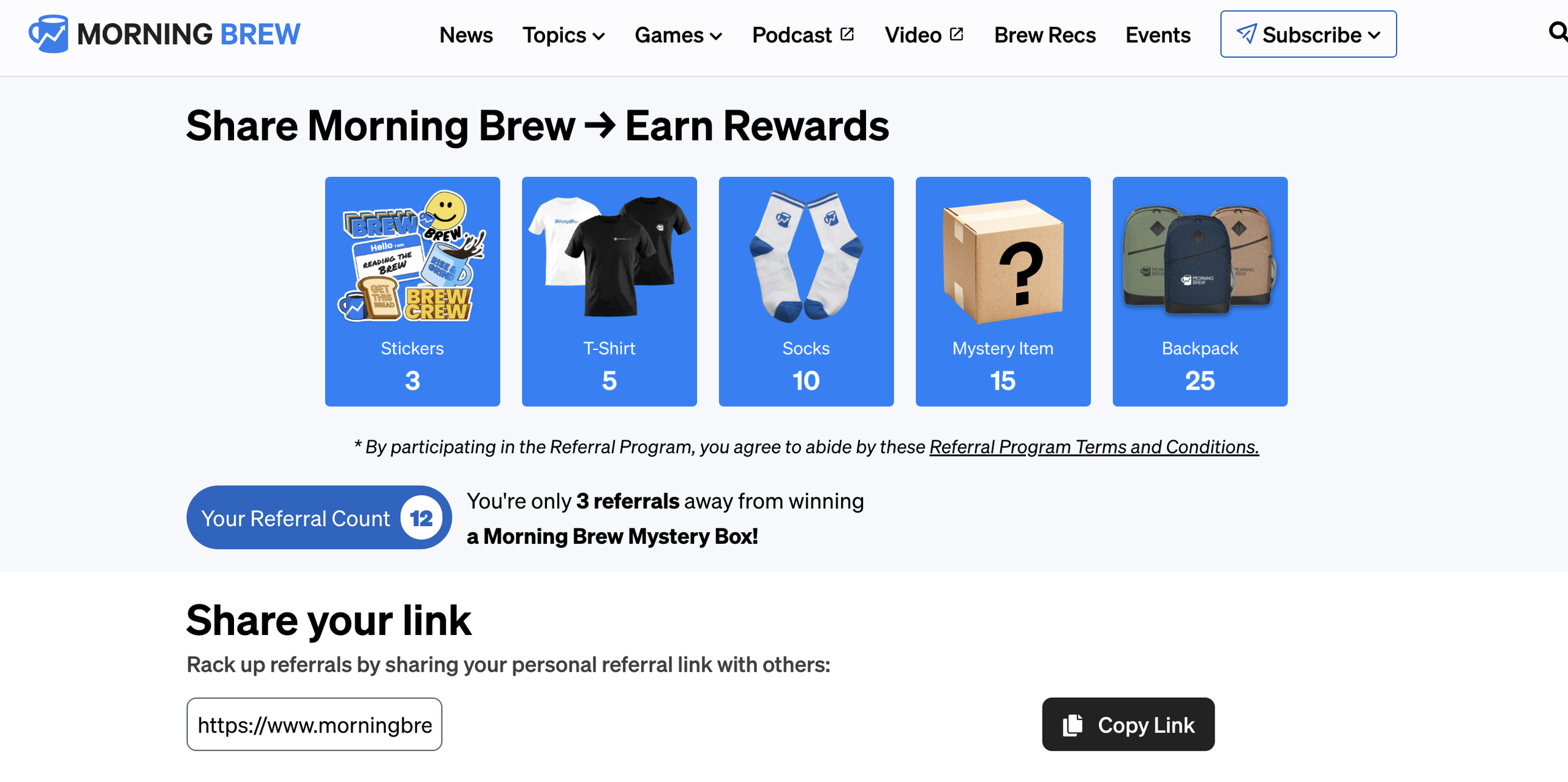
A strong referral program example is Morning Brew. Rather than giving every subscriber the same cash reward or discount, Morning Brew built its referral program around milestone-based rewards that its most engaged readers would actually value.
Historically, subscribers could unlock exclusive newsletter content after three referrals, access to a VIP community at 10, and branded merchandise such as T-shirts, mugs and sweatshirts at higher referral milestones.
At one point, its highest-tier reward even included a trip to Morning Brew’s New York office. The structure rewarded stronger advocates with progressively more exclusive benefits, turning referrals into a status and community experience rather than a simple transaction.
6. Use Multiple Channels to Refer Friends
A refer-a-friend program that only supports email sharing is leaving most of its potential referral sales untouched.
65% of referrals come from mobile messaging apps, with WhatsApp and iMessage now the dominant sharing channels in most markets. Email sharing is still relevant for older demographics and B2B referral programs, but it is no longer the primary channel for most consumer referral marketing programs.
Your referral marketing program should support sharing through:
- Direct messaging apps (WhatsApp, iMessage, Facebook Messenger)
- Automated post-purchase emails with pre-drafted referral message copy
- Social sharing to Instagram, Facebook, and TikTok with a one-tap referral button
- A copyable personal referral link and referral code for any other channel
- A physical QR code for in-store or packaging referral program mechanics
Each channel serves a different segment of your customer base. A customer who is highly active on Instagram will refer friends there. A customer who primarily communicates via WhatsApp will share their referral link there. Building friction into any one of these channels means leaving that segment’s referral sales on the table.
Mobile-optimized referral programs see 56% higher referral conversions according to Deloitte, which makes the mobile sharing experience one of the highest-ROI investments in referral program design.
7. Automate Referral Reward Delivery
Manual reward delivery is one of the most consistent sources of referral program failure.
When a current customer successfully refers a friend and the referral reward takes days to arrive, or requires them to contact support to claim their referral bonuses, the experience breaks the momentum of the referral marketing loop.
The existing customer who made the qualifying referral feels their effort was not recognized. The referred customer’s first experience of the brand is a delay rather than a welcome.
Automating your referral program means:
- Both the advocate and the referred customer receive their referral rewards the moment the referred customer completes the qualifying action, whether that is a first purchase, a sign-up, or a subscription
- Both the referrer and the referred customer receive a clear referral program notification confirming what they have earned and when they can use it
- Referral conversions are tracked automatically through each referral link and referral code, with no manual intervention required to track referrals or process referral bonuses
Most modern referral program software handles this natively. If your current referral program setup requires manual intervention to deliver referral rewards, this is the highest-priority operational fix in your refer-a-friend program.
The speed of referral reward delivery also has a direct impact on word-of-mouth marketing. A happy customer who receives their referral bonus instantly is more likely to mention the refer-a-friend program to another friend. A current customer who waits a week and has to follow up is not.
8. Promote the Referral Program Actively and Repeatedly
Most referral marketing programs do not fail because the referral program design was wrong. They fail because nobody saw them.
Businesses with formalized referral programs report 71% higher net promoter scores according to McKinsey, but the formalization part matters. A referral program that exists but is not actively promoted is not a referral marketing program. It is a referral program page on your website that nobody visits.
Active referral program promotion means:
Email marketing campaigns. A dedicated referral program launch email to your full current customer base, followed by a monthly reminder in your newsletter, followed by automated post-purchase emails to customers at high-intent moments in the customer journey.
Referral program page placement. The referral offer should appear prominently on the homepage, the checkout confirmation referral program page, the user account dashboard, and in the site navigation. Happy customers should not have to search for the refer-a-friend program to participate.
Post-purchase packaging. Physical insert cards with the referral link or referral code convert well for DTC referral programs, particularly when the unboxing experience is strong. Including a referral button prompt in packaging makes your customer referral program part of the physical brand experience.
Social media promotion. Regular posts across your brand’s social channels featuring referral program examples, referral rewards available, and success stories from past customers who have earned referral bonuses.
Customer service touchpoints. Train your support team to mention the referral marketing program after positive interactions. A single line at the end of a resolved support ticket converts at surprisingly high rates: “If you love us enough to refer friends, here is how our refer-a-friend program works.”
The referral marketing programs that generate the most referral sales are not the ones with the most sophisticated referral program software. They are the ones that promote the referral program consistently, everywhere, across every customer touchpoint.
9. Measure Referral Conversions Incrementally
Referral programs deliver 4x higher ROI than digital advertising according to Harvard Business Review, but only if you are measuring the right referral marketing metrics.
Most referral programs measure total referred customers and total referral program-attributed revenue. These numbers look good in marketing campaigns reporting but can be misleading.
The more important question is incremental impact: how many of these referred customers would have completed their first purchase anyway through another channel? How many current customers are generating qualifying referrals that actually convert versus those who share referral links that never result in referral sales? What is the new-to-brand rate of your referred customer cohort?
The best referral program metrics to track:
- Referral conversion rate: what percentage of customers shown the refer-a-friend program offer made a qualifying referral
- Referral-to-purchase conversion rate: what percentage of referral links sent resulted in a first purchase
- New-to-brand rate: what percentage of referred customers were genuinely new to your customer base
- Customer lifetime value of referred cohorts: how do referred customers’ lifetime value compare to non-referred customers over 12 and 24 months
- Top referrer concentration: which current customers are generating the most successful referrals and what do they have in common
Referral programs that track referrals at this level of granularity consistently find that a smaller number of genuinely new customers are worth significantly more than a large volume of last-touch referral attribution that includes past customers clicking through referral codes.
For a full breakdown of which metrics actually matter in referral and affiliate program management, see our guide on what affiliate marketing reports to ask your agency for.
10. Review and Iterate the Referral Program Quarterly
An analysis of 3,000 or more referral programs reveals that consumer motivations have shifted significantly and the traditional “Give $20, Get $20” refer-a-friend program model has evolved.
A referral marketing program that was well-designed at launch drifts out of alignment with your customer base within 12 to 18 months without deliberate review. Different referral incentives perform differently across seasons, customer segments, and product categories, and the referral program that works for your current customers today may not work for the new customers joining your customer base next year.
Every quarter, run through these five referral program best practices checks:
Referral conversion rate. What percentage of customers who were shown the refer-a-friend program offer actually made a qualifying referral? If this is below 5%, the referral rewards may not be compelling enough or the referral ask is not clear enough on your referral program page.
Referral-to-purchase conversion rate. What percentage of referral links sent actually resulted in a first purchase? If referral conversions are low, the landing page experience, the welcome referral offer, or the referred customer’s first impression of your brand may need work.
New-to-brand rate. What percentage of referred customers were genuinely new to your customer base? This is the true measure of your referral marketing program’s customer acquisition value and the metric that separates a successful referral program from one that is merely recycling existing customers.
Top referrer analysis. Who are your most active referrers among your current customers? What do they have in common? Can you build a more dedicated refer-a-friend program structure or tiered rewards track around them to encourage participation from similar customers?
Referral reward redemption rate. Are customers actually using the referral rewards and referral bonuses they earn? Low redemption rates signal that the referral incentive is not compelling enough to motivate action on future purchases, which means the referral program needs different referral incentives.
At Vivian Agency, we build referral programs with this measurement cadence built in from the start. If you want to review how your current referral marketing program is performing against these referral program best practices, book a free call and we will walk through it together.
What the Best Referral Programs Have in Common
After reviewing the structure of successful referral programs across e-commerce, SaaS, and B2B categories, the patterns are consistent.
The most successful referral programs make the referral ask explicitly, repeatedly, and at the right moment in the customer journey.
They offer dual-sided referral rewards that create a win win for both the advocate and the referred customer.
They make the referral process and the whole referral process frictionless across multiple channels, particularly on mobile.
They automate referral reward delivery so referral bonuses and referral rewards arrive instantly after qualifying referrals.
They promote the refer-a-friend program across every customer touchpoint as a core part of their referral marketing strategy, not just at launch.
They track referrals and measure referral conversions against what actually matters: new customers, incremental referral sales, and customer lifetime value of referred cohorts.
And they treat the referral marketing program as a living channel requiring regular review and iteration, not a set-and-forget feature of the business model.
Companies with referral programs see a 24% reduction in customer acquisition costs according to Deloitte. For brands under pressure from rising paid marketing campaign costs, a strong referral program built on these referral program best practices is one of the highest-ROI customer acquisition investments available.
Frequently Asked Questions
What is the most important element of a successful referral program?
The clarity and timing of the referral ask. 83% of satisfied customers say they would refer friends, but only 29% actually do. This referral-to-action gap almost always comes down to referral program visibility and ease of participation, not customer willingness.
The most sophisticated referral reward structure in the world does not help if happy customers do not know the refer-a-friend program exists or find the referral process too complicated to bother with. A great referral program makes the referral ask clear, specific, and easy to act on across multiple channels.
Should my referral program offer the same referral reward to both sides?
Over 78% of consumer referral programs are double-sided, and 54% offer the same referral reward to both the advocate and the referred customer.
Dual-sided referral rewards consistently outperform one-sided referral programs because they transform the referral into a genuine win win rather than a self-interested transaction.
The referral rewards do not need to be identical, but both the referrer and the referred customer need to receive something meaningful enough to make the referral ask feel generous rather than self-serving.
How long does it take for a referral marketing program to generate meaningful results?
Most well-designed referral marketing programs with active promotion generate their first wave of referred customers within 30 to 60 days of launch.
Consistent, compounding referral sales typically take 3 to 6 months to build as the customer base grows and word of mouth marketing compounds. Referral programs that do not generate meaningful referral conversions within the first 90 days almost always have a promotion problem rather than a referral program design problem.
See our guide on how long affiliate marketing takes to work for a realistic timeline comparison across performance-based marketing channels.
For further reading on building referral and affiliate programs that drive consistent, measurable results, see our guides on 8 referral program ideas your customers will rave about, referral landing pages examples, affiliate marketing vs referral marketing, how to find affiliates for your brand, and Referral Rock alternatives.