
US affiliate marketing spend is projected to hit $13 billion in 2026 — nearly double what it was five years ago. And the brands driving the largest share of that growth aren’t enterprise retailers with nine-figure ad budgets. They’re merchants building an affiliate marketing program for Shopify stores that generate 15–40% of their total revenue without spending a dollar upfront on ads.
The economics are hard to argue with. While Google Ads delivered an average ROAS of $3.31 in 2025, affiliate marketing consistently returns $12 for every $1 spent – and you only pay after the sale clears. As paid social costs continue rising and third-party cookie tracking degrades, Shopify affiliate marketing is becoming less of a “nice to have” and more of a core acquisition strategy for ecommerce brands of every size.
This guide covers everything you need to start one correctly: why DTC affiliate marketing works so well for Shopify stores, a six-step launch framework, the mistakes that sink programs before they get traction, and an honest look at when it makes sense to build it yourself versus bringing in help.
By creating an effective affiliate marketing for Shopify store, you can leverage the power of partnerships to enhance your digital marketing strategy and bring in new customers through your online store.
Table of Contents
Overview
| What is a Shopify affiliate program? | A performance-based marketing program where partners earn a commission for every sale they drive to your Shopify store through a unique referral link or coupon code. You pay only when a sale is confirmed — no upfront ad spend. |
| Who is it for? | Shopify merchants with at least 20% net product margins and proven product-market fit. Particularly effective in beauty, health, fashion, home, and lifestyle categories. |
| How much does it cost to start? | Shopify affiliate apps range from free plan options to $29.99/month (UpPromote) to $99/month (Refersion). Commission costs are variable — you only pay after sales clear. |
| Typical commission rates | 10–15% for most DTC categories. Beauty and skincare: 15–25%. Health and supplements: 20–40%. Electronics: 3–8%. |
| How long to see results? | 3–6 months for a well-managed program with active recruitment. 9–12 months if relying solely on passive signups. |
| Revenue potential | Mature Shopify affiliate programs typically drive 15–40% of total store revenue. |
| What you’ll need | A Shopify affiliate app, commission rules, 20–30 manually recruited affiliates at launch, an onboarding sequence, and a plan for ongoing communication and optimization. |
| DIY or agency? | DIY is viable if you have 8–10 hours per week and a clear niche. An agency compresses the timeline and brings existing creator relationships — typically cutting time to meaningful revenue from 9–12 months to 3–4. |
Why Shopify Affiliate Marketing Works for DTC Brands
Establishing an affiliate marketing program for your Shopify store not only improves your revenue but also helps build a community around your brand, giving affiliate partners a reason to keep promoting products to their established audience.
Before getting into the how, it’s worth being clear on the why — because DTC affiliate marketing has structural advantages that don’t apply equally to all business models.
You pay only for results. Unlike paid ads where you pay per click or impression regardless of outcome, affiliate marketing is pure performance. You define your commission rules upfront, and you pay only when a sale is confirmed. It’s the only major Shopify marketing channel where money only leaves your account after revenue comes in.
By implementing an affiliate marketing program for your online store, you can increase sales and reach new customers through motivated affiliate partners who use their active website, blog, or social media platforms to drive traffic.
Shopify affiliate apps make tracking native and reliable. The best Shopify affiliate apps integrate directly with your store’s order data, which means attribution doesn’t depend on third-party cookies or ad pixels that degrade with browser privacy updates. Every sale tracked through a referral link or coupon code is verified against actual Shopify checkout data — more reliable than any paid channel.
Happy customers make your best first affiliates. 42% of influencers worldwide now monetize through affiliate links alongside brand sponsorships. But your most powerful affiliate pool isn’t influencers — it’s your existing customers. Happy customers who already love your product refer with authenticity that no paid promotion can replicate, and they convert at dramatically higher rates than cold traffic. For Shopify merchants, this is the most underutilized asset in the entire affiliate marketing playbook.
The revenue contribution compounds over time. Affiliate revenue for mature Shopify stores typically accounts for 15–40% of total sales, with some high-trust niches like supplements and health tech seeing affiliates drive the majority of their revenue. The longer the program runs and the stronger the affiliate relationships, the higher that number climbs — without proportionally increasing costs.
Here’s how Shopify affiliate marketing compares to other acquisition channels for ecommerce brands:
| Channel | Avg. ROAS | When You Pay | Attribution Reliability |
| Shopify affiliate marketing | 12:1 | After confirmed sale | High (Shopify-native) |
| Google Ads | 3.3:1 | Per click | Medium (cookie-dependent) |
| Meta Ads | ~2–4:1 | Per impression/click | Low (iOS-impacted) |
| Influencer marketing (flat fee) | Variable | Upfront | Low (self-reported) |
| Email marketing | ~36:1 | Per send | High (first-party) |
6 Steps to Starting an Affiliate Program for Shopify Brands
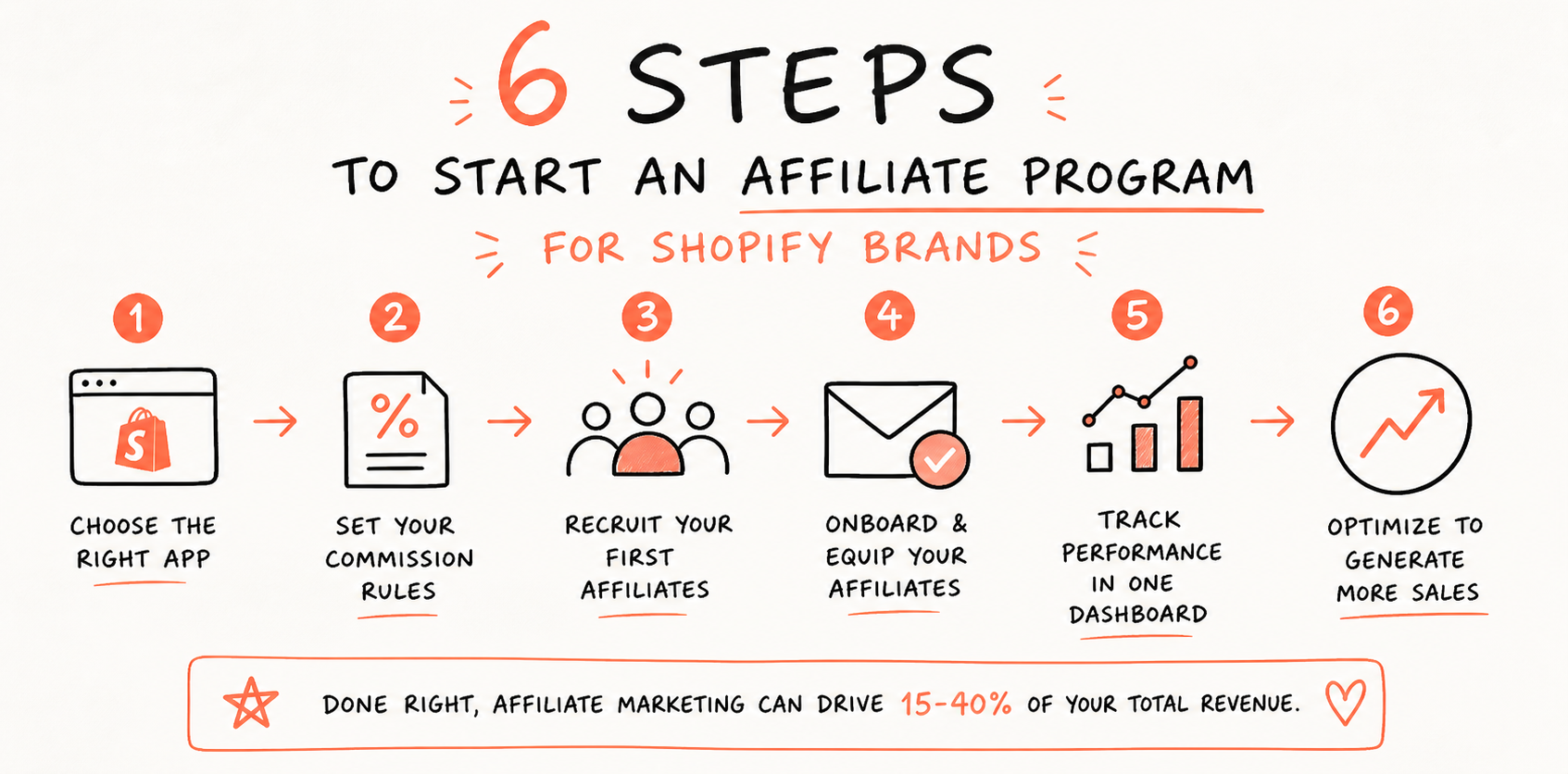
Step 1: Choose the Right Shopify Affiliate App
An effective affiliate marketing program for a Shopify store can create a win-win scenario for both merchants and affiliate partners, giving them all the tools they need to start promoting products right away.
The right app is the foundation on which your entire program runs. It determines how affiliates sign up, how referral links and coupon codes are generated, how sales are tracked, how the affiliate dashboard works, and how payouts are processed. For Shopify merchants, the main Shopify affiliate apps in 2026 are:
| App | Starting Price | Free Plan? | Best For |
| UpPromote | $29.99/month | Yes | Beginner-friendly all-in-one app with built-in affiliate marketplace and unlimited affiliates on paid plan |
| Refersion | $99/month | No | Scaling Shopify stores that need advanced tiered commissions and influencer team management |
| Shopify Collabs | Free | Yes | Shopify merchants just starting out who want native integration and quick setup |
| BixGrow | $7.99/month | Yes | Beginner-friendly, budget-conscious stores that need fraud filters and a clean affiliate dashboard |
A few things to check when choosing the right app for your Shopify store: Does it offer a free plan to test before committing to a paid plan? Does it support PayPal integration for paying affiliates internationally? Can affiliates access their own dashboard to track their referral link performance? Does it support unlimited affiliates as your program scales, or does the app cap partner numbers on lower tiers?
When you launch an affiliate marketing program for a Shopify store, you tap into new customers and create opportunities for your affiliate partners to earn money while driving traffic to your shopify website. Most apps are available directly from the Shopify App Store and integrate with your Shopify admin in minutes with easy setup.
For most DTC Shopify merchants launching their first program, UpPromote offers the best balance of features, beginner-friendly setup, and accessible pricing. We used it to build the Click & Grow program, helping us recruit 1,000+ affiliates and track over $1 billion in affiliate GMV. For a full comparison of Shopify affiliate apps, see our guide on the best affiliate app for Shopify.
In your commission structure, consider what works best for your affiliate marketing program, ensuring your flexible commissions are attractive to potential affiliate partners.
Offering competitive rates — and even auto tier commissions for top performers — can help your own affiliate program stand out against affiliate networks like Amazon Associates and other competing programs.
Step 2: Set Your Commission Rules and Structure
Commission rate is the single biggest lever in your Shopify affiliate program. Too low and quality affiliates won’t bother. Too high, and every sale eats into the margin. The starting framework:
Calculate your floor first. Take your average net profit margin and multiply by 30–50%. That’s the maximum you can pay affiliates without going negative on affiliate-driven sales.
Moreover, affiliate tracking is essential for the success of your affiliate marketing program, giving you full control over performance and allowing you to make informed decisions.
Use industry benchmarks as your anchor, per ReferralCandy’s 2026 commission guide:
Recruiting the right affiliate partners is crucial to your successful affiliate program — they are the driving force behind your affiliate sales.
Regular engagement will strengthen their commitment and encourage affiliates promote your products consistently across their website and social media platforms.
| Product Category | Typical Commission Range | Notes |
| Beauty & Skincare | 15–25% | High margins (70–80%) support generous rates |
| Health & Supplements | 20–40% | Subscription models justify higher first-order rates |
| Fashion & Apparel | 10–20% | Mid-range margins, strong influencer marketing fit |
| Home & Lifestyle | 10–18% | Good for content creators and bloggers |
| Electronics | 3–8% | Thin margins limit what’s sustainable |
| Food & Beverage | 8–15% | Repeat purchase value justifies moderate rates |
Set a 30-day cookie window as your default — this captures 93–98% of conversions in most ecommerce programs and is the industry standard affiliates expect. Extend to 60–90 days for higher-consideration products.
Build tiered commissions from the start. A typical structure for Shopify merchants: 10% base commission for all affiliates, 15% for those driving 10+ sales per month, 20% for top earners. Tiered commissions give new affiliates a clear incentive to push harder and reward the partners who actually perform. Most Shopify affiliate apps let you configure tiered commissions directly in the app dashboard — no code required.
Utilizing a strong onboarding process can significantly enhance the performance of your affiliate campaigns and help you build a successful affiliate program from day one.
Decide on coupon codes vs. referral links. Both are valid tracking methods, and most Shopify affiliate apps support both. Referral links work better for blog posts, email, and social channels. Coupon codes work better for TikTok and Instagram Stories, where links aren’t always clickable. Coupon codes also create a natural discount incentive for the customer — but be aware that coupon leaks (codes shared publicly beyond the intended affiliate) are a real risk. Your commission rules should address this, and your chosen app should include coupon leak detection.
Step 3: Recruit Your First Affiliates Manually
This is where most Shopify stores underinvest. Launching a Shopify affiliate program and waiting for affiliates to find you rarely works — especially in the first six months. Manual affiliate recruitment is the fastest path to your first meaningful sales.
Your existing customers are your best first affiliates. Happy customers who already love your product are your most powerful affiliate asset. They already trust you, they’ve used what they’re promoting, and their referral link carries genuine credibility. Set up a post-purchase email sent 7–10 days after delivery that invites satisfied customers to join your affiliate program. Our guide on how to reach out to affiliates includes proven email templates for exactly this sequence.
Search for niche creators across social channels. Search Instagram, TikTok, and YouTube for content in your product category. Look for creators with 5K–100K followers and strong engagement — micro-influencers in this range consistently generate more sales per follower than larger accounts. For a full methodology, see our post on how to find affiliates for your brand.
List your program on affiliate networks and marketplaces. Platforms like ShareASale, Impact, and UpPromote’s built-in affiliate portal put your new affiliate program in front of affiliate partners who are actively looking for programs to join. This gives your affiliate links wider distribution across their website, email lists, and social media platforms — and is one of the fastest ways to build a broader affiliate network without additional outreach spend.
Target bloggers and content creators in your niche. Bloggers with organic traffic in your product category can drive steady affiliate sales that compound over months — a referral link in a well-ranked blog post keeps working long after it’s published. Pitchbox and Hunter are useful tools for finding and reaching these creators at scale.
Step 4: Onboard and Provide Affiliates with What They Need
A weak onboarding process is one of the most common reasons Shopify affiliate programs stall. When affiliates sign up and don’t hear from you, can’t easily access their affiliate dashboard, or don’t have clear assets to promote, they simply don’t. A strong onboarding sequence for Shopify merchants:
To maximize the effectiveness of your affiliate marketing program, implement strategies that keep affiliate partners motivated and give them all the tools they need — from affiliate links to creative assets — to start promoting products immediately through their website and social media platforms.
- A welcome email confirming their commission rate, cookie duration, and payment schedule — sent within 24 hours of approval
- Clear instructions on how to access their affiliate dashboard and find their referral link and coupon codes
- Three share-ready creative assets: product photos, lifestyle images, or short video clips, they can post across social channels immediately
- Your commission rules in plain language — what’s allowed, what isn’t (coupon leaks, brand keyword bidding, misleading claims)
- PayPal details for payment — confirm upfront whether you pay via PayPal, bank transfer, or store credit, so there’s no confusion at payout time
- A point of contact for questions — a real person, not a generic inbox
Use email automation to deliver this sequence rather than sending it manually. Most Shopify affiliate apps include basic email automation — set it up once, and every new affiliate gets the same professional onboarding experience automatically.
The brands that generate 30%+ of total revenue from affiliates treat onboarding like a customer experience. The ones that stall treat it like a formality.
Step 5: Track Affiliate Performance in One Dashboard
Most Shopify stores stop at commission payouts. A managed affiliate program tracks everything that tells you whether the program is healthy and where to focus optimization efforts.
| Metric | What It Tells You | Healthy Benchmark |
| Conversion rate (affiliate traffic) | Whether affiliate audiences are a good fit for your store | 2–5% for DTC ecommerce |
| EPC (earnings per click) | How motivated affiliates are to keep promoting | Higher = more partner interest |
| Average order value (affiliate vs. direct) | Whether affiliates attract high-value buyers | Aim for parity or above |
| Active affiliate rate | What % of your affiliates are actually promoting | 20–30% is healthy |
| Revenue per affiliate | Who your top earners are | Track monthly |
| Reversal rate | How many affiliate sales are refunded or cancelled | Below 10% is healthy |
Pull all of this into one dashboard — your Shopify affiliate app’s built-in reporting should cover most of it. Consolidating affiliate performance data into a single dashboard rather than across multiple spreadsheets and apps is critical once your network grows past 30–40 partners. Shopify’s guide to affiliate marketing metrics provides a full breakdown of how to calculate and act on each metric.

Step 6: Optimize to Generate More Sales Over Time
Launching the program is the beginning, not the finish line. The Shopify merchants who see affiliate sales compound quarter over quarter do three things consistently:
Finally, continuously optimizing your approach will ensure the long-term success of your affiliate program for a Shopify store.
Communicate regularly across social channels and email. Monthly newsletters with performance updates, new product launches, and seasonal campaign briefs keep affiliates engaged and give them fresh content to promote. Affiliates who hear nothing from a brand for 60+ days quietly move on to other programs.
Identify and invest in your top earners. In most Shopify affiliate programs, 20% of affiliates drive 80% of sales. Find those partners, give them exclusive tiered commissions, early product access, and direct contact with your team. A strong relationship with one top earner is worth more than recruiting 50 passive affiliates who never post.
Refine your commission rules based on data. If your active affiliate rate is below 20%, your commission rules may not be competitive enough. If your reversal rate is high, your onboarding may be attracting the wrong partners. Let your affiliate dashboard data drive monthly adjustments — not quarterly gut-feel reviews.
For a comprehensive checklist on building a sustainable referral and affiliate program, see our guide on how to set up an influencer affiliate program.
Not sure which Shopify affiliate app is right for your store?
Take our quick quiz and get a personalized action plan based on your product category, margins, and current stage.
6 Common Mistakes Shopify Merchants Make with Affiliate Programs
1. Setting Commission Rules Too Low
A 3% commission on a $40 product pays affiliates $1.20 per sale. No creator with a real audience will prioritize that store over programs paying 15–20%. Before setting your commission rules, research what comparable Shopify stores in your category offer. Quality affiliates compare programs before joining — your commission is your headline offer, and it needs to compete.
2. Launching Without a Recruitment Strategy
A Shopify affiliate program with no affiliates generates no sales. Many Shopify merchants install the app, configure their commission rules, and wait. Nothing happens. A realistic launch plan includes at least 20–30 manually recruited affiliates — happy customers, niche creators, and relevant bloggers — ready to share their referral link from day one. See our breakdown of the difference between affiliates, influencers, referrals, and partnerships if you’re still working out which type of partner to prioritize.
3. Ignoring Coupon Leaks and Fraud
Nearly 20% of all affiliate traffic contains some form of fraud — fake clicks, coupon leaks, or cookie stuffing. Coupon leaks are particularly common on Shopify: an affiliate shares their discount code publicly on a deal site, and suddenly you’re paying commission on sales that weren’t driven by genuine affiliate activity. Your commission rules should explicitly prohibit unauthorized code sharing, your chosen app should have coupon leak detection, and fraud filters should be enabled from day one. Our post on affiliate contract compliance covers exactly what to include.
4. Treating All Affiliates the Same
A deal site, a lifestyle blogger, and a micro-influencer on TikTok need completely different commission structures, creative assets, and communication strategies. Sending the same welcome email and the same referral link to all three is why most Shopify stores see an active affiliate rate below 15%. Segment your affiliates by type from the start — coupon affiliates, content affiliates, social channel affiliates — and tailor your approach to each.
5. Skipping Email Automation for Onboarding
Affiliates who don’t receive a structured, prompt onboarding sequence almost never promote. They joined with enthusiasm and then went cold, waiting for direction. Setting up email automation through your Shopify affiliate app costs almost nothing and ensures every new affiliate gets an immediate welcome, access to their affiliate dashboard, their referral link and coupon codes, and clear commission rules — within 24 hours of approval.
6. Only Checking Total Revenue, Not Program Health
A Shopify affiliate program can show growing total revenue while quietly becoming dependent on one affiliate, attracting only coupon-hunters, or accumulating a reversal rate that’s eating margin. Check your affiliate dashboard regularly for the full picture: active affiliate rate, top earners vs. inactive partners, coupon leaks, EPC trends, and average order value from affiliate traffic versus direct traffic. These are the metrics that distinguish a healthy program from one that looks fine until it collapses.
DIY vs. Hiring an Agency to Manage Your Shopify Affiliate Program
The success of your affiliate program for a Shopify store depends on the strength of the relationships you build with affiliates.
This is worth thinking through honestly.
The DIY case is real. If you have product-market fit, a clear niche, and someone who can dedicate 8–10 hours per week to recruitment, communication, and checking the affiliate dashboard, building the program yourself is completely viable. The Shopify affiliate apps are beginner-friendly, benchmarks are available, and the barrier to entry is lower than ever.
Where it gets harder: Managing affiliates compounds in complexity as the program grows. Managing a handful of affiliates — sending their referral link, paying via PayPal, checking the affiliate dashboard monthly — is manageable. Building a network of 50, 100, or 500 partners while managing commission rules, coupon leaks, payout disputes, content compliance across social channels, and performance optimization across multiple Shopify apps is a different operation entirely. Most in-house teams hit their ceiling at 30-80 active affiliates.
What a managed affiliate program actually brings: A specialist agency brings an existing network of vetted affiliates, tested email automation sequences, established relationships with key Shopify affiliate apps and platforms, and the pattern recognition that comes from managing affiliates across dozens of programs in different categories. That experience typically compresses the timeline from 9–12 months to 3–4 months for a well-managed launch — and brings more sales in that window than a first-time DIY program would.
The real question is what the opportunity cost of a slow start actually is for your Shopify store. Every month without a functioning affiliate program means revenue and referral links that don’t exist yet.
At Vivian Agency, we build and manage referral and affiliate programs for DTC brands on Shopify. We’ve generated over $12M in partner revenue across more than 50 programs — from initial setup through managing affiliates, onboarding, tracking, and optimization. If you want to see what that looks like in practice, our case studies are a good place to start. If you’re weighing whether a managed affiliate program makes sense for your store right now, book a free call — no pitch, just a conversation about what would actually move the needle.
Ready to build a Shopify affiliate program that drives real sales?
Book a free call with our team — we’ll walk through your margins, your niche, and what a realistic program looks like for your store.
FAQs
What is a Shopify affiliate program, and how does it work?
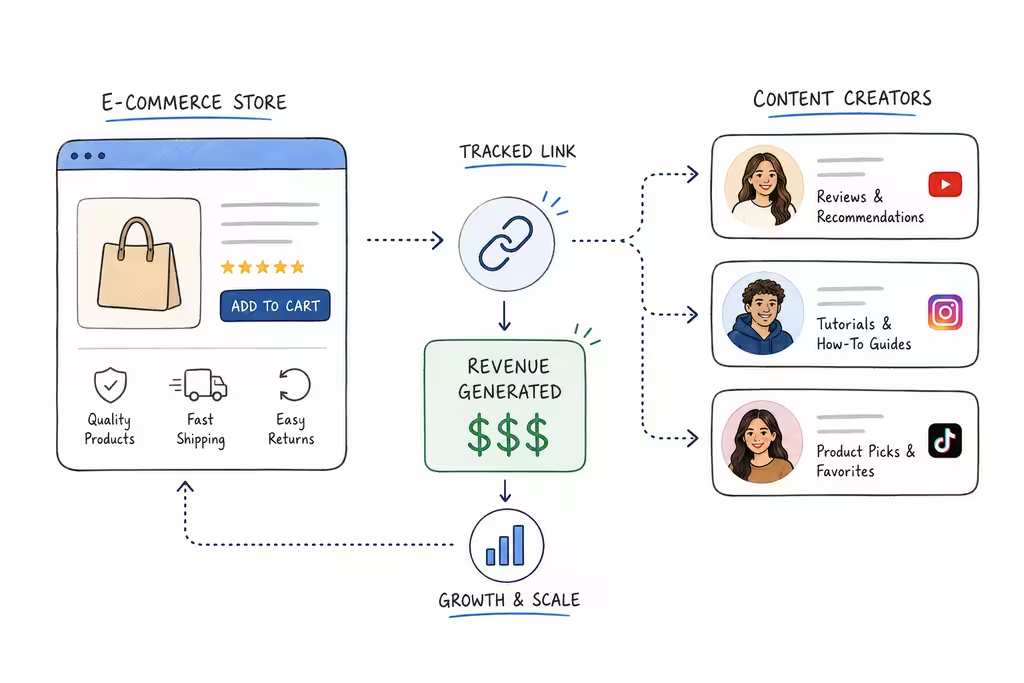
A Shopify affiliate program is a performance-based marketing setup where partners promote your store and earn a commission on every sale they generate. Each affiliate gets a unique referral link and/or coupon codes to share across their social channels, website, email list, or blog. When someone clicks the referral link—or enters a coupon code at checkout—and completes a purchase, the affiliate dashboard logs the sale and automatically credits the commission. You only pay affiliates after a confirmed sale — no upfront ad spend, no wasted budget on clicks that don’t convert.
Which Shopify affiliate app is best for beginners?
For Shopify merchants just starting out, UpPromote and Shopify Collabs are the most beginner-friendly options. Shopify Collabs is free and integrates natively with your Shopify store — great for quick setup with no paid plan required. UpPromote offers a free plan with core features and upgrades to more advanced tiered commissions, unlimited affiliates, PayPal integration, and a more robust affiliate dashboard as you scale. Both apps support referral links and coupon code tracking and are straightforward to configure without technical knowledge.
How much does it cost to start a Shopify affiliate program?
Platform costs range from free (Shopify Collabs, or free plan tiers on UpPromote and BixGrow) to $29.99/month (UpPromote paid plan) to $99/month (Refersion). Beyond the app, the main investment is time — recruiting affiliates, creating onboarding assets, managing affiliates, and regularly reviewing your affiliate dashboard. Commission costs are variable and only occur after a sale is confirmed, so there’s no fixed upfront spend on performance.
How do I pay affiliates on Shopify?
Most Shopify affiliate apps support PayPal as the primary payout method, making it easy to pay affiliates internationally. Some apps also support bank transfer, store credit, or gift cards. Set your payment schedule upfront — monthly payouts with a minimum threshold (typically $50–$100) are standard. Always confirm that your PayPal integration is working correctly before your first affiliates start generating sales, and include payment details in your onboarding email to avoid confusion at payout time.
What’s the difference between a referral program and an affiliate program?
A referral program typically incentivizes existing customers to refer friends in exchange for store credit, discounts, or a small cash reward. An affiliate program is broader — it recruits content creators, bloggers, influencers, and other publishers to promote your store to new audiences in exchange for a commission on sales. Referral and affiliate programs aren’t mutually exclusive; many Shopify merchants run both. Your happy customers are your referral program; your content creators and niche publishers are your affiliate program. For a full breakdown, see our post on affiliate marketing vs referral marketing.
How long does it take to see results from a Shopify affiliate program?
Realistically, 3–6 months to meaningful sales for a well-managed program with active recruitment. Month one is app setup, commission rules, and initial outreach. Months 2–3 are the early stages of affiliate activation and the first conversions. By months 4–6, a Shopify store with 30–50 active affiliates starts generating consistent, trackable revenue. Programs that rely on passive signups — without proactive recruitment and email automation — typically take 9–12 months to reach the same point.
What’s the difference between a Shopify affiliate program and influencer marketing?
A Shopify affiliate program is performance-based: affiliates earn commission only on sales they generate, tracked through referral links or coupon codes. Influencer marketing typically involves paying a flat fee upfront for content creation, regardless of how many sales it drives. The two are increasingly combined in a hybrid model—a small flat fee plus a performance commission—that gives creators predictable income while aligning their incentives with your sales goals. For a full breakdown, see our posts on affiliate marketing vs referral marketing and why affiliate influencer marketing works.
When does it make sense to hire an agency to manage my Shopify affiliate program?
When your team doesn’t have 8–10 hours per week available for managing affiliates, when you’ve tried building the program yourself and stalled below 20 active affiliates, when you want to generate more sales faster than a DIY program allows, or when you’re entering a new category where you don’t have existing creator relationships. Vivian Agency specializes in building and managing Shopify affiliate programs for DTC brands — get in touch if any of those situations sound familiar.