
Your customers may interact with your brand through several channels. For example, a prospect may discover the brand through a paid social ad, then research it on Google. And finally convert through an offer when they return to your website.
That’s usually the case in B2B buying. According to McKinsey’s 2026 Global B2B Pulse Survey, B2B buyers use an average of 10 channels throughout their purchasing journey.
Cross-channel marketing is the answer to this kind of buyer behavior. Channels are interconnected so the audience gets a cohesive marketing message.
For stronger return on investment (ROI), you need practical cross-channel marketing ideas. That way, you expand your reach, generate qualified leads, and drive conversions.
Table of Contents
What Is Cross-Channel Marketing?
Cross-channel marketing is a strategy that uses multiple marketing channels in a coordinated way. The goal is to engage customers throughout the buying journey with consistent experiences that ultimately encourage conversion.
These channels may be paid advertising, organic search, social media, email, SMS, websites, mobile applications, or even offline events.
The idea is that campaigns on various channels aren’t separate. In fact, they are activated in coordination. This way, they meet prospective customers’ needs at different stages of their journey.
Even if each channel serves a different purpose, they work toward the same goal.
Data is at the heart of this kind of marketing. Different channels need customer data to know where and how they’ve interacted with the brand before. So, a cross-channel marketing approach connects different channels through a shared strategy and data.
Cross-Channel vs. Multichannel Marketing: What’s the Difference?
Multichannel marketing is about maintaining a presence across different channels. Cross-channel marketing focuses on connecting those channels to create a cohesive customer journey.
In multichannel marketing, a person may see the same ad on two different channels. But with cross-channel marketing, the second exposure is more deliberate and different. They’re retargeted with more context and move down the funnel.
These two approaches aren’t mutually exclusive. In fact, multichannel marketing is the base for a cross-channel strategy. The difference is that cross-channel marketing takes coordination seriously.
This is where brands turn to a creative strategy agency. They understand the relevance of different channels and connect them through a full-funnel strategy.
9 Cross-Channel Marketing Ideas to Drive Growth
Cross-channel marketing comes down to the channels you choose, the content you push, and how you connect interactions. It doesn’t require a large budget or fancy tools. But you do need strategic thinking, targeting, and consistent measurement and attribution.
Here are nine ideas to explore to build cross-channel marketing, especially in the B2B space.
1. Use Paid Social and Search Ads Together
Paid social and search advertising complement each other. They are a natural fit for cross-channel campaigns.
Social advertising platforms like LinkedIn, Meta, and TikTok let brands target relevant audiences based on demographics, interests, professional attributes, and other signals. They’re best for creating awareness and generating demand.
Search advertising helps you reach people who are actively looking for products, services, or solutions.
Coordinated Google Search campaigns give the company another chance to capture that interest and turn it into qualified leads. Because the audience already knows the brand through social media, they may click when an ad appears in search.
It’s no surprise that these two paid marketing channels top the list for most B2B marketers.
In Content Marketing Institute’s 2025 B2B research, 61% of B2B marketers using paid channels reported search engine marketing as a channel that produced their best results, while 49% reported social media advertising as a channel that produced their best results.
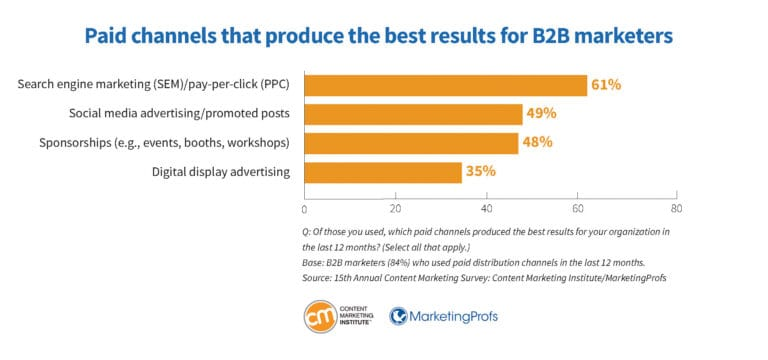
Source: CMI
To make these channels work together:
- Use the same keywords for social ad messaging as you would with search campaigns.
- Use social advertising to introduce products, services, and educational content to relevant audiences.
- Run branded and high-intent search campaigns to capture demand.
- Direct visitors to strong landing pages with consistent messaging.
2. Retarget Website Visitors on Multiple Channels
Retargeting is the building block of a good cross-channel marketing strategy. Most visitors don’t convert on the first interaction. And they don’t interact through the same channel repeatedly.
If you’re tracking visitors on your website, you can easily retarget them on other channels like social media and search through ads.
Suppose a visitor reads an educational blog post. You can show them related content promoted on LinkedIn or through display ads. If a prospect visited a product or pricing page, you can show them more conversion-focused messaging (customer testimonials, case studies, or demo invitations).
The secret is giving prospects more information further down the funnel so they have more reasons to convert. This also helps B2B marketers, since B2B buyers have long cycles when looking for vendors.
B2B consultancy Scaling Champions adopted an integrated organic and paid LinkedIn marketing strategy to target CEOs, founders, and entrepreneurs at technology companies. They used educational content (podcasts, webinars, white papers) with ongoing audience engagement and retargeting. They saw a 400% increase in qualified leads each month.
3. Integrate Email Marketing with Social Media Campaigns
Email and social media work well together with some planning.
Social media is great for expanding reach and generating engagement. Email is more intimate. You can communicate directly with subscribers (people who have shown interest) through more detailed, personalized messaging.
But how can you use them together?
Let’s look at a hypothetical example for a B2B company launching a webinar as a lead magnet:
- Announce the webinar through organic LinkedIn posts and then boost those posts with ads.
- Ask attendees to sign up for the webinar with their email.
- Send registration confirmations and event reminders.
- Post-webinar, follow up with attendees using related resources and consultation offers.
The same duo can work for product launches, promotions, customer education, and lead nurturing.
4. Repurpose High-Value Content Across Different Channels
Content repurposing is one of the best ways for cross-channel marketing. You’re essentially using the same piece of content on different platforms.
This is also cost-effective, since you don’t need to produce a ton of content for every channel.
That’s why perhaps content repurposing is one of the top five trends, according to HubSpot’s 2026 research. Over 35% of marketers are doing it.
But don’t just copy-paste one post across all channels. It’s best to make the content more platform-native with a few edits.
For example, a B2B podcast episode can be short-form video for YouTube, Meta, and LinkedIn. Quotes from the conversation can be LinkedIn posts. Key takeaways from the episode can go into a newsletter. The conversation topic can also become a blog post.
Each asset can guide interested audiences toward the original asset or related resources. The message and conversion opportunity stay the same, but you get exposure across multiple channels at once.
5. Connect Influencer Marketing with Paid Advertising
Influencer marketing is about follower reach for the most part. But ads can further amplify that reach.
With usage rights, you can use influencer content as ad creative. That means if an influencer is popular on Instagram, you can also use their content on YouTube.
This approach works best for consumer brands vying for awareness.
Social platforms also allow whitelisting creator content, where brands can advertise through the creator’s account (like Spark Ads on TikTok). That’s even more powerful. The ad appears a tad more authentic and native than an ad linked with the brand’s account.
There are B2B opportunities here, too.
Instead of partnering with lifestyle influencers, B2B companies can collaborate with industry analysts, subject matter experts, consultants, and professionals. These folks have credibility with their target audiences. They can then push that content through ads on relevant platforms to generate demand and build awareness.
6. Connect SEO and Content Marketing With Email Lead Nurturing
Search engine optimization (SEO) and content marketing are arguably the most relevant tactics for B2B.
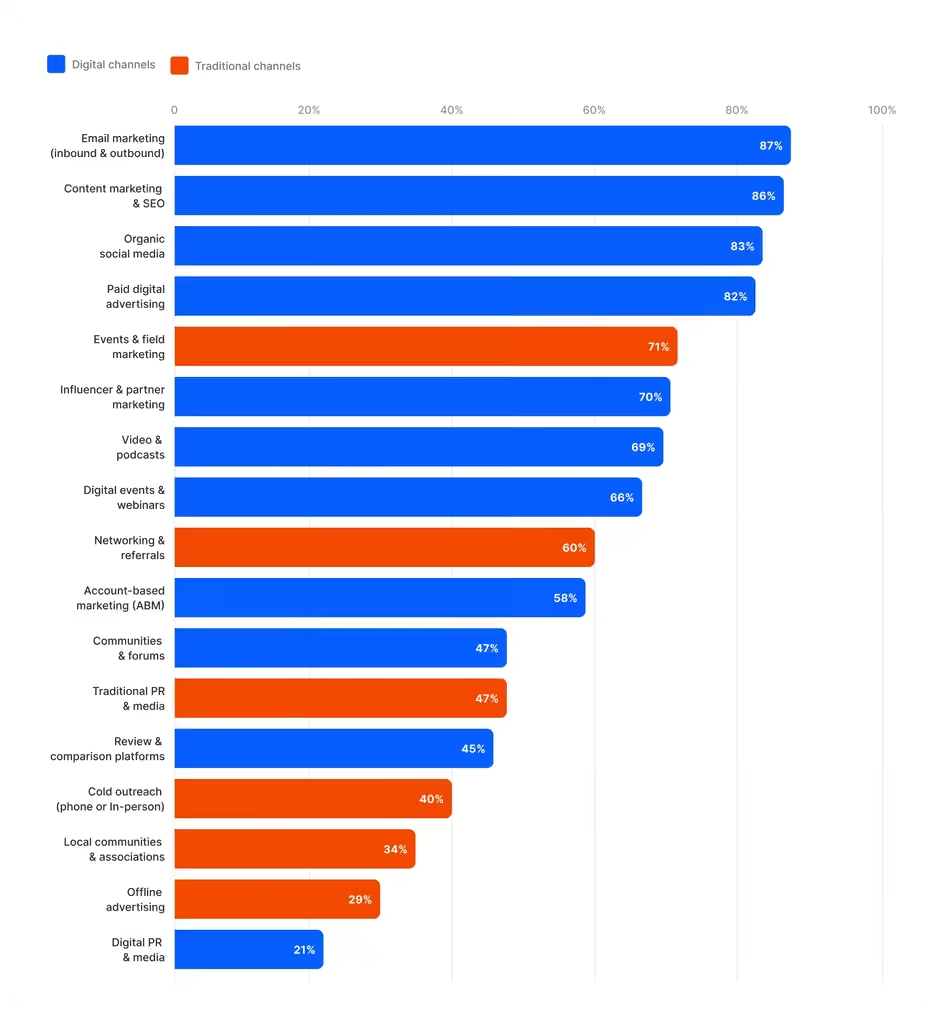
Belkin’s 2026 research found content marketing and SEO to be the second most widely used B2B marketing channel (86%, only a percentage behind the first).
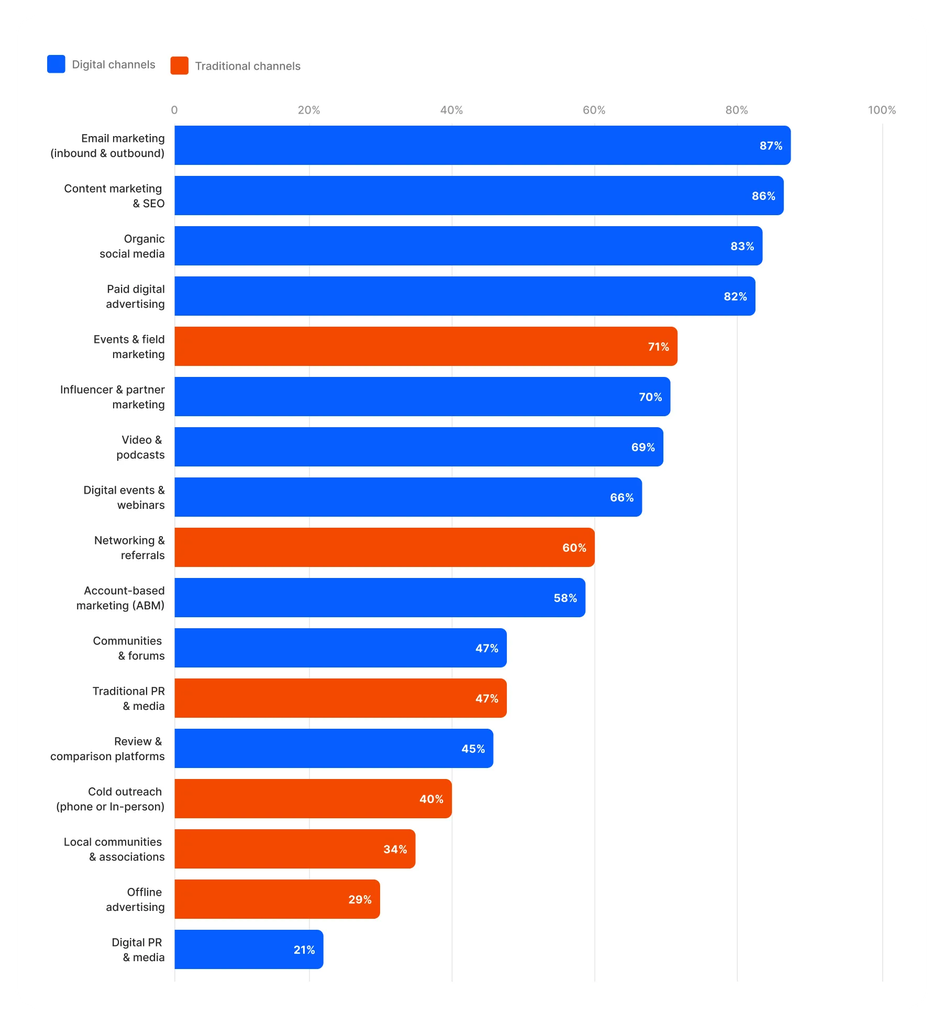
Source: Belkin
Organic search can introduce your brand to potential customers who are actively researching a problem. Quality informational content that ranks for common search queries can draw in potential customers.
But don’t expect those visitors to convert so quickly. This is where email marketing comes in. It can then help turn that initial interest into a longer-term relationship.
Incorporate email list building as a content marketing goal. That means each piece of content should encourage the reader to sign up for emails. You can also use lead magnets like free templates, industry reports, and ebooks to grow the list.
Once visitors subscribe, you can nurture them through an email sequence. Send more information, product- and service-specific guides, and offers.
This connects organic search discovery with ongoing interactions and eventually a conversion opportunity.
7. Coordinate SMS and Email Campaigns
Email and SMS are another effective combination, especially for time-sensitive communications.
Email works well for detailed information, educational content, product updates, and personalized recommendations. SMS is better suited to brief reminders, confirmations, and timely notifications.
An ecommerce company, for example, could announce a promotional campaign through email. Then, they could send opted-in customers a short SMS reminder as the promotion approaches its end.
Similarly, a B2B consulting firm could email event details and send SMS reminders shortly before an appointment or webinar.
Other use cases are customer onboarding, subscription renewals, service notifications, and appointment confirmations. These are important for retention marketing.
Pro Tip: Make sure email and SMS interactions are coordinated and recorded. If someone has already responded to an email, don’t send follow-up messages via text.
8. Promote Offline Events with Digital Marketing
You can connect offline and online channels with the same underlying goal.
Trade shows, conferences, workshops, retail activations, and other in-person experiences create opportunities to build relationships that can continue through digital marketing.
This is all the more relevant for B2B brands. Conferences and industry events play an important role in generating leads and building trust.
According to the same 2025 Content Marketing Institute report, 52% of B2B marketers say in-person events are one of their most effective content distribution channels.
To connect offline events with digital campaigns, take this three-stage approach:
- Before the event: Promote your participation through LinkedIn advertising, email invitations, and website content.
- During the event: Capture leads through registration forms, QR codes, product demos, or digital content downloads.
- After the event: Segment contacts by interests and engagement. Follow up with personalized emails, relevant content, and retargeting campaigns.
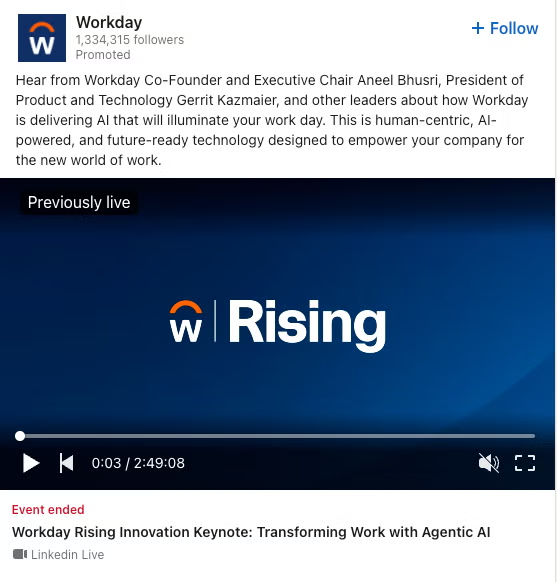
Workday actually did this. They ran campaigns before and after the event on LinkedIn. They got 20% higher click-through rates and 32% higher lead form completion among members previously exposed to event campaigns.
Source: LinkedIn
Growing brands can apply a simpler version of this strategy to smaller conferences, local workshops, or networking events.
9. Build Automated Cross-Channel Customer Journeys
As your brand grows, manually coordinating campaigns across several channels can become increasingly difficult. This is where marketing automation becomes essential, driven, of course, by data.
When you have a central source of customer data, particularly a customer relationship management (CRM) system, you can connect it to marketing to automate sequences across different channels.
Instead of sending the same messages to everyone, you can develop automated journeys that respond to specific customer actions.
For example, if a prospect downloads an educational guide and their information is stored in the CRM, an email marketing sequence can activate, sending personalized emails to walk them through the funnel.
Similarly, when the CRM data is linked to, say, Google Ads (Customer Match), search and display campaigns can be deliberately targeted toward prospects already familiar with the brand.
How to Measure Cross-Channel Marketing Success
Cross-channel marketing can be difficult to measure because customers may interact with multiple campaigns before converting.
This is where you might want to invest in marketing attribution solutions that actually measure channel impact on the customer journey and assign credit accordingly.
But before that, it’s important to define the key performance indicators (KPIs) for each stage of the customer journey:
| Customer Journey Stage | Goals | Metrics |
| Awareness | Increase brand visibility | Reach, impressions, branded search volume, website traffic |
| Engagement | Encourage audience interactions | Engagement rate, content downloads, email clicks, returning visitors |
| Lead generation | Convert interested prospects | Lead conversion rate, cost per lead, marketing-qualified leads |
| Sales | Turn qualified leads into customers | Customer acquisition cost, opportunity conversion rate, pipeline generated, revenue |
| Retention | Grow customer relationships | Repeat purchase rate, retention rate, customer lifetime value |
Improvements in KPIs across stages indicate that the cross-marketing strategy is paying off. Poor performance at a specific stage indicates that stage and its associated channels need more work.
For B2B businesses, it’s always important to tie marketing activity with sales outcomes.
A campaign generating hundreds of leads looks good on paper. However, its real value depends on whether those leads become paying customers.
Final Thoughts: Make Your Marketing Channels Work Together
Growing brands typically lean on multiple channels, but more channels aren’t always the answer. In fact, the key to success is focusing only on relevant channels and connecting them, so they work together to bring your customer from awareness to conversion, or better yet, retention.
Cross-channel marketing creates opportunities to connect awareness, engagement, lead generation, and customer retention activities into a more cohesive strategy.
No matter which channels you use, each should contribute to a shared business objective.
Initially, go with just two or three channels (ideally a combination of organic and paid). Create simple goals, and measure how they perform together. As you gather insights and refine your approach, you can expand your cross-channel strategy for even more business growth.
Influencer and affiliate marketing can play a valuable role in your cross-channel strategy, helping you expand reach, build trust, and turn audience engagement into measurable results.
At Vivian Agency, we help brands launch and manage influencer and affiliate marketing programs that complement their wider marketing efforts and drive sustainable growth. Book a call with our team to discuss how we can help you integrate partnerships into your cross-channel marketing strategy.