Growth marketing sounds straightforward. It seems like a word to describe marketing that focuses on growth — which, in a way, is all marketing.
However, the term is often used incorrectly and as a catch-all phrase to describe very different things, which makes it harder to understand what it actually involves.
Growth marketing is a structured approach to improving business growth through testing, measurement, and iteration. You focus on learning what works through real performance data, and then applying those insights consistently over time.
The sections below will walk you through what growth marketing strategies involve and how teams like yours can apply it in practice.
Table of Contents
What Is Growth Marketing?

Growth marketing strategies focus on improving growth by testing, measuring, and refining how people interact with your product or service over time.
Unlike traditional marketing, it doesn’t focus only on the promotion aspect, but also looks at what happens before and after someone converts.
It seeks to understand what encourages somebody to stay, come back, or recommend your product/service to others.
What sets growth marketing apart from other forms is how it approaches experimentation. It works in shorter cycles rather than relying on long, fixed campaigns. Teams will try small changes, see how people respond, and use those results to decide what to do next.
Many of these experiments are designed to answer practical questions, such as:
- Who is using the product, and how are they finding it?
- What problems are users trying to solve, and what pushes them to take action?
- Where do users drop off or lose interest?
Over time, this strategy makes it clear what’s driving growth. In this context, “growth” doesn’t just mean adding more users. It can also mean improving retention, increasing revenue per customer, or encouraging referrals.
The idea is to start small, learn from real results, and focus your marketing efforts on the areas that show the best results.
How Does Growth Marketing Differ from Traditional Marketing?
The main difference comes down to where the focus is. Traditional marketing concentrates on the top of the funnel. It’s centered around building awareness, driving traffic, and acquiring new customers. Once someone converts, the work is largely considered done.
Growth marketing takes a broader view. It looks at the entire customer journey, from the first interaction all the way through retention and referrals. The goal is to bring new customers in, but also understand what keeps them engaged and encourages them to stick around.
This kind of approach shifts how your team makes marketing decisions. Instead of measuring success only through impressions or traffic, you will pay attention to how users behave after they convert. This means you’ll focus more on aspects like:
- Using feedback and data to refine your product or messaging
- Testing small changes across campaigns to improve conversion or engagement
- Strengthening retention through email, referrals, or lifecycle messaging
- Improving onboarding so new users reach value faster
While both marketing approaches aim to grow a business, they solve different problems. Traditional marketing focuses on reach and visibility, and growth marketing works to turn that visibility into sustained, small improvements that add up over time.
The Key Principles Behind Growth Marketing
When teams apply growth marketing, a few patterns tend to show up again and again. These aren’t strict rules or frameworks, but common ways of working that can structure your growth marketing efforts.
1. Growth Marketing Is a Multi-Team Effort

Growth marketing rarely belongs to marketing alone. While it’s the marketing team that often runs experiments, the most useful signals come from other teams.
Product teams notice when users get stuck, support teams notice what questions or complaints come in repeatedly, and data teams spot unusual drops or spikes in usage. Growth work starts when these insights are shared and acted on.
When growth marketing is treated as a shared responsibility, it becomes much easier to spot meaningful opportunities rather than simply guessing what might work.
2. It Works Through Small, Focused Tests
Growth marketing works like this: teams test one idea, see how users respond, and adjust from there.
That idea might involve messaging, onboarding, partnerships, or how an offer is presented. Most teams don’t really create dramatic shifts, but focus on small improvements that compound over time.
3. Data Matters (a Lot)
Growth marketing strategies reliy heavily on numbers to decide what’s working and what isn’t.
Every experiment is tied to a specific metric. This can be signups, click-through rate, activation rate, retention, conversions, and so on.
An A/B test is designed to compare two versions of the same thing (like a landing page or an email) and see which one performs better against that metric.
Over time, these tests help teams understand patterns. You can see which messages lead to action, which channels engage users more, and where people seem to quit.
Once you have these numbers, it makes it much easier to adjust your campaigns based on evidence rather than guesswork alone.
4. Growth Happens Across Multiple Channels
Growth isn’t driven by one marketing channel. Most people will see your brand multiple times, in different places, before they decide to take action.
Someone might discover you through a creator, look you up later, read an email, and only decide to buy your product/service after a second or third interaction.
Growth marketing must pay attention to this entire sequence rather than just fixing one channel in isolation. Growth teams focus on how channels support each other and move people forward.
This means your team will be investing in multiple channels at the same time, like creator and influencer content, social media, email, paid ads, your website, and more.
Growth Marketing Strategies: How to Run a Growth Experiment Without Complicating It
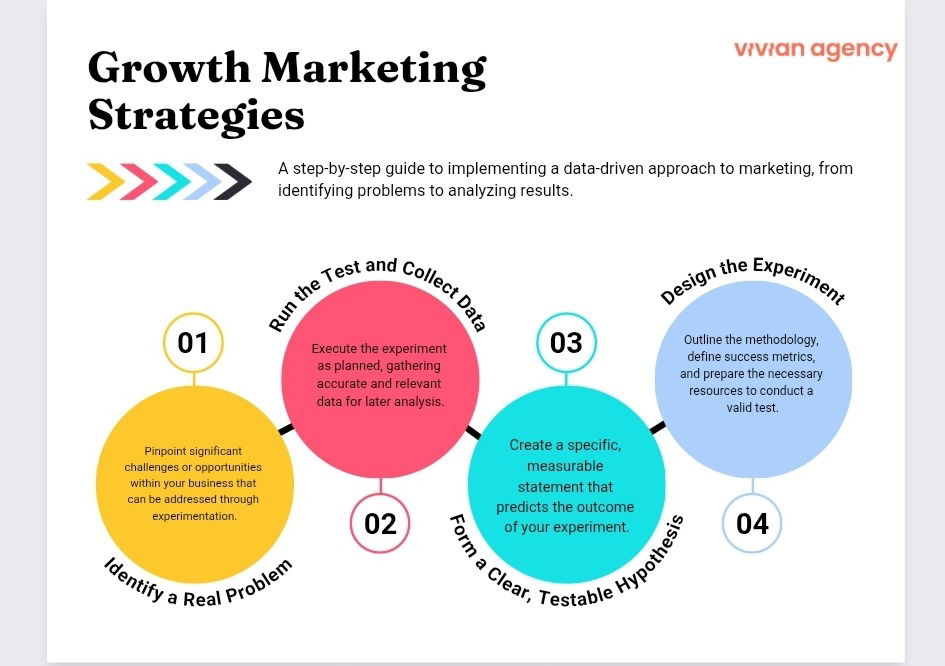
A growth experiment doesn’t have to be complex or overly technical. It’s just a structured way to test one idea, learn from it, and decide what to do next.
Here’s how to approach it.
1. Start by Identifying a Real Problem
Before testing anything, get clear on what isn’t working. Look at your funnel and identify where things are stalling. This could be:
- High traffic, low conversion on a landing page
- Strong signups, weak activation
- Good first-time usage, poor retention
Pick one problem that can be realistically tested. Your experiment will work best when you keep it focused.
2. Form a Clear, Testable Hypothesis
A hypothesis explains what you believe is happening and why. It should be based on data, observation, or user feedback, not an estimation.
For example: “We believe visitors aren’t converting because the landing page headline doesn’t clearly explain the product’s core use case. By testing a headline that highlights [specific benefit], we expect to see an increase in signup conversion rate.”
Writing this down matters because it shapes the experiment. It determines what you will change, what is being measured, and how you will judge success.
3. Design the Experiment
Once you have the hypothesis, decide how to test it. Most growth experiments include:
- A control and a variant. The control is the current version. The variant includes the changes you want to test.
- A primary metric. This could be conversion rate, activation rate, email open rate, or another metric tied directly to the problem you identified.
- A defined time frame. Simple tests may run for days or weeks. Larger experiments, like SEO or channel tests, may need months to show significant changes.
Some experiments are more straightforward, like testing website copy. Others will be more complex, like testing a new acquisition channel. For complex cases, results may be more directional rather than statistically conclusive, and that’s expected.
4. Run the Test and Collect Data
Once the experiment is live, track the metric consistently. Depending on the experiment, this could involve monitoring results daily, weekly, or monthly. Common data points that you may measure include:
- Conversion rates
- Traffic volume and quality
- Email engagement
- Keyword rankings
- New user or revenue data
Make sure you don’t change variables mid-test, as this can skew your results. If something is clearly broken, decide on a new variable and run the experiment again.
5. Analyze the Results
Once the experiment ends, compare the outcome against your hypothesis. Ask:
- Did the change improve the primary metric?
- Was the impact meaningful or marginal?
- Were there any unexpected effects somewhere else in the funnel?
Not every experiment will produce a clear winner. Sometimes, your predicted hypothesis will prove false or return inconclusive. This is all part of the process and is a learning experience.
6. Decide What to Do Next
Every experiment should lead to a decision. If the test works, you can roll it out more broadly or design a follow-up experiment. If it doesn’t, you can either adjust the hypothesis or move on to a different problem.
For growth marketing, the important part is that each experiment will feed into the next one. Changes in one part should be informed and improved with information from other channels, and not treated as standalone problems.
Apply Growth Marketing with Vivian Agency
Growth marketing strategies work best when distribution, experimentation, and partnerships are all treated as parts of the same system.
That’s why channels like influencer marketing, affiliates, and creator-led campaigns fit so naturally into a growth approach. They let teams test ideas in real conditions.
When you involve a creator to advertise your product, you can see how people respond, what questions they ask, and whether they take the next step and convert.
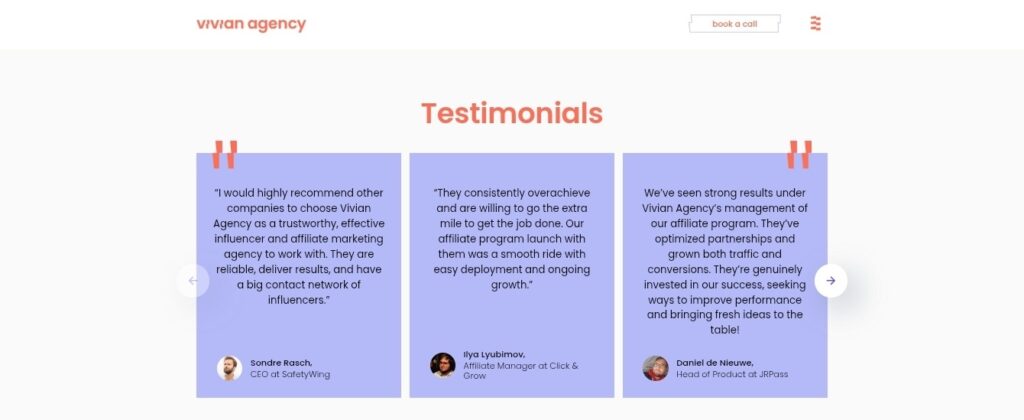
This is the kind of work Vivian Agency focuses on. We help brands apply growth thinking to community marketing by matching you with the right partners, structuring your campaign around clear goals, and tracking what actually performs.
With a network of 10,000+ influencers and publishers, we have run 80+ successful affiliate and influencer programs and helped generate over $15 million in revenue for our clients.
If you’re looking to apply growth marketing principles through partnerships with creators, influencers, and affiliates, we’d be happy to talk.
Book a call with our team or send us a message, and we’ll walk you through what a growth-focused strategy can look like for your brand.