

You need reliable affiliate marketing metrics to understand how well your affiliate program performs. These metrics help you identify your top affiliate partners, refine your affiliate marketing strategies, improve ROI, and evaluate your overall affiliate marketing success.
By tracking the right KPIs, you gain a clear picture of your affiliate marketing program’s profitability. If you select the wrong KPIs or try to track everything at once, you may lose sight of the metrics that matter and make decisions without understanding the actual performance of your efforts.
In this guide, we’ll highlight the key metrics every program should track, followed by deeper insights into additional data points that reveal the full health of your affiliate program.
Table of Contents
7 Important Affiliate Marketing Metrics to Track for Success
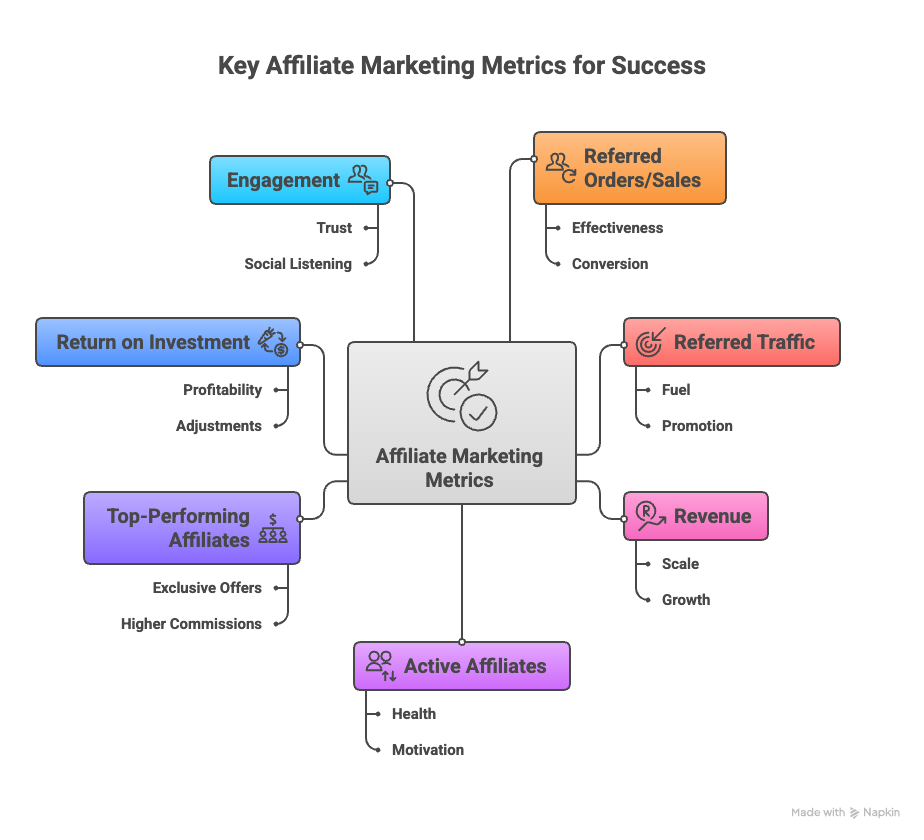
The affiliate marketing metrics that matter most reveal the quality of your traffic, the conversion rate performance, the affiliate revenue generated, and the sustainability of your affiliate marketing campaign.
Below are the KPIs to track if you want measurable results.
1. Referred Orders/Sales
Referred orders represent the total number of completed orders that come directly from affiliate referrals, after accounting for refunds and cancellations. This metric indicates the effectiveness of your affiliate marketing campaign in converting website traffic into sales.
You can find this KPI inside your affiliate network dashboard. Since many other metrics depend on it, you should review it consistently to understand how well your affiliate partners perform.
2. Referred Traffic (Clicks/Visits)
Referred traffic is simply the number of times prospects click an affiliate link. This metric is like the raw fuel of your program: no clicks, no sales. You can track the number of clicks from a web analytics platform such as Google Analytics or your affiliate dashboard.
A sudden drop in the referred traffic volume often signals changes in promotion, broken links, or a decline in affiliate engagement. You can resolve these issues by contacting affiliates, replacing faulty links, or checking your marketing materials.
3. Revenue
Revenue shows the total monetary value of referred sales, excluding commissions and operational costs. It reflects the program’s overall scale and growth trajectory. You can also pull this KPI from your affiliate dashboard.
This metric is vital for budget allocation, commission structures, and long-term marketing strategies.
When your revenue increases, your affiliate marketing efforts gain momentum. If revenue drops, it may signal issues with affiliate traffic quality, affiliate performance, or the attractiveness of your affiliate products or services.
4. Active Affiliates
Active affiliates are partners who generate traffic or sales within a specific period. It gives insights into your program’s health.
For instance, a program with 5,000 registered affiliates but only 80 active ones is dying. In that case, you can increase activity through incentives, contests, updated marketing materials, and consistent communication.
The fuel for a successful affiliate program is motivated affiliate marketers. So, monitor this metric regularly and optimize your program to enhance affiliate retention rates.
5. Top-Performing Affiliates
It’s not enough to know your affiliates are working. You need top performers to increase revenue. Your top-performing affiliates are the top few partners ranked by revenue or sales. Sometimes, these top performers contribute a significant fraction of your revenue.
Many affiliate networks have features that help you spot which affiliates are driving the most clicks, conversions, and revenue. With this information, you can prepare exclusive offers, conduct personal outreach, or offer higher commission tiers to encourage them and keep your program profitable.
6. Return on Investment (ROI)
Revenue alone can lie. A program that generates $500k in revenue but pays out $450k in commissions is barely profitable. The return on investment (ROI) reveals how much profit your affiliate program produces after covering all costs. It helps you know whether your program needs adjustments.
ROI = (Total Revenue Generated By Affiliates – Affiliate Costs)/Affiliate Costs x 100
Generally, positive ROIs indicate a profitable program. If your ROI is negative, you should review commission rate structures, traffic quality, or promotional strategies.
7. Engagement

Engagement includes likes, comments, shares, video views, and user interactions on content produced by affiliates. Some managers dismiss likes and comments as “feel-good” numbers. However, the metric is a strong leading indicator of future traffic, sales, and program health.
High engagement means users trust the affiliate’s recommendation. You can use social listening tools to track engagement. Watch out for sudden engagement spikes and encourage the affiliate to maximize results.
4 Other Essential Affiliate Marketing Metrics
To measure affiliate marketing success more precisely, you can track additional affiliate marketing metrics and KPIs that reveal deeper performance indicators. A few other metrics to monitor include:
Conversion Rate
The conversion rate measures the percentage of visitors who complete the desired action after clicking on your affiliate links.
(Referred orders/Referred Traffic) x 100 = Conversion rate (%)
A program with 1 million clicks and 2% conversion rate makes exactly the same sales as one with 100k clicks and a 20% conversion rate. However, the second one costs 90% less in commissions and overhead. This makes the conversion rate the ultimate efficiency score, telling you the quality of your traffic.
Average Order Value (AOV)
Average Order Value (AOV) is the average amount of money a customer spends per purchase made through an affiliate link.
AOV = Total Revenue/Referred Orders
For instance, if affiliate links generated $1,000 from 20 orders, the AOV is $50. A higher AOV indicates that customers are spending more per transaction, leading to increased revenue per conversion.
Analyzing affiliate AOV can highlight opportunities for upselling and cross-selling, allowing you to maximize earnings from existing traffic without the cost of acquiring new visitors.
Traffic Sources and Geo Data
Traffic sources are the channels that drive visitors to your site, while geo data metrics track the geographic locations of those visitors.
Affiliate marketers often use different marketing channels to drive traffic. Identifying these traffic sources will help you better advise your affiliates and even your in-house marketing team on what channels to optimize.
Additionally, geo data is relevant because profitability can vary from one country to another. Tracking it lets you spot and double down on the gold-mine countries while pausing or fixing the low-performing ones before they bleed your program dry.
Program Growth Rate
Affiliate marketing is growing globally due to its effectiveness in generating sales. If your program isn’t growing as well, you’re falling behind every serious competitor who will eventually eat your partners and revenue.
So, monitor your program growth rate. How many new affiliates join the program monthly? What’s the retention rate? Do you have significantly more active affiliates? You can answer these questions by checking the performance of your affiliates on your affiliate network dashboard.
Before Analyzing These Metrics…
Set Clear Goals for Your Affiliate Marketing Journey
Your affiliate marketing goals shape the KPIs to track. So, determine your overall goal first. It could be increased sales, web traffic, or brand awareness. Then identify the specific metrics relevant to the goal.
Next, set a benchmark for each KPI to avoid blind analysis. For example, many affiliate programs have a conversion rate between 1% and 3%. You could set your benchmark at 2.5%, then track progress and adjust your marketing activities based on performance trends.
Keep in mind that metrics can quantify or qualify your affiliate marketing efforts. However, clear affiliate marketing goals and performance benchmarks provide the necessary context to understand if those metrics indicate success or failure.
Use an Advanced Affiliate Marketing Platform

An advanced affiliate marketing platform (like Tapfiliate) simplifies tracking and allows you to monitor metrics without manual calculations. It provides you with everything you need, from individual affiliate performance to total affiliate sales and revenue. Some platforms even handle affiliate commissions.
With this system, you can focus on data-driven decisions and optimize your affiliate marketing strategy rather than collecting numbers.
Common Mistakes in Tracking Affiliate Marketing KPIs
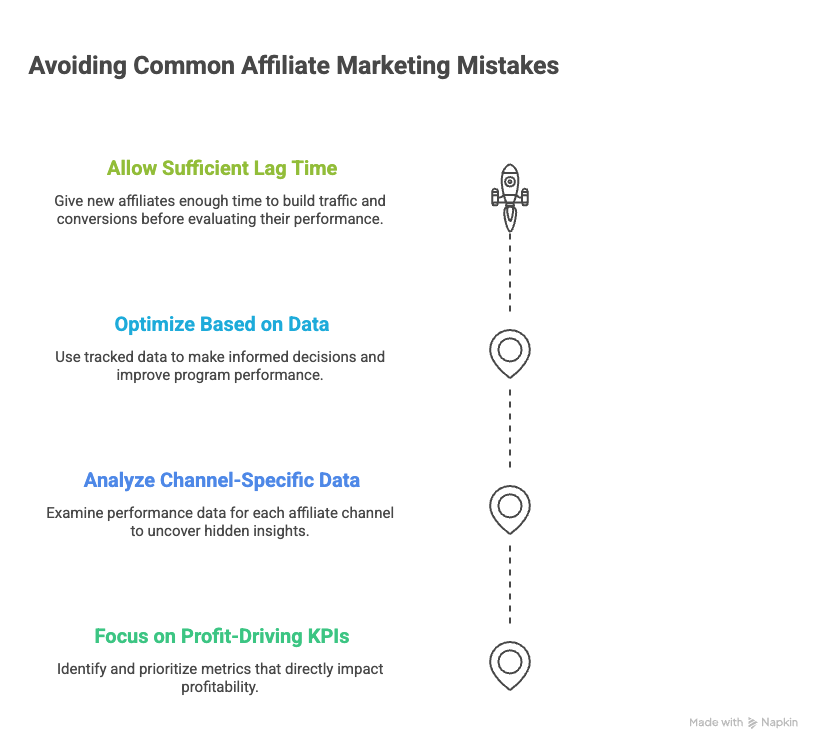
Even when you know the right KPIs, it’s easy to track them incorrectly and end up making costly mistakes. Below are some common pitfalls to look out for:
1. Chasing Vanity Metrics
Some affiliate managers chase vanity metrics such as impressions or total registered affiliates. They look great in reports, but have zero correlation with profit. Instead, pick a few profit-driving KPIs, and make everything else a nice-to-have that you check once a quarter.
2. Looking Only at Blended Numbers Instead of Channel-Specific Truth
Using blended averages across all channels can hide the fact that some affiliate types are wildly unprofitable.
Say you’re looking at the customer acquisition cost (CAC), that is the amount you spend (commissions + bonuses + tools + agency fees) to get one new customer through affiliates. It’s easy to look at a blended (averaged) value across all marketing channels and think everything is fine.
Let’s say Google Ads has a CAC of $20, Facebook Ads $30, and affiliates $50. You could say in your report that the average CAC across all marketing channels is $33. But on closer look, the affiliate channel actually costs $50 per customer, more expensive than the other channels.
If the average customer lifetime value is only worth $80, then paid ads are profitable and affiliates are losing you money. Hence, stopping or optimizing the affiliate program should be the next step.
So, always check for channel-specific numbers, even within your affiliate campaign. See individual affiliate performance and specific traffic sources.
3. Tracking Everything and Optimizing Nothing
The purpose of tracking is to improve your affiliate marketing program. If you invest in advanced tools, but make no data-driven decisions to move your program forward, it’s as good as nothing.
Additionally, don’t track everything. Choose one north star metric, such as revenue generated, and add a few supporting metrics. In the same vein, don’t obsess over one metric and ignore everything else. Again, let your goal guide the key metrics you choose.
4. Ignoring Lag Time and Killing Winners Early
Some affiliates need several weeks before traffic and conversions build. When you remove an affiliate too early, you risk losing long-term value. Rather, give every new content or review-site partner a 30- to 90-day runway. Judge them on leading indicators (engagement, views, etc) for the first few days while you gather more performance data.
Best Way to Avoid These Tracking Pitfalls
If you’re already swamped with work and don’t have the bandwidth to build, police, and maintain an affiliate program, from execution to continuous management, outsourcing can help.
Brands like SafetyWing, Click and Grow, and One Way Fly trust Vivian Agency to manage their affiliate programs and grow them into a recurring revenue channel.
You can rely on the same expertise to monitor metrics, improve the quality of your affiliate partnerships, and increase the profitability of your affiliate marketing efforts.
Let’s have a quick call to discuss your current needs. Contact our team now or book an appointment today.